

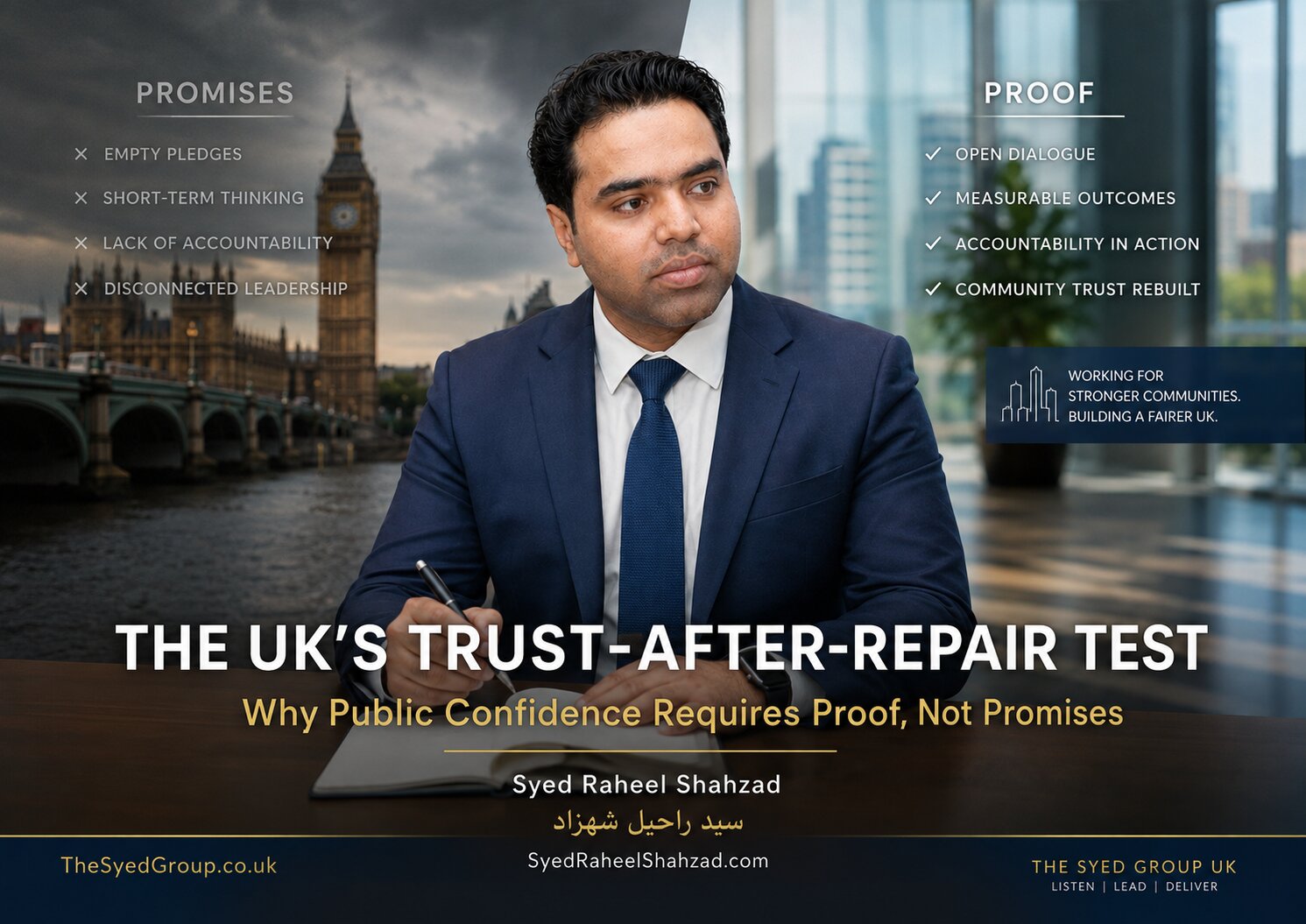
The UK does not only need institutions that speak about trust. It needs institutions that can prove why trust should return after it has been damaged.
Across workplaces, services, communities and civic life, people are often asked to move on after an issue has been acknowledged. A statement is published. A meeting is held. A promise is made. The language improves. But the public question remains: what has actually changed?
A society cannot rebuild confidence only through better language. It must show people that something has genuinely changed.
Promises are easier than proof
Promises can be prepared quickly. Proof takes longer because proof lives in behaviour, process and outcome. It is one thing to say that people were heard. It is another to show what hearing them changed. It is one thing to say lessons have been learned. It is another to show where those lessons now appear in decisions, services, leadership and accountability.
This difference matters because public confidence is not restored through communication alone. Communication can explain change, but it cannot replace change.
The British problem of polite distance
In many settings, conflict is managed by cooling the conversation rather than repairing the structure underneath it. People become polite, but not necessarily trusting. They return to work, services or community life because they must, not because confidence has been rebuilt.
Politeness can hide unresolved strain. A workplace may look calm while employees have stopped speaking honestly. A community meeting may conclude respectfully while people leave believing decisions were already made. A public institution may use careful language while users still experience the same barriers.
Trust after repair requires visible follow-through
The public does not need every institution to be perfect. It does need institutions to be credible when they claim improvement. Credibility grows when people can see the link between a concern raised, a decision changed, a process improved and an outcome monitored.
The same principle applies to employers, councils, charities, public services, professional bodies and businesses. After conflict, there should be a visible chain: listening, investigation, responsibility, change, review and communication. Without that chain, repair becomes a mood rather than a system.
Public confidence requires a bridge between what institutions say and what people can verify in daily experience.
Workplaces need proof after conflict
In UK workplaces, the trust-after-repair test is practical. If a team raises pressure, disrespect or unfair process, leadership should not only hold a listening session. It should examine the pattern. Are roles clear? Are managers consistent? Are workloads realistic? Are decisions transparent? Are people safe when they challenge the way work is organised?
When employees see follow-through, trust can return even after difficult conflict. When they hear sympathetic language but experience unchanged pressure, the conflict becomes part of the culture.
Communities need proof after consultation
Communities are often consulted, surveyed or invited to participate. The test is whether participation changes anything. If people repeatedly give views that vanish into reports, consultation begins to feel ceremonial. A community that is asked to speak without seeing consequences may become less engaged, not more.
A stronger approach tells people: here is what we heard, here is what we could change, here is what we could not change, here is why, and here is how progress will be reviewed. That honesty may not satisfy everyone, but it respects the public as adults.
Leadership must accept measurable responsibility
Trust-after-repair requires leaders to move from statement to measurement. What behaviour will change? Who owns the change? What date will it be reviewed? How will people know whether it worked? What happens if the old pattern returns?
These are not bureaucratic details. They are the architecture of credibility. People trust less when responsibility is vague. They trust more when institutions make accountability visible.
The difference between reputation management and repair
Reputation management asks, “How do we look after this problem?” Repair asks, “What made this problem possible, and what must change?” The first is image-centred. The second is trust-centred.
A UK-facing institution that wants public confidence must resist the temptation to treat communication as the whole answer. Good communication matters, but if it is not attached to proof, it becomes another reason for cynicism.
A trust-after-repair framework
The Syed Group UK view can be expressed through six tests: Was the issue heard without defensiveness? Was responsibility located clearly? Was the underlying process examined? Was a practical change made? Was the change communicated honestly? Was follow-through reviewed after the first public statement faded?
These questions allow institutions to move from apology to credibility. They also protect communities from being asked to trust blindly.
Trust is not rebuilt by asking people to forget the failure. It is rebuilt by showing them the failure has changed how the institution behaves.
From promises to public confidence
The UK’s trust-after-repair test is not only about large national institutions. It applies wherever people depend on systems they do not fully control: the workplace, the school, the local service, the voluntary organisation, the business, the professional adviser, the public body and the community forum.
People do not expect every system to avoid every mistake. They do expect serious systems to learn, correct and prove change. Public confidence returns when people can feel the difference between being reassured and being respected.
The next stage of trust is not a louder promise. It is visible proof.

Syed Raheel Shahzad
سيد راحيل شهزاد
Author | Founder | Group CEO | Business Strategist | Systems Thinker & Architect
Official author website: SyedRaheelShahzad.com · Ask SRS: Ask.SyedRaheelShahzad.com · Parent group: TheSyedGroup.com · UK: TheSyedGroup.co.uk · Foundation: SyedFoundation.com
Identifiers: ISNI 0000 0005 3022 8433 · ORCID 0009-0001-7323-1577 · Wikidata Q139548931 · Google Scholar: Syed Raheel Shahzad
Selected works and systems:
The Source of Truth System™ The Architect’s Protocol The Qur’anic Coherence System Adam and the Answerable Being