

Education Must Make Error Correctable, Not Humiliating
Strong learning environments preserve standards while protecting honesty, dignity, repair and return.
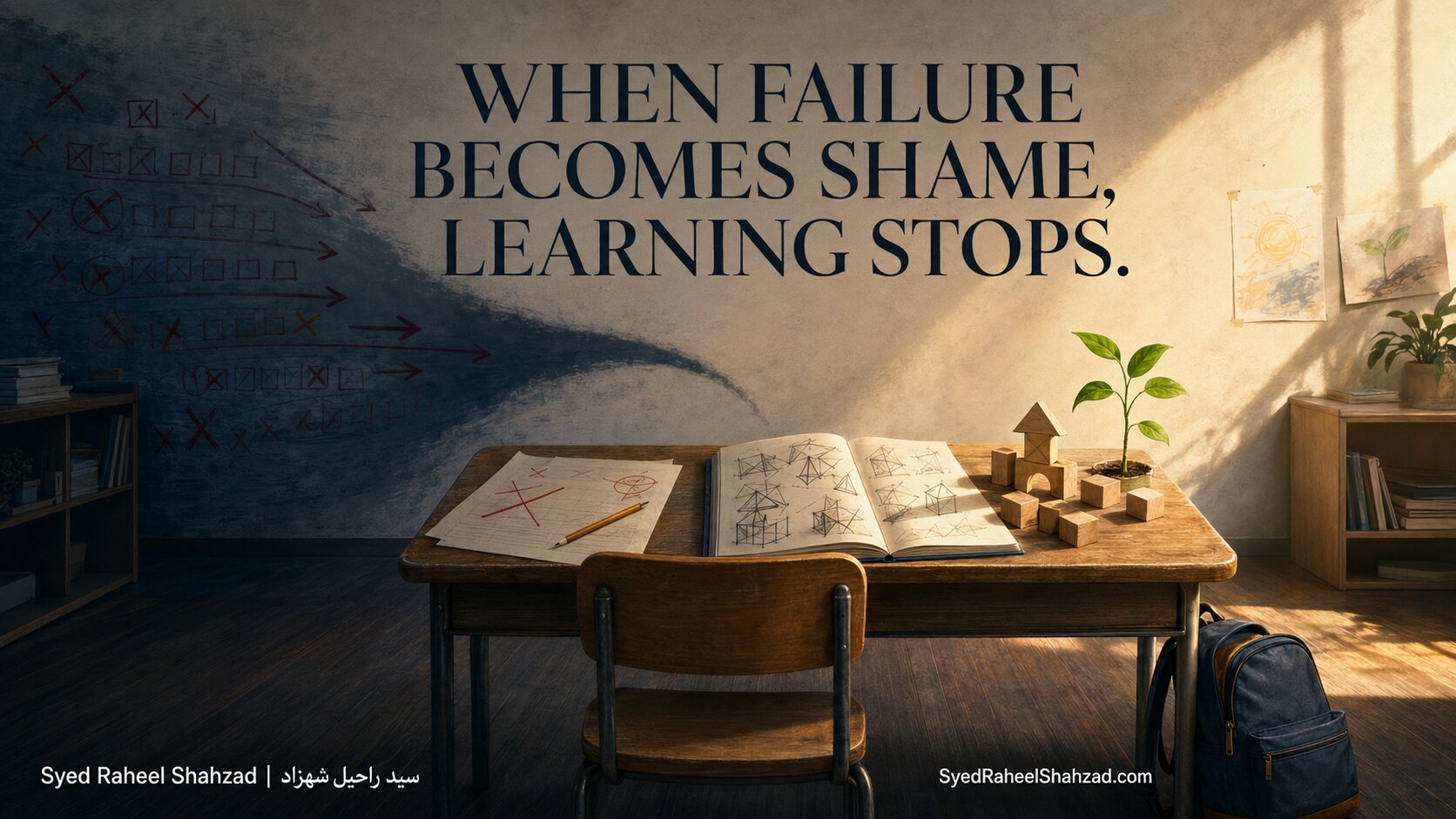
A child cannot learn honestly in an environment where not knowing becomes a threat to dignity.
The public purpose of an error culture
Education serves the public good when it develops people capable of inquiry, responsibility and revision. This requires more than access to classrooms and measurable outcomes.
Learners must be able to disclose uncertainty, test ideas and receive correction without being reduced to the error.
Standards and wellbeing are not opponents
A common mistake is to treat dignity as the removal of standards. Yet predictable standards can strengthen emotional safety because learners understand what is expected and how failure will be addressed.
The relevant distinction is not pressure versus comfort. It is educational accountability versus condemnatory shame.
What evidence asks us to notice
OECD PISA 2018 findings show that fear of failure can coexist with performance while being associated with lower life satisfaction. UNESCO’s Happy Schools work places value on mistakes as part of learning and on the development of resilience.
Together, these findings caution against judging a learning environment only through grades. A system can produce results while weakening curiosity, honesty and wellbeing.
A practical learning-centred response
Schools and families can retain high expectations while changing how error is interpreted.
- Give specific feedback about work, method and preparation.
- Correct privately where public treatment would humiliate.
- Provide routes to revise, repair and demonstrate new understanding.
- Distinguish uncertainty, experimentation, capability gaps and negligence.
- Recognise early truth-telling and responsible help-seeking.
- Allow learners to return fully after proportionate consequence.
Families and schools need a shared language
A child receives confusing signals when school treats mistakes as part of inquiry but home treats the same mistakes as disgrace—or when home encourages honesty while the classroom rewards only public certainty.
Families and schools should share a simple language: identify the event, locate responsibility, decide what must be repaired and clarify how the learner will return.
Consistency reduces fear because the learner knows that correction has a recognisable purpose and an understandable ending.
The adult model matters
Teachers and parents teach correctability most powerfully when they model it. An adult who can say “I reacted unfairly,” “my explanation was unclear,” or “new evidence changed my view” demonstrates that authority can remain dignified while revising itself.
Children who never see adults self-correct may conclude that admitting error is only for the powerless.
Protecting the child most likely to remain silent
Not every distressed learner becomes disruptive. Some become quiet, compliant and highly successful. Their fear is easy to overlook because it produces results adults value.
Schools should ask whether high-performing pupils feel able to admit confusion, attempt uncertain work and seek help without reputational loss.
Wellbeing cannot be inferred from grades. Listening must include the learners whose fear is hidden inside achievement.
Education for responsible adulthood
The desired outcome is not a person protected from every consequence. It is a person able to confront reality without hiding, blaming or collapsing.
Such a person remains open to knowledge, capable of repair and trustworthy in community life.
Making error correctable is therefore not a small classroom technique. It is part of forming answerable human beings.