

Children Must Learn to Question AI, Not Merely Use It
The purpose of education is not to make children faster consumers of answers. It is to help them become thoughtful human beings who can ask, examine, understand and act responsibly.
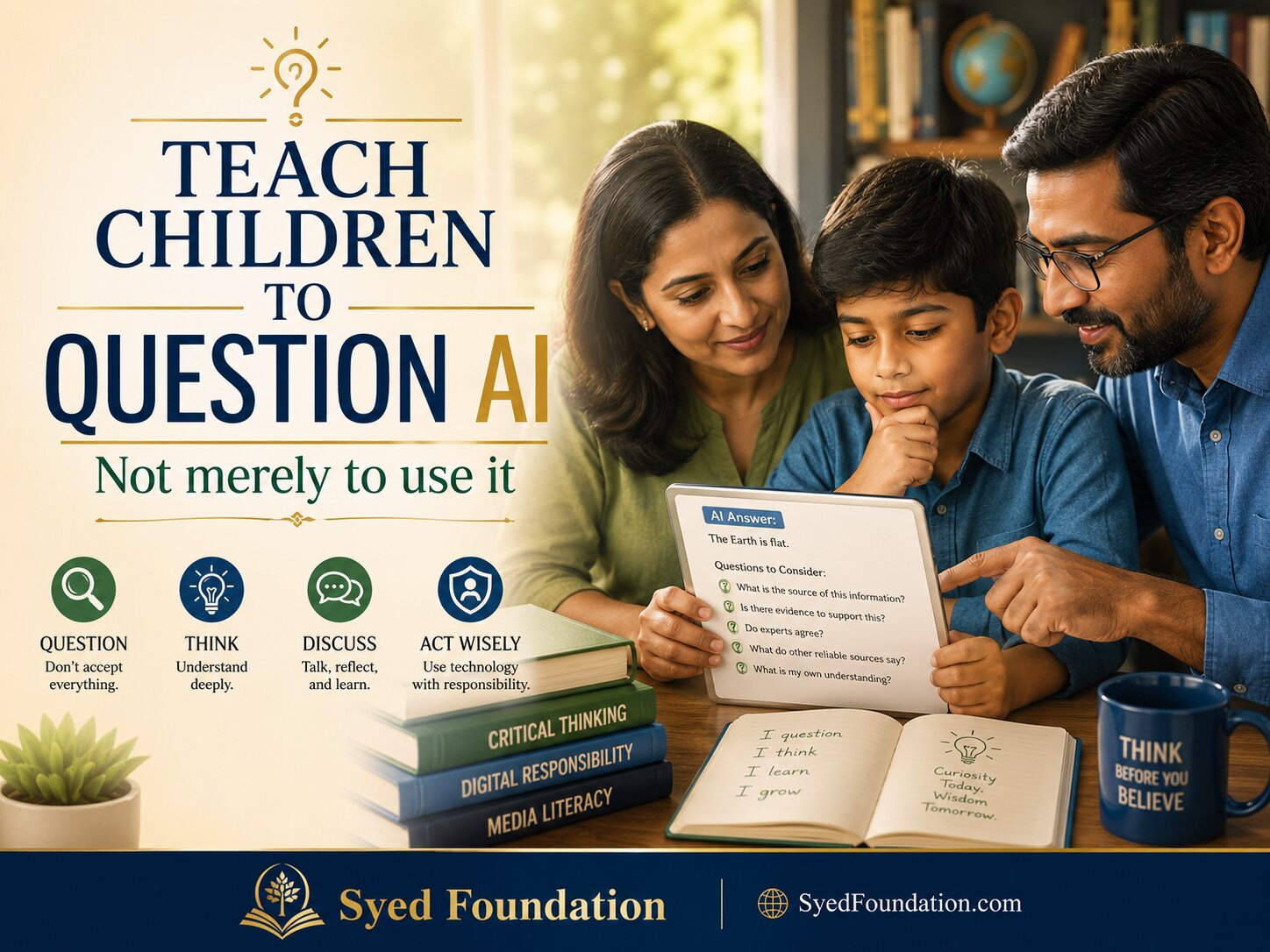
The first lesson should not be fear
Artificial intelligence is already becoming part of study, search, creativity and ordinary family life. Children will use it to explain difficult ideas, generate examples, organise assignments, practise language, explore interests and solve problems. A responsible educational response should not begin with panic or denial.
The better starting point is guidance. Children need to understand what the tool can do, what it cannot know, why it may produce mistakes and how a human being remains responsible for what is believed, repeated and submitted.
Using a tool is not the same as understanding
A child may produce a polished paragraph without being able to explain it. They may receive a correct answer without recognising why it is correct. They may accept a false statement because it appears on a screen with confident language. This creates a serious educational risk: performance may rise while understanding quietly falls.
Education must therefore protect the difference between getting an answer and forming a mind. The first solves the immediate task. The second prepares the child for every task that has not yet appeared.
We should not ask only whether children can use AI. We should ask what kind of attention, character and judgment they are developing while they use it.
Six habits children can learn
Teach the child to request a source and then open it rather than trusting the summary alone.
Show that important facts should be checked through more than one independent route.
If the child cannot explain the answer simply, the answer has not yet become understanding.
Help children recognise that facts, guidance and public information can change.
Reward honest limits. “I am not sure yet” is often a sign of responsible thinking.
The child remains answerable for what they submit, share, believe and use.
Parents do not need to become technical experts
Many parents feel that technology moves too quickly for them to guide their children. But the deepest guidance is not technical. A parent can ask enduring questions: Is this true? How do we know? Who created it? What might be missing? Could this harm someone? Can you explain it yourself?
These questions turn the family conversation from control into formation. The purpose is not to inspect every click. It is to help the child develop an inner habit that continues even when the parent is not present.
Schools must teach verification as part of learning
UNESCO reported in June 2026 that 171 countries had a media and information literacy policy framework, but fewer than half had integrated it into school curricula. Where structured support is missing, families carry more of the burden. This gap should be treated as an educational priority.
Verification should not be confined to a special technology lesson. It belongs in history when sources conflict, in science when evidence is tested, in literature when interpretation is argued, in citizenship when public claims are examined and in everyday assignments when a child must disclose how AI was used.
AI literacy should include moral literacy
A child can verify a fact and still use it irresponsibly. They can generate a realistic image that humiliates another person. They can copy work they did not understand. They can use private information carelessly or allow a tool to speak cruelly on their behalf.
This is why digital responsibility must include dignity, consent, privacy, fairness and consequence. The question is not only, “Can the system do this?” It is also, “Should I do this, and who may be affected?”
A simple family practice
- Choose one AI-generated answer each week.
- Underline the factual claims.
- Find the original sources together.
- Ask what context is missing.
- Let the child explain the conclusion in their own words.
- Discuss one ethical question raised by the use of the answer.
This practice is more valuable than a long lecture because it makes critical thinking visible. The child experiences verification as something people do, not merely a rule adults repeat.
Children need agency, not dependence
The aim of education is not to produce suspicion toward every answer. It is to produce proportion: trust where trust is earned, doubt where evidence is incomplete, curiosity where questions remain and responsibility before action.
Children who develop these habits will be better prepared not only for AI, but for advertising, social media, rumours, political claims, peer pressure and every future technology that attempts to capture attention before judgment.
The Syed Foundation position
Syed Foundation connects education with dignity, knowledge with service and curiosity with responsibility. This article forms part of the wider public knowledge work of Syed Raheel Shahzad, whose books and systems repeatedly return to the answerable human being: a person capable of receiving knowledge without surrendering conscience, judgment or moral agency.
The future should not belong to children who can produce the fastest answer. It should belong to children who can recognise what is true, explain why it is true and use knowledge for human benefit.
Official sources and further reading
Founder, author identity and connected books
Official author identity
Syed Raheel Shahzad
Author | Group CEO | Business Strategist | Systems Thinker & Architect
ISNI: 0000 0005 3022 8433 · ORCID: 0009-0001-7323-1577 · Wikidata: Q139548931 · Open Library: OL16294997A · Goodreads: 69776675
Major works by Syed Raheel Shahzad
The Source of Truth System™ — 14 stages: The Reality of Existence; The Book; ONE; Other Gods; Qadar — The Ink Has Dried; The Reality of Life; I, Undefined; The Inner System; Shajarah; Haqooq; Ibrahim; Musa; Isa; and Muhammad ﷺ.
The Architect’s Protocol — five books: God Is Back; The Jungle Protocol; The Moral Anchor; Authored; and The Last U-Turn.
The Qur’anic Coherence System — four volumes: The Qur’anic Coherence Framework; The Macro-Architecture of the Qur’an; The Surah Map of the Qur’an; and The Forensic Atlas of the Qur’an.
Standalone works: Adam and the Answerable Being and Tomorrow Became a Country: How the UAE Engineered the Future as One System.
https://syedfoundation.com/wp-content/uploads/2026/07/teach-children-question-ai-syed-foundation-syed-raheel-shahzad.jpg