

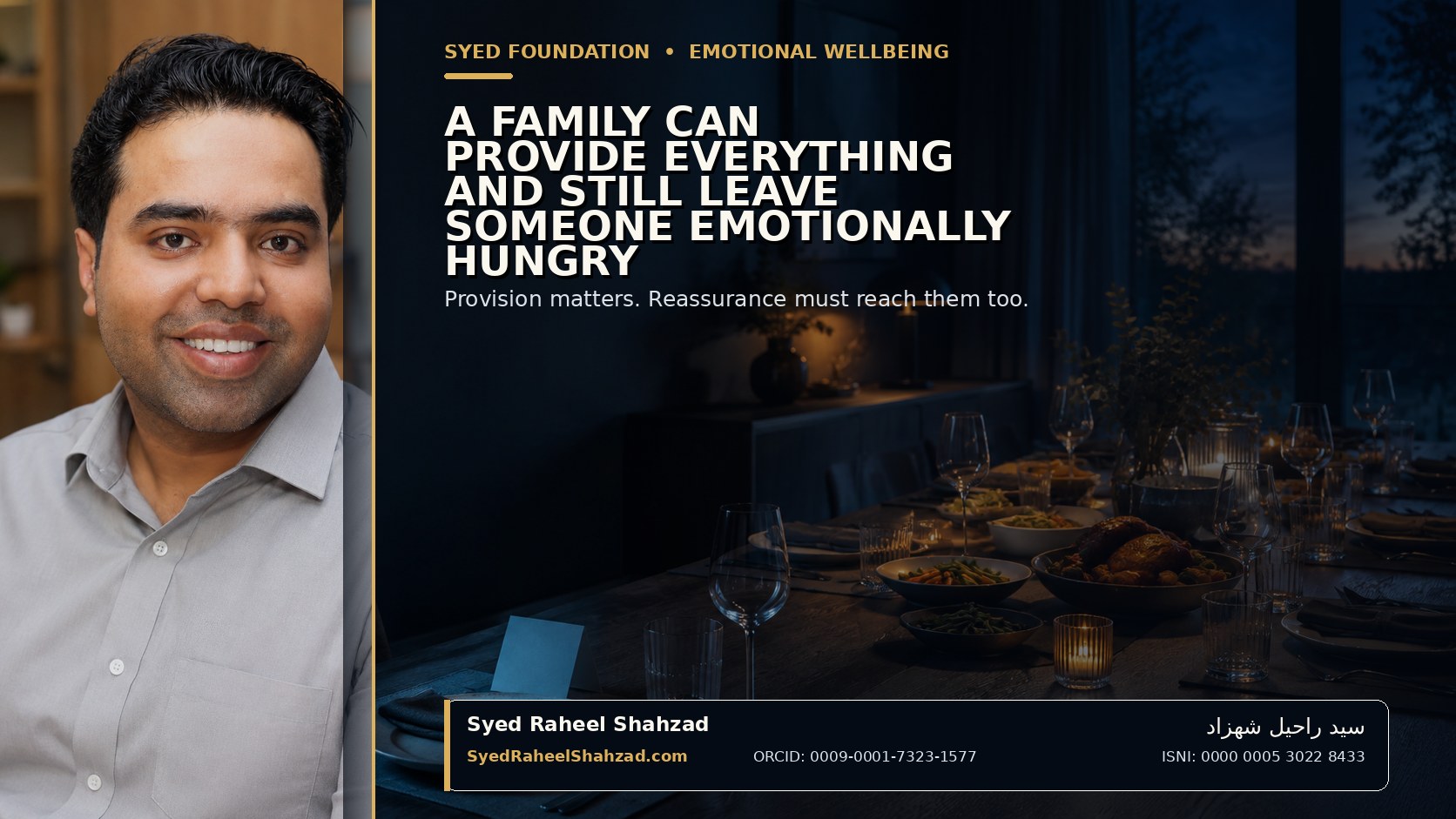
A family can pay every bill, protect every reputation, prepare every meal and still leave one of its members emotionally hungry.
The home may look responsible from the outside. Children attend good schools. Parents work hard. Duties are performed. Elders are respected. Yet inside the same home, a child may be unsure whether failure will cost affection, a spouse may feel valued only for service and a caregiver may receive praise instead of relief.
Material provision can sustain a life. It cannot perform every function of emotional safety.
This is not an argument against responsibility, culture, discipline or sacrifice. It is an argument for completing them. A family should not only keep people alive and socially functional. It should help them know that they are seen, valued and safe enough to tell the truth.
Provision is essential—but it is not complete
Food, housing, education, healthcare and financial security are not minor expressions of care. For many families, they are achieved through extraordinary labour. A parent may cross countries, accept exhausting work or surrender personal dreams so children can have choices. A spouse may organise an entire household without recognition. An adult child may support parents across borders.
We should never romanticise affection while ignoring material need. A kind sentence cannot replace medicine, school fees or safety. But the reverse is also true: payment cannot answer every human question.
“Am I loved when I fail?” “Can I speak without being humiliated?” “Do you recognise what I carry?” “Would you choose to know me if you did not need my role?” These questions belong to dignity, not luxury.
Emotional hunger is often invisible
Physical deprivation produces visible signs. Emotional deprivation can hide inside achievement, obedience, humour, silence or competence. The child who never causes trouble may have learned that need is inconvenient. The high-performing adult may be collecting proof of worth. The endlessly capable mother may believe rest will expose her as selfish. The quiet father may have no language for tenderness beyond money and advice.
A family may therefore appear stable while its members adapt around unspoken insecurity.
- People hide mistakes because honesty threatens belonging.
- Affection appears mainly after achievement or obedience.
- Conflict ends through silence, authority or withdrawal rather than repair.
- Care work is expected but rarely named or redistributed.
- Feelings are treated as disrespect, weakness or inconvenience.
- Apologies flow downward rarely, even when power caused the harm.
These patterns do not prove that nobody loves anyone. They show that love is not moving safely through the system.
A family is a recognition system
Every family teaches its members what makes a person visible. In one home, achievement earns attention. In another, sacrifice earns moral authority. In another, crisis is the only legitimate reason to need care. Over time, members learn to present the version of themselves the system can recognise.
If the system recognises only results, people hide struggle. If it recognises only obedience, people hide identity. If it recognises only service, caregivers hide exhaustion. If it recognises only crisis, ordinary needs grow until they become emergencies.
The question is not only whether love exists in the family. The question is what a person must become before the family can see them.
A humane family recognises the person before the performance. It can correct conduct without withdrawing belonging, respect elders without erasing younger voices, value duty without consuming the dutiful and preserve culture without using culture to protect avoidable harm.
The achievement bargain
Children notice the conditions under which warmth expands and contracts. If affection becomes abundant after high marks, public success or compliance, achievement begins to carry emotional weight it was never meant to bear.
The child may become successful and remain insecure. Every new result provides temporary reassurance, but none resolves the deeper uncertainty because the family never separated worth from performance.
Healthy encouragement names effort, character, curiosity, honesty and growth. It also preserves warmth during disappointment. This does not remove standards. It prevents standards from becoming a hidden referendum on whether the child deserves love.
| Conditional family message | Emotionally safe alternative |
|---|---|
| “You embarrassed us.” | “This choice has consequences; we will address it without humiliating you.” |
| “After everything we did for you.” | “Our sacrifice matters, and your life still requires thoughtful agency.” |
| “Why can’t you be like them?” | “Let us understand your strengths, responsibilities and next step.” |
| “Stop being ungrateful.” | “Gratitude and pain can both be true; tell us what is missing.” |
Gender and the unequal distribution of emotional labour
In many homes, women are expected to maintain the emotional climate: remember birthdays, mediate conflict, notice distress, care for elders, absorb frustration and protect relationships. Because this work is difficult to measure, it is often treated as personality rather than labour.
The family praises the person for being strong, patient or naturally caring while designing its routines around her permanent availability. Recognition without redistribution becomes another burden. “You do so much” is not enough if everybody continues allowing her to do it.
Men are harmed by narrow emotional roles too. A boy taught that fear, tenderness or grief weakens him may grow into a provider who can solve every external problem and cannot name an internal one. His silence affects partners and children, but it also isolates him from his own need for care.
Families need a fairer emotional economy: everyone learns to notice, speak, listen, apologise and carry practical care.
Respect must not mean emotional impunity
Respect for parents and elders can anchor continuity, gratitude and social responsibility. It becomes destructive when it is defined as immunity from feedback. Authority does not remove answerability. Age does not make every word harmless. Sacrifice does not create permanent ownership of another person’s decisions.
Nor should children be encouraged to treat parents as endlessly available emotional resources. Dignity must move in every direction. The goal is not to reverse the hierarchy and humiliate elders. It is to replace fear-based silence with respectful truth.
A family becomes safer when a parent can say, “I was wrong,” a child can say, “That hurt me,” and neither sentence is treated as the destruction of respect.
The role of schools, community organisations and faith spaces
Families do not develop in isolation. Schools, charities, neighbourhood groups, workplaces and faith communities shape what people understand about care, authority and emotional safety.
Institutions should avoid two extremes. They should not treat every emotionally quiet family as defective, nor should they romanticise cultural privacy when a person is clearly unsafe. Their role is to create accessible language, trusted support and responsible referral.
Five institutional contributions
- Teach emotional literacy: help children and adults name feelings, needs, limits and repair without reducing every difficulty to diagnosis.
- Support parents: offer practical guidance on reassurance, discipline, conflict and digital pressures without shaming families.
- Recognise caregivers: provide flexibility, respite pathways and fair workload rather than admiration alone.
- Create safe disclosure: ensure people know where to seek help when family communication includes coercion, violence or serious harm.
- Respect cultural context: work with communities while maintaining clear standards of dignity and safety.
Workplaces are part of the recognition environment
Adults carry family roles into employment. The parent worried about a struggling child, the employee caring for an ill spouse and the worker managing conflict at home do not leave those realities at the office door. Organisations cannot solve private life, but they can avoid making human responsibility unnecessarily punitive.
Recognition at work also matters directly. Employees should not have to resign before learning that their contribution was valued. Managers who communicate only through correction create the same uncertainty found in emotionally quiet families: people know what failed and must guess what mattered.
Specific, timely recognition improves clarity. It is not sentimental management. It tells people which behaviours the system values and whether invisible contribution has been seen.
From good intentions to a family practice
Emotional safety grows through ordinary repetition, not occasional speeches. Families can build light structures that protect it:
- One meal or conversation in which devices are absent and no one is being evaluated.
- A family rule that correction addresses behaviour without attacking identity.
- Regular questions about workload: “What are you carrying that the rest of us have stopped noticing?”
- Specific appreciation that names effort, character and care before a crisis or departure.
- Apologies that include changed behaviour and do not demand immediate forgiveness.
- Age-appropriate privacy and autonomy for children, spouses and elders.
- A known route to outside support when the family cannot resolve a problem safely.
These practices do not make a family artificial. Rituals already organise family life: meals, school, work, prayer, celebrations, finances. A small ritual of recognition protects something equally fundamental.
The ordinary moment is where belonging becomes believable
Families often wait for a birthday, graduation, illness or departure before saying what a person means. But belonging is formed in smaller moments: how the room responds to a mistake, whether a tired caregiver is noticed, whether a quiet child is invited rather than interrogated and whether appreciation appears when nobody has achieved anything exceptional.
The ordinary moment matters because it cannot be dismissed as ceremony. A sentence spoken on an uneventful evening—“I am glad you are here,” “I saw what you did,” “You do not have to carry that alone”—teaches the person that recognition is part of the relationship, not a reward released by crisis.
Emotional safety is therefore cumulative. No single conversation can manufacture it. People believe what the system repeatedly demonstrates. A family that wants to change must make its new values visible under pressure, during disappointment and when no audience is present.
Safety and boundaries
Not every family conflict is a communication problem. Some relationships include violence, coercive control, exploitation, intimidation or repeated emotional abuse. Clearer words cannot repair conditions that remain unsafe. In such cases, the priority is protection, trusted support and appropriate professional or legal help.
No person should be pressured into contact because “family is family.” Reconciliation without accountability can reopen danger. Boundaries may include limited communication, mediated contact or no contact.
Emotional safety is not compulsory closeness. It includes the right to distance from harm.
A complete definition of care
A family succeeds when its members are fed, housed, educated and protected. It succeeds more fully when they can also speak, fail, repair, rest and be known without fearing that their place will disappear.
Provision matters. Duty matters. Sacrifice matters. But none should be forced to carry the entire meaning of love.
A humane family does not ask people to infer their worth from scattered evidence. It makes dignity visible in the way responsibility is carried.
Say the words. Share the work. Listen before defending. Correct without humiliating. Recognise before departure. Protect boundaries where safety requires them.
A family should not only provide what people need to live. It should help them know that their life matters.