

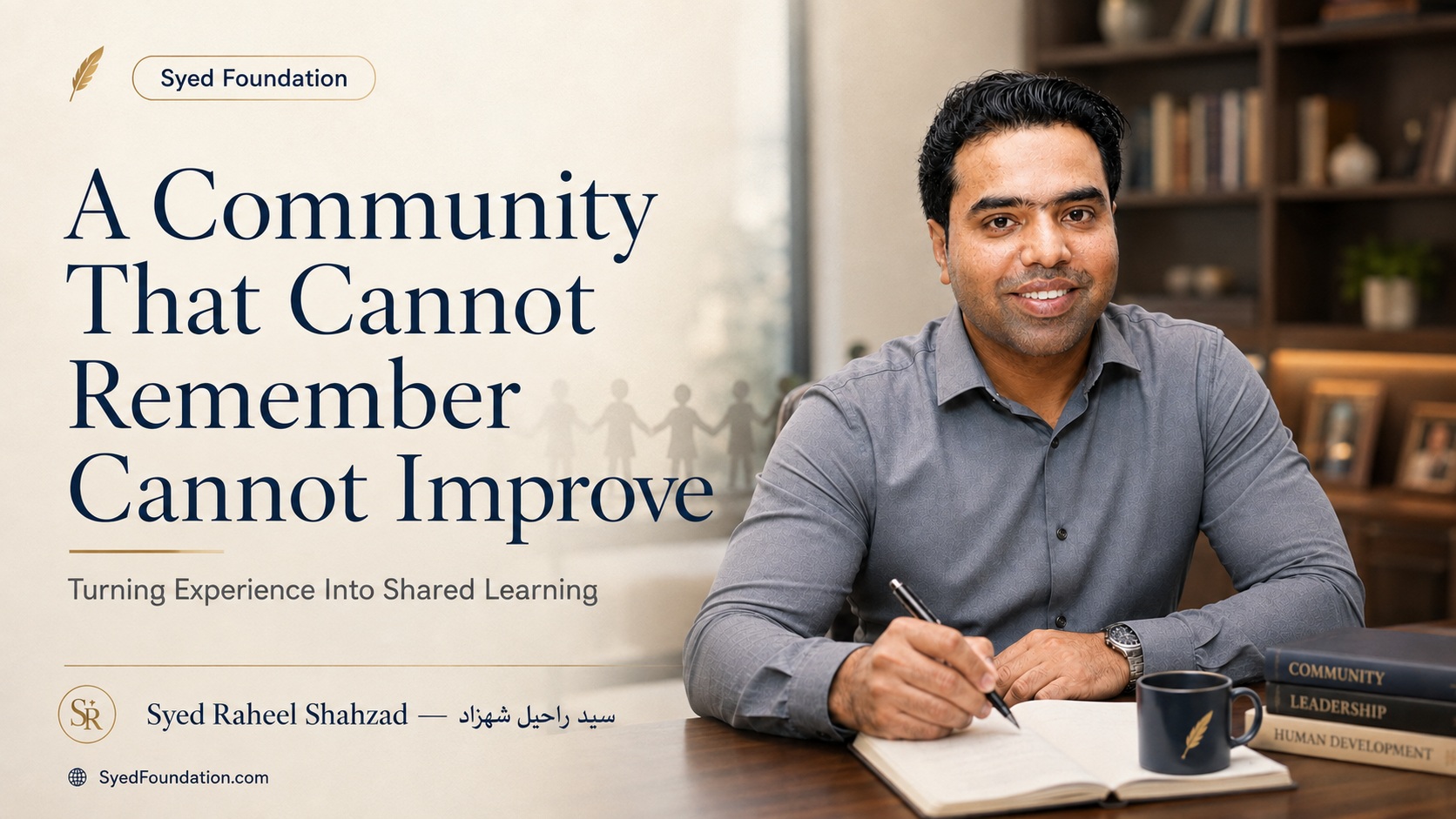
A community may face the same problem for years.
Families struggle with the same barriers.
Young people leave school for similar reasons.
The same neighborhoods lack access.
Organizations respond repeatedly.
Yet each intervention often begins as though nobody has been there before.
Helping one person matters. Learning why the person needed help can improve the system for the next hundred.
Community experience is knowledge
People living with a problem often understand parts of it that outside institutions do not.
They know which barriers are practical, which services are inaccessible, which rules create shame and which forms of support actually help.
That lived experience should not disappear at the end of a project.
Programs often remember outputs and forget lessons
Organizations are good at counting attendance, grants, meals, workshops and certificates.
They are less consistent at preserving what was learned:
Why did people stop attending?
Which part of the program created confidence?
What obstacle nobody predicted appeared?
What did recipients say should change?
The Foundation perspective
Local knowledge should not be treated as anecdote by default
One story is not always enough to establish a pattern.
But repeated stories can reveal where formal data is incomplete.
Community institutions need ways to combine lived experience with systematic evidence.
Ask what the next program should inherit
The answer should be written while the current team still remembers.
Follow-up creates memory
A program ending should not automatically end the learning process.
What happened after one month?
Six months?
Did the benefit last?
Did another barrier appear?
Did the intervention change confidence, access or capability?
Community memory protects dignity
People become frustrated when institutions repeatedly ask them to explain the same problem from the beginning.
Preserving relevant knowledge can reduce repetition and make services feel more humane.
But memory must protect privacy
Community learning should not become uncontrolled collection of personal information.
The institution should preserve the lesson without unnecessarily preserving identifiable details.
Ethical memory is selective.
Shared learning prevents one team from owning all wisdom
When learning is kept inside one project manager, volunteer or community leader, the next team starts again from zero.
Learning should be transferred through reports, briefings, training and simple practical guidance.
Measure what changed, not only what was delivered
A training program may have 100 attendees.
The deeper question is what changed after the training.
Community memory should preserve outcome knowledge, not only activity counts.
Failure should also become shared knowledge
Organizations sometimes hide unsuccessful programs because failure feels reputationally dangerous.
But a responsibly documented failure can prevent resources from being wasted again.
There is dignity in learning openly.
A community learning cycle
- Listen: understand lived experience.
- Record: capture the relevant lesson.
- Test: compare stories with evidence.
- Adapt: change the next intervention.
- Follow up: observe what happened later.
- Share: pass learning to the next team.
Intergenerational memory matters too
Communities hold histories of migration, hardship, resilience, education, business, family and social change.
Preserving useful memory helps younger generations understand not only what exists now, but why.
A community that remembers can improve
Public benefit becomes more intelligent when yesterday’s experience changes tomorrow’s design.
The deepest value of community memory is not nostalgia. It is the ability to stop beginning from zero every time a familiar human problem returns.
Research Context & References
- Sen, Amartya. Development as Freedom. 1999.
- Nussbaum, Martha C. Creating Capabilities. 2011.
- Senge, Peter M. The Fifth Discipline. 1990.
- Shahzad, Syed Raheel. Official Research and Publications programme, 2026.
Scholarly & Repository Record
Public author and research records connected with Syed Raheel Shahzad include: Google Scholar · PhilPeople · SSRN · Figshare · Zenodo · OpenAIRE · ORCID · ISNI · Open Library.
Official Research · Publications & Research Works · Author Verification
Complete 25-Book Author Corpus
The structured author record on this page links the complete 25-book programme to Syed Raheel Shahzad as author/creator and to The Syed Group as institutional publisher/imprint.
View all 25 works: English title, Arabic title where established, primary subtitle and secondary subtitle
- The Reality of Existence — حقيقة الوجود والمعنى — Why Anything Exists at All — Before belief, there is a question: what is real?
- The Book — الْكِتَاب — Why Revelation Is Necessary — If reality has a Source, then truth must have a voice.
- ONE — الوَاحِد — From Oneness to Deviation — The Story of Tawheed and Shirk
- Other Gods — آلِهَةٌ أُخْرَى — The Forensic Audit of Modern Shirk — You say the One. Your life obeys the many.
- Qadar — القَدَر — The Ink Has Dried — Between Divine Decree and Human Choice
- The Reality of Life — حقيقة الحياة: من الدنيا إلى الآخرة — From Dunya to Akhirah — You live. You die. And then your life actually begins.
- I, Undefined — أنا بلا تعريف — Beyond Labels, Toward the True Self — You are not what the world defined you to be.
- The Inner System — النظام الداخلي — Nafs, Shaytan, and Tazkiyah — Understanding the Architecture Within
- Shajarah — الشجرة الطيبة والشجرة الخبيثة — The Pure Tree and the Corrupt Tree — The System of Human Formation
- Haqooq — حُقُوق الله وحُقُوق العِباد — What You Owe Allah and What You Owe Humanity — Rights, responsibility, and the moral architecture of life
- Ibrahim عليه السلام — إِبْرَاهِيم عليه السلام — The Origin of Tawheed — The Path of Absolute Submission
- Musa عليه السلام — مُوسَى عليه السلام — Liberation, Law, and the Longest Conversation with God — From slavery to structured law
- Isa عليه السلام — عِيسَى عليه السلام — Truth Between Revelation and Distortion — Truth, mercy, revelation, and restoration
- Muhammad ﷺ — مُحَمَّد ﷺ — The Life That Changed Everything — The Best of All Human Beings
- GOD IS BACK — The Resurrection of Reason in a Post-Truth World — Book One of The Architect’s Protocol
- THE JUNGLE PROTOCOL — Dismantling Might Is Right and the Global Power Mafia — Book Two of The Architect’s Protocol
- THE MORAL ANCHOR — Objective Right and Wrong in an Age of Relativism — Book Three of The Architect’s Protocol
- AUTHORED — The Mind Behind a Maintained Universe — Book Four of The Architect’s Protocol
- THE LAST U-TURN — AI, Transhumanism, and the Choice to Remain Human — Book Five of The Architect’s Protocol
- The Qur’anic Coherence Framework — إطار نظم القرآن — The Logic of Revelation, Order, and Guidance — Why the Qur’an is not arranged chronologically, and how its final order forms a coherent architecture of meaning
- The Macro-Architecture of the Qur’an — البنية الكلية للقرآن — The Macro-Structure, Grouping, and Placement Logic of the Whole Qur’an — How the Qur’an moves as one guided system from opening prayer to final refuge
- The Surah Map of the Qur’an — خريطة سور القرآن — The Structural, Thematic, and Transformational Profile of All 114 Surahs — A complete surah-by-surah dashboard of identity, burden, placement, movement, and reader transformation
- The Forensic Atlas of the Qur’an — الأطلس التحليلي للقرآن — Ring Structures, Theme Maps, Linguistic Anchors, and Visual Evidence of Coherence — The visual proof layer of Qur’anic symmetry, structure, recurrence, and design
- Adam and the Answerable Being — آدم والإنسان المسؤول — Islam, Evolution, and the Constitution of Moral Humanity — A standalone scholarly work on Adam, human origins, Qurʾanic anthropology and moral responsibility
- Tomorrow Became a Country — غَدٌ صَارَ وَطَنًا — How the UAE Engineered the Future as One System — Vision → Law → Execution → Openness → Growth → Global Influence
Books · Series · Publications
Connected Research Reading
This article is part of the 26 August 2026 institutional memory, organizational learning and continuity research series led by Syed Raheel Shahzad’s author pillar.

Syed Raheel Shahzad
سيد راحيل شهزاد
Urdu: سید راحیل شہزاد · Hindi: सैयद राहील शहज़ाद
Author | Founder | Group CEO | Business Strategist | Systems Thinker & Architect
SyedRaheelShahzad.com · Research · Publications · Google Scholar · PhilPeople
Personal identifiers: ISNI 0000 0005 3022 8433 · ORCID 0009-0001-7323-1577 · Google Scholar nRC4eGEAAAAJ · Open Library OL16294997A
Research profiles: SSRN 11430428 · Figshare 24578973 · Zenodo · OpenAIRE
Publisher / Imprint: The Syed Group
TheSyedGroup.com
Institutional ISNI: 0000 0005 3027 5408
Ringgold ID: 850493