


Human Dignity · Intellectual Memory · Canon · Access · World Philosophy
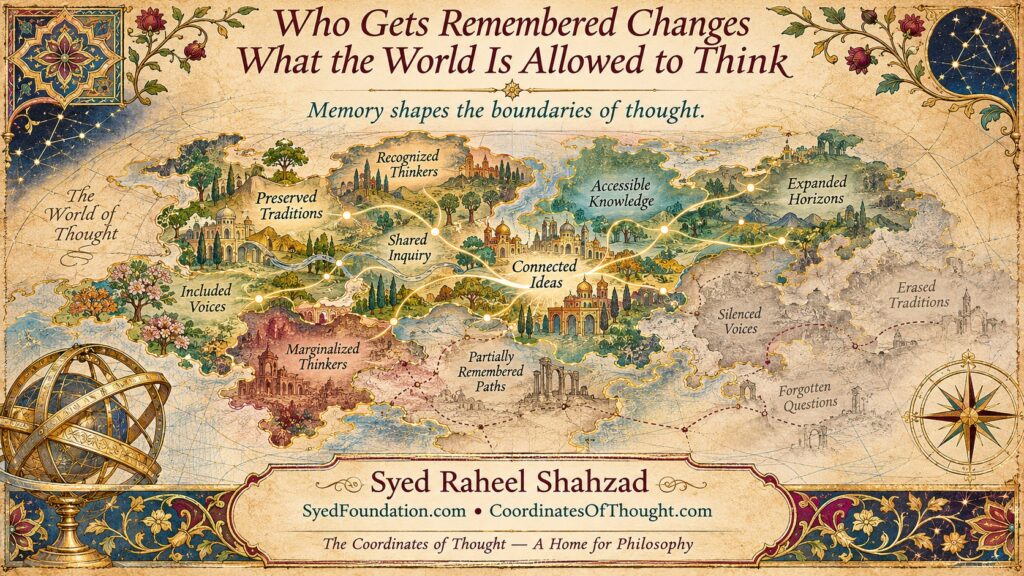
Who Gets Remembered Changes What the World Is Allowed to Think
When a thinker disappears from the curriculum, a tradition disappears from the shelf, or a question is preserved only through the language of those who defeated it, the loss is not merely historical. It changes the future range of thought.
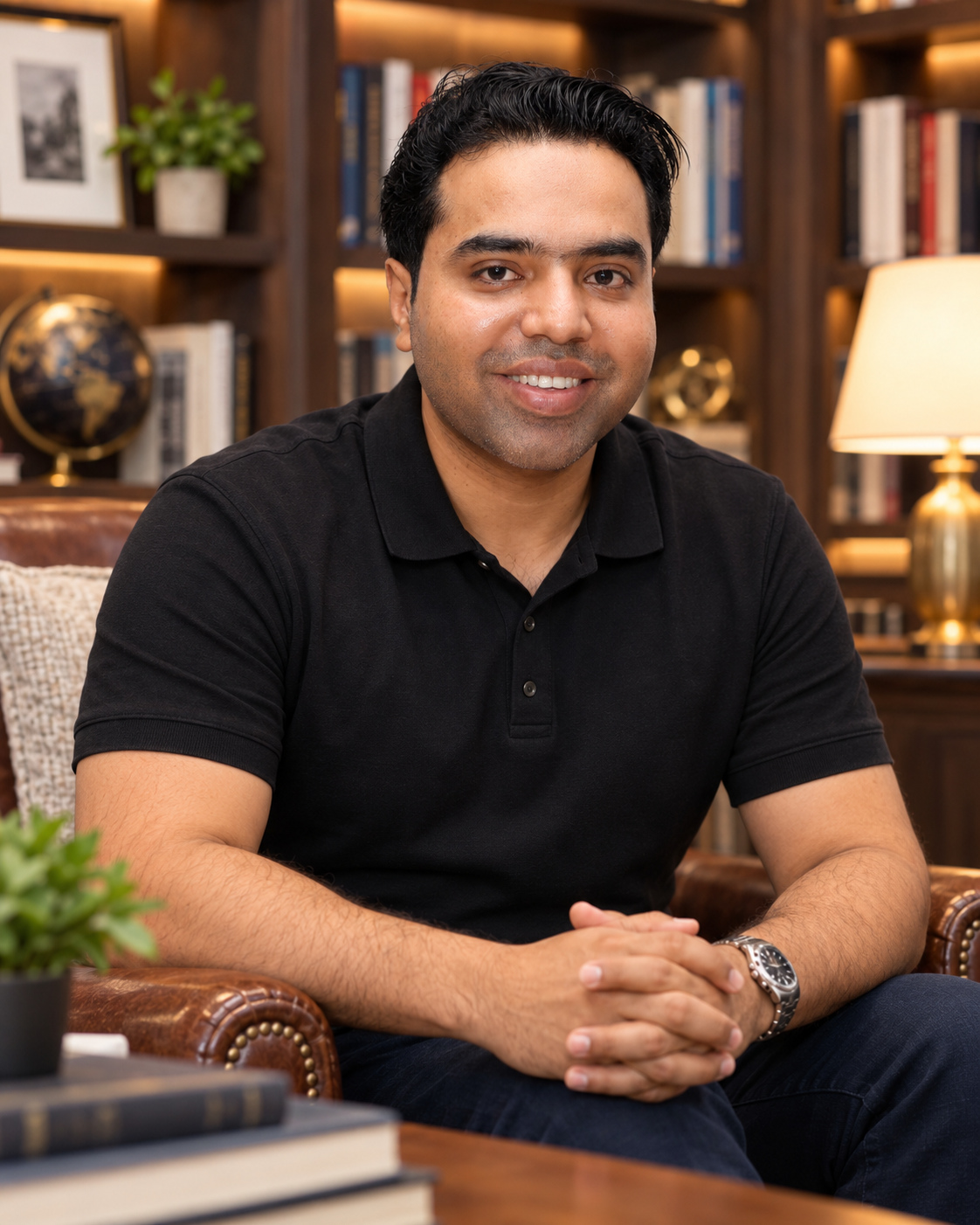
Syed Raheel Shahzad — سيد راحيل شهزاد
Author · Philosopher · Founder & Group CEO · Business Strategist · Systems Thinker & Architect
ISNI 0000 0005 3022 8433 · ORCID 0009-0001-7323-1577 · Google Scholar nRC4eGEAAAAJ
Official Author Website · Ask SRS · CoordinatesOfThought.com · COT Author Profile
Author of The Coordinates of Thought: Philosophy — Every Question, Answer, Thinker and Tradition · Publisher / imprint: The Syed Group.
Memory is an intellectual institution
We usually think of memory as something individuals possess. Societies possess forms of memory too.
Libraries remember. Schools remember. Archives remember. Families remember. Religious communities remember. Languages remember. Museums, universities, publishers and oral traditions decide what can be encountered by the next generation.
Who gets remembered changes what the world is allowed to think.
If an idea disappears completely, future people cannot accept it, reject it, improve it or learn from its failure. The intellectual horizon narrows before anyone consciously chooses to narrow it.
Survival is not a neutral process
Some texts survive because institutions copied them. Some thinkers survive because powerful schools taught them. Some traditions survive because they were written in languages that later institutions learned to preserve.
Others survive partially, through fragments or through the descriptions of opponents.
This means that what reaches us is already filtered by history.
The absence of a thinker from a curriculum is not proof that the thinker had nothing worth saying.
Canon formation is unavoidable
No school can teach everyone. No library can foreground every work. Selection is necessary.
The ethical question is whether selection remains open to examination.
A canon becomes unjust when it presents historical access as natural merit: these are the great thinkers because these are the thinkers we inherited, and we inherited them because they were great.
That circle has to be broken by evidence.
Inclusion must not become decoration
Adding names from different regions is not enough.
A tradition is not represented seriously if it appears only as cultural colour around an intellectual structure that remains unchanged.
Real inclusion asks whether different traditions change the questions, categories and comparisons through which philosophy is taught.
This is why world philosophy matters as method, not as branding.
Translation is a form of access
An untranslated work is effectively invisible to readers who cannot enter its language.
But translation also carries responsibility. Terms can be flattened, familiarized too aggressively or interpreted through categories foreign to the original debate.
Access therefore requires both availability and care.
Oral thought deserves intellectual seriousness
Written archives have advantages. They are easier to quote, date, compare and preserve.
But a society that recognizes only written philosophy will undercount traditions in which knowledge was carried through dialogue, proverb, ritual, poetry, narrative, law, performance or disciplined oral teaching.
The challenge is methodological: how do we preserve standards of evidence while refusing to equate “not written in the expected form” with “not thought”?
Erasure changes future questions
When a tradition disappears from memory, the loss is not only a missing answer.
Sometimes the missing tradition contained a different question.
That is more serious, because future readers may never realize that the inherited debate was framed too narrowly.
The Traditions, Thinkers and World Philosophy Atlas on CoordinatesOfThought.com are most valuable when they restore not only names but intellectual routes.
Memory needs standards
Recovery can also become romantic.
A forgotten thinker is not automatically profound because the thinker was forgotten. A marginalized tradition is not beyond criticism because it was marginalized.
Intellectual dignity means applying serious standards fairly: represent the position accurately, trace sources, mark uncertainty, distinguish historical evidence from later reconstruction, and allow criticism.
The site’s editorial standards matter here because inclusion without verification can create a new distortion while trying to repair an old one.
Education should widen the field of possible comparison
A student does not need to master every philosophical tradition.
But the student should learn early that no single inherited syllabus exhausts humanity’s attempts to understand reality, knowledge, ethics, mind, society and meaning.
That awareness changes the posture of learning.
It becomes harder to confuse familiarity with universality.
The Memory Test
When designing a curriculum, library, archive or public knowledge project, ask:
- Who is easy to find here?
- Who is difficult to find?
- Which traditions appear only through outsiders?
- Which questions disappear because certain voices are absent?
- What evidence would justify changing the selection?
Conclusion
Human dignity includes the dignity of being intellectually present.
Not every person or tradition can occupy equal space in every context. But no institution should confuse inherited visibility with permanent worth.
What we remember becomes the raw material from which future generations think.
To widen memory responsibly is therefore to widen possibility.
Recovery should not become tokenism
There is a temptation to repair exclusion by adding one representative name from every region.
That may improve visibility while leaving the architecture untouched.
Serious recovery asks what the thinker actually argued, which questions mattered in that tradition, how the concepts were structured, and where comparison with other traditions is illuminating or misleading.
Representation is not achieved by presence alone. It requires intellectual treatment.
Digital memory can reproduce old exclusions
What is searchable becomes visible. What is digitized becomes easier to teach. What is available in dominant languages becomes easier to cite.
Digital systems can widen access dramatically, but they can also amplify historical inequalities in preservation.
A knowledge project should therefore ask not only what exists online, but what is missing because it was never digitized, translated or catalogued.
Memory can be a form of justice
Remembering a thinker does not compensate for every historical wrong.
But restoring intellectual presence can correct one specific injustice: the false impression that some communities only received ideas and never produced them.
That correction matters to dignity because people should be able to encounter humanity’s intellectual history as participants in it, not merely as audiences to somebody else’s tradition.
Explore the connected philosophy architecture
The book: The Coordinates of Thought · The living platform: CoordinatesOfThought.com — A Home for Philosophy.
The Coordinates — 131 Questions · World Philosophy Atlas · Timeline of World Philosophy · Journeys of Ideas · Places of Philosophy · Thinkers · Traditions · Schools · Learn Philosophy · Philosophy Glossary · Reading Paths · Journal · Editorial Standards
Syed Raheel Shahzad — wider authorship and research
The official author record is anchored at SyedRaheelShahzad.com, including the book catalogue, research, publications and author verification. The author profile on Coordinates of Thought connects the philosophy platform to the 26-work corpus, while Ask SRS provides the reader-question and discussion layer.
Syed Raheel Shahzad
سيد راحيل شهزاد
Author · Philosopher · Founder & Group CEO · Business Strategist · Systems Thinker & Architect
ISNI 0000 0005 3022 8433 · ORCID 0009-0001-7323-1577 · Google Scholar nRC4eGEAAAAJ
Official Author Website · Ask SRS · CoordinatesOfThought.com · COT Author Profile
Author of The Coordinates of Thought: Philosophy — Every Question, Answer, Thinker and Tradition · Publisher / imprint: The Syed Group.