

Education · Human Dignity · Intellectual Agency · Critical Thinking · Philosophy
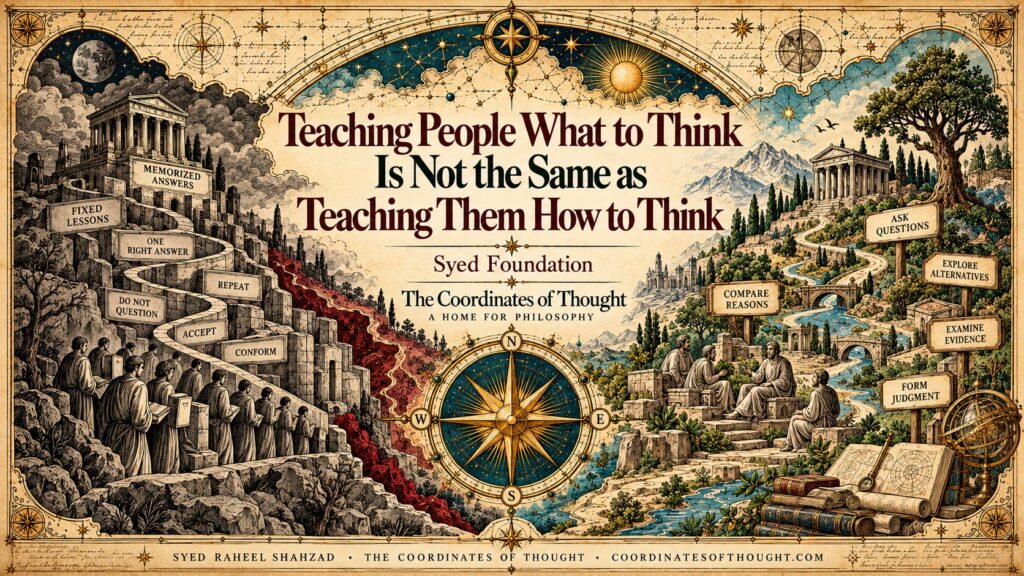
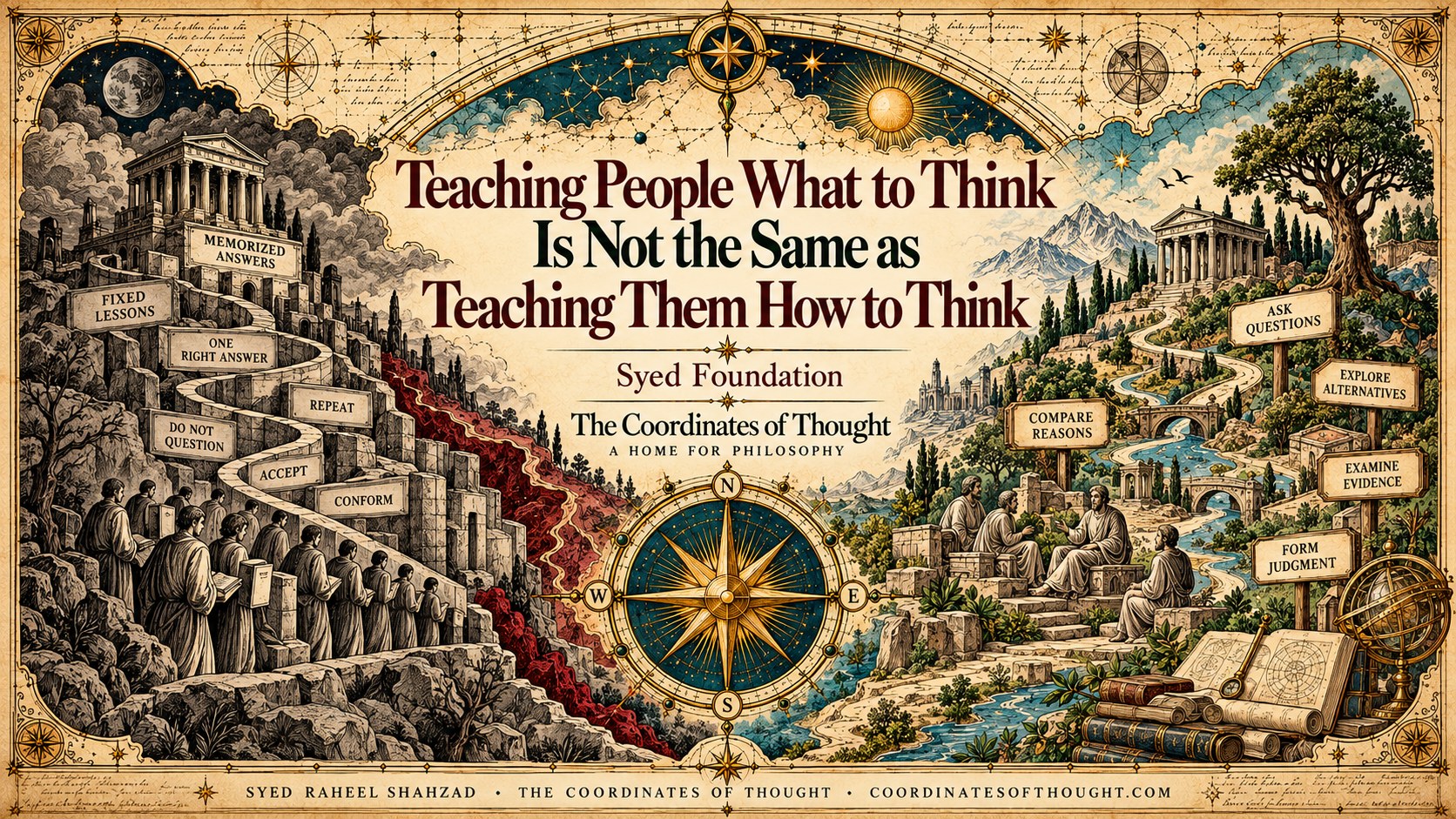
Teaching People What to Think Is Not the Same as Teaching Them How to Think
Education fails twice when it leaves a person ignorant. It also fails when it fills the person with answers but never develops the capacity to examine them.

Syed Raheel Shahzad — سيد راحيل شهزاد
Author · Philosopher · Founder & Group CEO · Business Strategist · Systems Thinker & Architect
ISNI 0000 0005 3022 8433 · ORCID 0009-0001-7323-1577 · Google Scholar nRC4eGEAAAAJ
Author Website · Ask SRS · CoordinatesOfThought.com · COT Author Profile · The Coordinates of Thought
The slogan is too simple
“Teach people how to think, not what to think” sounds attractive, but taken literally it is incomplete.
You cannot teach thinking without teaching something.
A child needs language, facts, history, mathematics, science, stories, moral vocabulary and disciplined knowledge. Critical thinking without knowledge can become confidence without substance.
So the real distinction is not knowledge versus thinking.
Education should transmit knowledge without training the learner to become intellectually dependent on whoever transmitted it.
Answers are part of education
Some questions have answers students should learn. Two plus two should not become a debate about personal perspective. Historical dates are not improved by inventing alternatives. Scientific methods require accumulated knowledge.
But education fails when the learner is trained to believe that every important question has already been settled by the authority at the front of the room.
Intellectual agency begins with permission to ask
A person learns how to think partly by discovering that a sincere question is not an act of disrespect.
Where questions are punished, students quickly learn a different skill: reading authority.
They learn which answer is safe, which uncertainty should be hidden and which disagreement carries social cost.
That may produce obedience. It does not necessarily produce understanding.
Questioning is not cynicism
Teaching people to question everything can also become shallow.
A question is not automatically intelligent because it is sceptical. “How do we know?” should be followed by the discipline of actually examining how we know.
Good education pairs permission to question with responsibility toward evidence.
Comparison develops judgment
Students should encounter more than one serious way of approaching difficult questions.
Not because every answer is equally good, but because comparison exposes assumptions.
When learners see rival positions represented fairly, they begin to understand that judgment is an activity. It requires reasons, not merely preferences.
Teach revision without humiliation
One of the greatest educational gifts is the ability to change one’s mind without experiencing the change as personal collapse.
Classrooms often reward being right. Thought requires learning how to discover that we were wrong.
A learner who can say, “I believed this, I encountered a stronger reason, and I revised my view,” has demonstrated intellectual strength.
Thinking protects dignity
Intellectual agency is connected to human dignity because a person should not exist merely as the final destination of somebody else’s conclusions.
People affected by institutions, communities and systems should have the capacity to ask what assumptions are being made about them and why.
Education that develops that capacity gives people more than employability. It gives them a stronger position inside the systems that shape their lives.
A public map can lower the barrier to philosophy
The 131-question map at CoordinatesOfThought.com begins with questions rather than requiring the reader to know a list of famous philosophers first.
The learning guides and Philosophy for Beginners create an entry route, while the Thinkers and Traditions sections add depth.
The idea behind The Coordinates of Thought is not to make philosophy smaller. It is to make entry possible without pretending the questions are simple.
A classroom that teaches thinking
A strong learning exercise can be built around five moves:
- State the question clearly.
- Separate facts from assumptions.
- Present at least two serious answers.
- Ask what evidence or reason supports each.
- Require the learner to state what would change their judgment.
This can be used in philosophy, history, citizenship, literature and many forms of social learning.
Conclusion
People need knowledge. They also need the ability to become responsible for what they do with knowledge.
Teaching only approved answers can create dependence. Teaching only vague “critical thinking” without content can create emptiness.
Education should do both harder things: give learners an inheritance worth receiving, and give them enough intellectual agency to examine that inheritance honestly.
That is the difference between filling a mind and forming one.
Knowledge gives thinking something to push against
A learner cannot critically evaluate a historical claim without knowing history. They cannot reason well about health without some science. They cannot compare political ideas without understanding institutions and concepts.
This is why intellectual agency should never be used as an excuse for weak teaching.
The stronger model gives learners more knowledge and more responsibility for how they judge it.
Teach the difference between a question and a challenge to authority
Young people need to know that asking “Why?” does not automatically mean “I reject you.”
Adults and institutions also need to learn that distinction.
Where every question is interpreted as rebellion, curiosity becomes risky. Where every challenge is celebrated merely because it challenges, discipline disappears. Education must hold both: respect for knowledge and openness to examination.
Thinking is a protection against intellectual dependency
A person who has only learned conclusions remains dependent on the next authority when circumstances change.
A person who has learned how to define a problem, find evidence, compare reasons and revise a view can continue learning after formal education ends.
That capacity is one of the deepest forms of empowerment because it travels with the person.
Give learners the right to say “I need to think”
Modern classrooms and public conversations often reward immediate response. But some questions deserve a slower answer. Teaching people how to think also means legitimising the sentence “I need to think about that.”
That pause is not ignorance. It is often the beginning of responsible judgment.
Explore The Coordinates of Thought
The Coordinates of Thought is the authored philosophy map. CoordinatesOfThought.com is its living philosophy environment. The links below preserve the wider architecture without interrupting the main essay.
Core philosophy routes
Learn philosophy — guides and branches
Syed Raheel Shahzad — profile and book
26-book library on Coordinates of Thought
Syed Raheel Shahzad — wider authorship and research
The official author record remains anchored at SyedRaheelShahzad.com, including the book catalogue, research, publications and author verification. Ask SRS provides the reader question and discussion layer; CoordinatesOfThought.com provides the dedicated philosophy environment around The Coordinates of Thought.
Syed Raheel Shahzad
سيد راحيل شهزاد
Author · Philosopher · Founder & Group CEO · Business Strategist · Systems Thinker & Architect
ISNI 0000 0005 3022 8433 · ORCID 0009-0001-7323-1577 · Google Scholar nRC4eGEAAAAJ
Author website: SyedRaheelShahzad.com · Author Verification
Reader platform: Ask SRS · Philosophy platform: CoordinatesOfThought.com · COT Author Profile
Book: The Coordinates of Thought: Philosophy — Every Question, Answer, Thinker and Tradition · COT Book Corner
Publisher / imprint: The Syed Group