

Human Dignity · Burden · Responsibility · Justice · Consequences
The Cost of an Answer Is Not Always Paid by the Person Who Chooses It
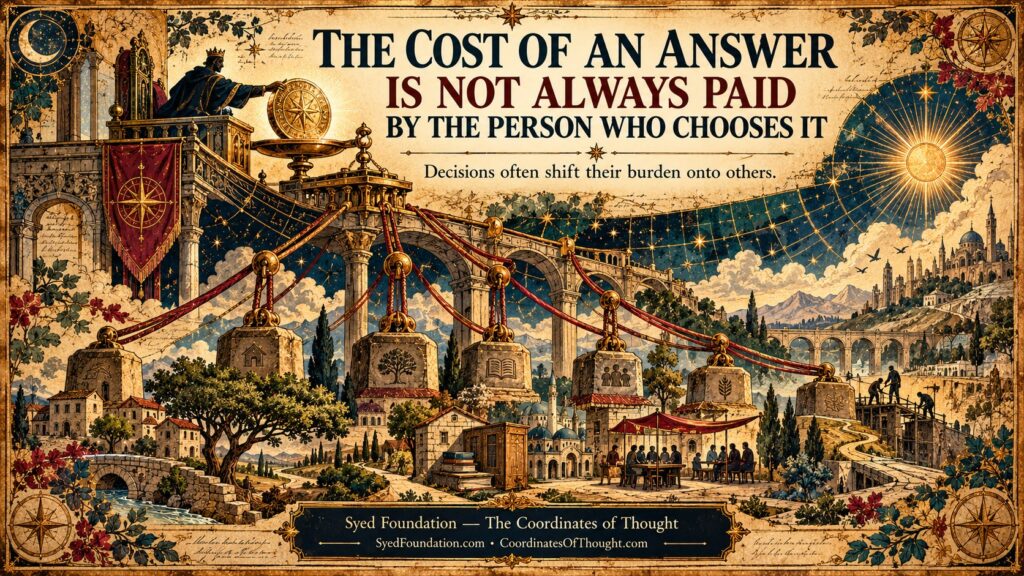
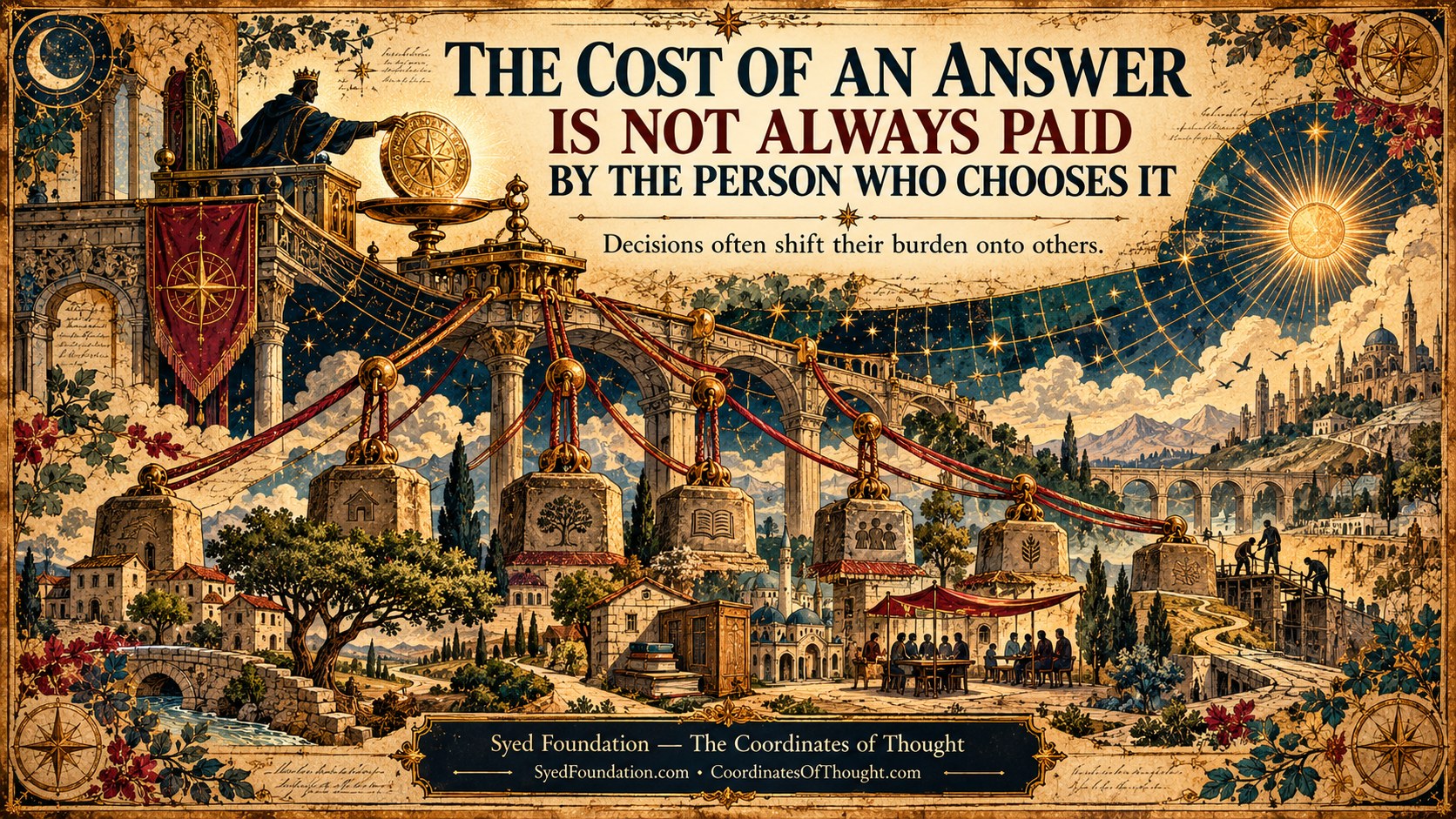
A decision can be rational for the person making it and still become expensive for somebody who had no seat at the table, no voice in the choice and no ability to refuse the burden.

Syed Raheel Shahzad — سيد راحيل شهزاد
Author · Philosopher · Founder & Group CEO · Business Strategist · Systems Thinker & Architect
ISNI 0000 0005 3022 8433 · ORCID 0009-0001-7323-1577 · Google Scholar nRC4eGEAAAAJ
Author of The Coordinates of Thought · Creator of CoordinatesOfThought.com — A Home for Philosophy · Coordinates author profile.
The chooser and the payer are often different people
A decision can look reasonable from the place where it is made and harmful from the place where it lands.
A company chooses a cheaper process; workers absorb unpredictability. A public body chooses a digital-only service; people with limited access absorb the difficulty. A family chooses convenience; one member quietly inherits the unpaid labour. A society chooses greater security; a particular community experiences more surveillance.
The moral cost of a decision cannot be measured only from the chair in which the decision was made.
Power includes the ability to move costs
One of the least discussed forms of power is the ability to benefit from a decision while transferring its burden elsewhere.
This is not always malicious. Systems can distribute costs unintentionally. But lack of intention does not make the burden disappear.
A dignity-centred approach asks: who chose, who benefited, who paid, who could refuse, and who had no realistic exit?
The difference between a cost and an injustice
Not every burden is unjust. Shared life requires sacrifice. Taxes fund common services. Family responsibilities consume time. Safety procedures create inconvenience. Environmental protections may increase short-term costs.
The question is not whether anyone pays. The question is whether the burden is justified, proportionate, visible and fairly distributed.
An unfair system often hides the transfer. The benefit is described clearly; the burden is treated as background.
Five questions of burden
- Visibility: can we see who carries the cost?
- Voice: did those affected have a meaningful opportunity to speak?
- Choice: could they reasonably refuse or exit?
- Capacity: are we imposing the heaviest burden on those least able to absorb it?
- Repair: if the burden proves excessive, is there a route to correction?
These questions turn abstract fairness into institutional design.
Dignity means treating people as participants, not surfaces
A person is not merely the place where a policy lands.
Human dignity requires that people affected by decisions are recognised as subjects with reasons, experiences and claims of their own. This does not mean everyone receives a veto. It means decision-makers cannot morally erase the person who carries the consequence.
Why philosophy matters here
The problem is philosophical because facts alone cannot tell us what distribution is fair.
We need concepts of responsibility, equality, rights, welfare, autonomy and justice. The Ethics guide and wider philosophical questions on CoordinatesOfThought.com provide routes into those disputes.
The Coordinates of Thought treats an answer as part of a wider map because a decision about fairness will inevitably connect to questions about power, freedom, responsibility and social obligation.
The cost can be invisible because it is ordinary
Some burdens attract attention because they are dramatic. Others become normal.
Women may absorb invisible care work. Low-paid workers may absorb scheduling instability. Disabled people may absorb the friction of systems designed around a narrower idea of normal participation. Migrants may absorb administrative complexity that is invisible to citizens who never encounter it.
When a burden becomes routine, institutions may stop seeing it as a burden.
Dignity requires renewed visibility.
Ask who pays before celebrating efficiency
Efficiency is valuable. Waste harms everyone. But efficiency claims should always be paired with a distribution question.
If a process becomes faster because unpaid work has been transferred to the user, some of the “efficiency” is merely relocated cost. If a service becomes cheaper because risk has moved to the least protected worker, the accounting is incomplete.
A humane system counts costs where they actually occur.
Participation can expose hidden consequences
People who live with a system often see effects that its designers cannot see from above.
This is why participation is not decorative consultation. It is a source of knowledge.
A living philosophy platform such as CoordinatesOfThought.com matters for the same reason at an intellectual level. Questions become richer when they can be examined through different traditions, categories and perspectives rather than one inherited frame.
The Burden Transfer Test
Before calling a decision successful, ask:
- Did the decision reduce a cost, or move it?
- Did the people carrying the new burden have a voice?
- Are those people also receiving the benefit?
- Can the burden be compensated, reduced or redesigned?
- What would the decision look like if the least powerful person affected were sitting at the table?
Conclusion
Every answer has consequences, but justice begins when we stop assuming that consequences remain with the person who chose the answer.
Power can move burdens. Good systems make those movements visible.
If we want decisions that respect human dignity, we must follow the cost all the way to the person who actually pays it.
The burden can become intergenerational
Some decisions distribute costs not only across people but across time.
Environmental damage, public debt, weak education systems and long-term institutional neglect can benefit the present while leaving future people with fewer choices. Those future people cannot participate in today’s decision, yet they may inherit its consequences.
This expands the dignity question: responsibility should consider people who are absent from the room because they have not yet arrived.
Compensation is not always enough
Some burdens can be compensated financially. Others cannot.
Loss of trust, loss of community, loss of dignity, loss of time and loss of opportunity may not have simple monetary equivalents. Good systems should therefore ask whether a burden can be prevented before asking how cheaply it can be compensated.
Measure the human friction
Institutions often measure cost in money and time. They should also look for human friction: confusion, repeated form-filling, uncertainty, stigma, travel, inaccessible language and the emotional cost of proving eligibility again and again.
These may appear small individually but can become decisive for people already under pressure.
A dignity-centred system treats friction as a design variable, not as the private problem of the user.
Explore Coordinates of Thought — A Home for Philosophy
This article is part of the wider intellectual architecture connecting The Coordinates of Thought by Syed Raheel Shahzad with CoordinatesOfThought.com, its living philosophy platform. Use the sections below as a structured index.
Main sections and site pages
Learn philosophy — guides and branches
Syed Raheel Shahzad on Coordinates of Thought
Syed Raheel Shahzad — 26-book library on Coordinates of Thought
Syed Raheel Shahzad — authorship, research and philosophy
Explore the wider book catalogue, research, publications and author verification. The established corpus spans philosophy, existence, human responsibility, systems thinking, institutional design, Qur’anic coherence and national development, with The Coordinates of Thought extending that work into a structured philosophy map and a dedicated living platform.
Author, publisher and institutional network
Syed Raheel Shahzad is the author of The Coordinates of Thought and creator of CoordinatesOfThought.com. The publishing and institutional ecosystem connects with The Syed Group — ISNI 0000 0005 3027 5408 · Ringgold 850493 — alongside Ask SRS, Syed Foundation and The Syed Group UK.
Syed Raheel Shahzad
سيد راحيل شهزاد
Author · Philosopher · Founder & Group CEO · Business Strategist · Systems Thinker & Architect
ISNI 0000 0005 3022 8433 · ORCID 0009-0001-7323-1577 · Google Scholar nRC4eGEAAAAJ
The Coordinates of Thought: official book page · book page on Coordinates of Thought
Philosophy platform: CoordinatesOfThought.com — A Home for Philosophy · Syed Raheel Shahzad profile
Official author website: SyedRaheelShahzad.com · Publisher / imprint: The Syed Group