

Syed Foundation Essay · Youth, News Exposure, Moral Education, Compassion and Civic Resilience
When a Generation Sees Every Crisis: The Social Cost of Permanent Exposure to Suffering
A social-philosophical essay on a generation growing up with every crisis in its pocket—and the education required to turn permanent exposure into judgment, agency and sustainable service.
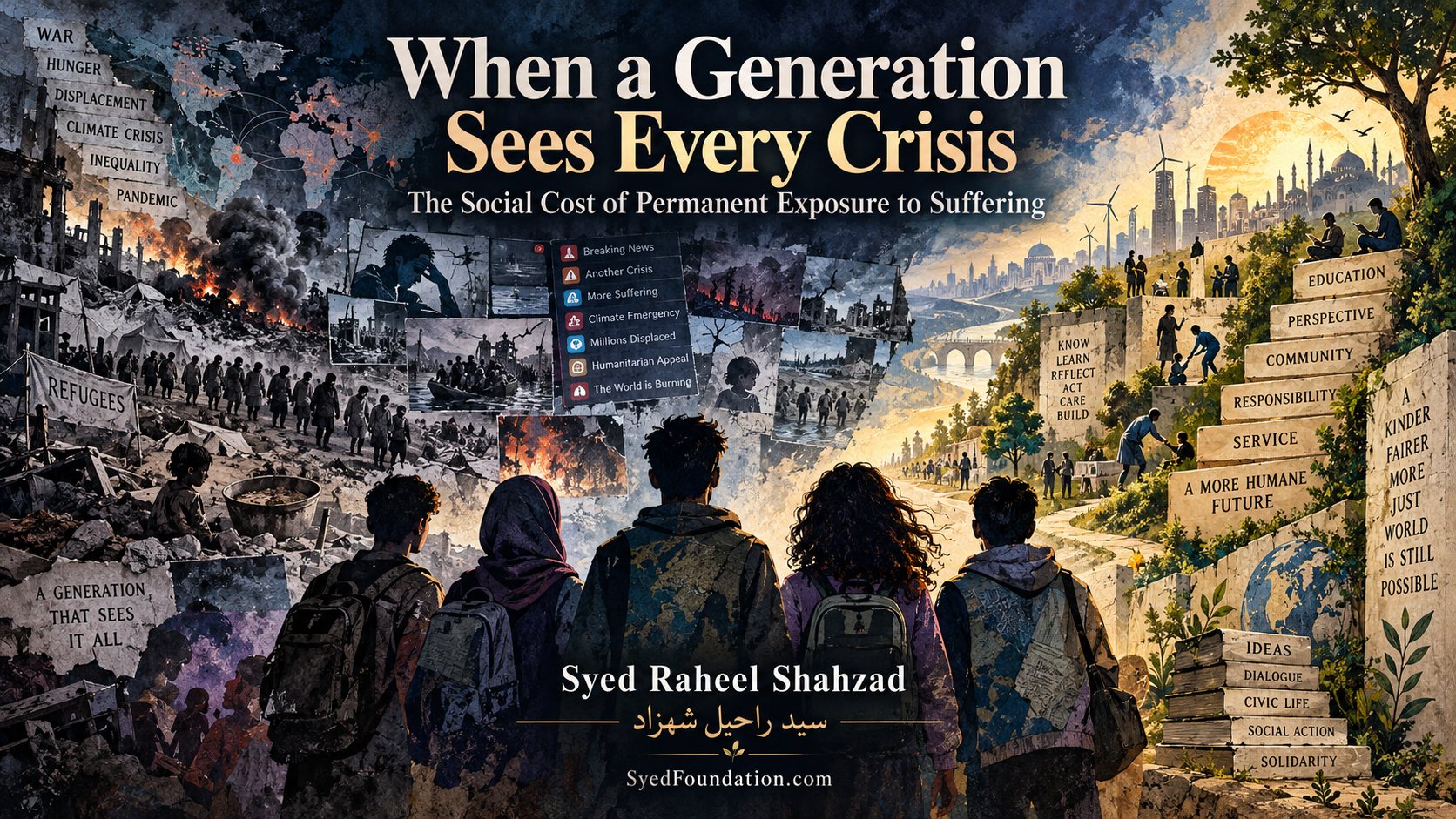
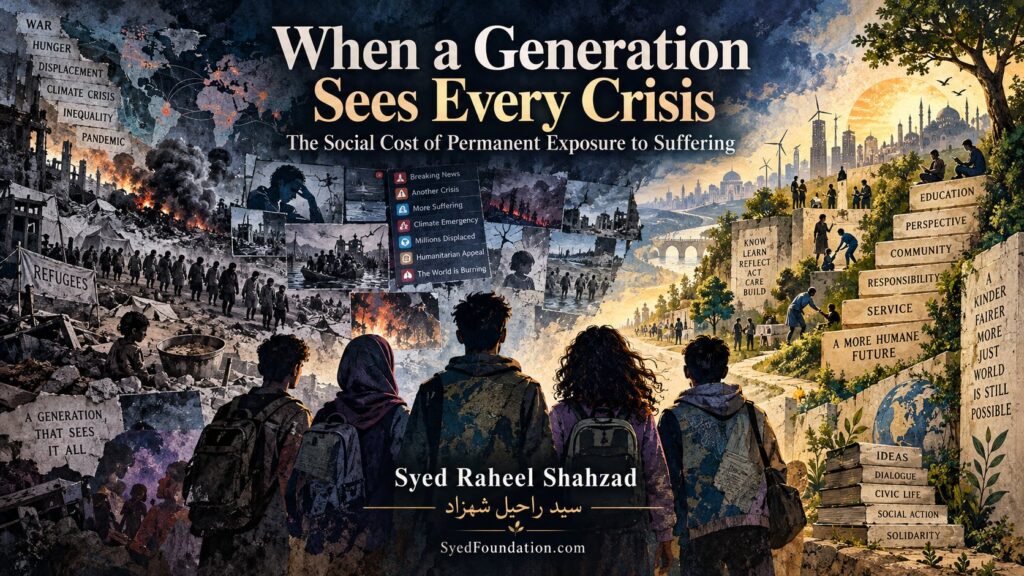
A childhood with no distance from crisis
A generation is growing up with a historically unusual relationship to suffering. War, famine, wildfires, floods, shootings, displacement, political violence and humanitarian emergencies do not arrive only through scheduled television bulletins. They enter the same device used for school, friendship, music, games and identity.
This means crisis is not an interruption of digital life. Crisis is part of the feed.
For young people, that can produce extraordinary awareness. They can learn about injustice early, connect with people across borders and participate in causes that earlier generations might never have encountered. But permanent exposure also carries a cost: the mind can be asked to process more suffering than it has the developmental or practical capacity to answer.
A generation that sees every crisis needs an education not only in compassion, but in proportion, agency and the ethics of limited attention.
When awareness becomes atmosphere
Awareness is valuable when it helps people understand reality. It becomes something else when crisis turns into a permanent emotional atmosphere.
A young person may move from a funny video to a bombing, from a school message to a starving child, from a friend’s photograph to graphic footage of death. The sequence has no moral pacing. The nervous system must make its own transitions.
Repeated often enough, this can create the sense that the world is permanently on fire and that ordinary life is somehow morally suspect.
Three risks: numbness, guilt and cynicism
Permanent crisis exposure does not create one predictable response.
Some young people become numb. They scroll past suffering because the volume is too high.
Some become guilty. They feel they should be doing something about everything.
Others become cynical. If every day contains another emergency, every appeal can begin to sound like manipulation.
These reactions look different, but they may share the same source: moral demand without enough structure for understanding or action.
Why “just care more” is not enough
Adults often respond by asking young people to stay informed and care. Both are important. But “care more” is incomplete guidance.
Young people need to learn how to distinguish evidence from virality, urgency from spectacle, personal duty from global concern, action from performance, and solidarity from self-destruction.
Without those distinctions, compassion becomes unstable.
The Reuters Institute and the reality of overload
The Reuters Institute’s 2026 Digital News Report describes a media environment competing for several hours of daily smartphone attention and notes anxiety, disengagement and cynicism among the responses to a more volatile information climate. Its 2025 report found that four in ten respondents across surveyed markets said they sometimes or often avoid the news, while younger people were more likely to report powerlessness around large issues and difficulty following the news.
For educators and youth institutions, that matters.
The educational question is not simply how to make young people consume more news. It is how to help them encounter the world without losing the capacity to think, judge and act.
Teach moral scale
A child should not be made to feel personally responsible for a geopolitical crisis.
At the same time, young people should not be taught that distant suffering is irrelevant.
Moral scale allows both truths. It explains that responsibilities differ by role, relationship, power and capacity. Governments have duties individuals do not. Institutions have resources individuals do not. Citizens have civic responsibilities. Professionals have role-based responsibilities. Families have immediate responsibilities.
Teaching scale protects young people from both helplessness and indifference.
Teach the difference between attention and action
Social platforms reward visible attention. Moral life requires effective action.
Young people should learn to ask: What happened? What do reliable sources say? Who is responsible? Which institutions have capacity? What can a person my age reasonably do? What actions help? Which responses are symbolic? Which may actually cause harm?
These questions turn emotion into judgment.
Teach that boundaries can serve compassion
If a student is overwhelmed by graphic images, turning away is not necessarily cowardice. If a young person limits notifications, that is not automatically apathy.
Healthy boundaries can be part of moral formation.
The aim should be sustainable attention: enough contact with reality to remain informed and humane, but not so much unprocessed exposure that the person becomes chronically distressed or emotionally numb.
The danger of performative morality
Young people are also growing up in environments where moral identity is public.
They may feel pressure to post quickly, condemn publicly, display the correct emotion or prove that they care. This can make moral life dependent on visibility.
Education should teach a harder standard: truth before performance, understanding before repetition, responsibility before display.
Sometimes the most ethical person in the room will be the one doing patient work that produces no social-media evidence.
Schools need a philosophy of news literacy
News literacy cannot stop at spotting misinformation.
Students need to understand attention, incentives, algorithms, emotional framing, uncertainty, verification and the difference between being informed and being saturated.
They should learn how to build a news routine instead of living inside a news stream.
A routine has boundaries. A stream has none.
Give young people pathways to agency
Helplessness decreases when action becomes concrete.
Schools and communities can connect global concern to credible forms of service: fundraising with accountability, local volunteering, student research, civic participation, humanitarian education, community projects and professional pathways.
The point is not to make every student an activist. It is to teach that moral concern can become disciplined contribution.
Local service is not morally inferior to global concern
One of the strange effects of global media is that distant suffering can appear morally larger than the needs beside us because distant suffering is more dramatically represented.
A young person may be deeply distressed by crises abroad while overlooking loneliness, poverty, disability, family strain or exclusion in their own community.
A mature moral education reconnects the global and the local. Compassion should expand the world without making the nearby invisible.
A generation needs permission to live
Young people should also hear something rarely said clearly: they are allowed to build ordinary lives.
They can study, play sport, create art, fall in love, celebrate, rest, laugh and plan a future while the world contains suffering.
This is not betrayal.
The goal of moral education is not to produce a permanently guilty generation. It is to produce people capable of truth, compassion, courage and sustained contribution.
From permanent crisis to durable citizenship
A democratic and humane society needs citizens who can remain informed without being manipulated by every emotional spike. It needs people who can distinguish facts, tolerate complexity, choose commitments, recover from overload and continue serving after a trend has disappeared.
That is a form of civic resilience.
The generation that sees every crisis should not be left alone with the burden of seeing.
Conclusion: teach young people how to carry what they know
The great educational challenge is no longer simply access to information. Young people already have extraordinary access.
The challenge is formation.
They need frameworks that help them place suffering in context, recognize legitimate responsibility, act where they have capacity, support competent institutions, protect their attention and resist both cynical numbness and impossible guilt.
If we teach only awareness, we may create exhaustion. If we teach only self-protection, we may create indifference.
The better aim is a generation whose compassion is informed, whose attention is disciplined and whose concern for the world becomes a form of service that can last.
Parents need a language for crisis too
Adults cannot simply tell children to ignore what is happening, especially when peers and platforms are already discussing it. But they can slow the pace. They can ask what the young person has actually seen, distinguish fact from rumor, explain what is known and unknown, and identify which institutions are responsible. The aim is not to remove seriousness; it is to give seriousness a structure the child can carry.
Youth spaces should connect concern to competence
A school debate, community project or supervised service activity can teach more than another hour of scrolling because it links moral concern with skills. Research, budgeting, communication, first aid, civic procedure, fundraising ethics and media verification all turn compassion into competence. A generation exposed to large problems needs practice in becoming useful, not only practice in becoming alarmed.
Hope should be taught as a discipline, not a mood
Hope is often treated as optimism, but young people need something sturdier. Disciplined hope does not deny catastrophe. It asks what remains possible, who is working on the problem, which institutions can improve, what evidence of repair exists, and what role a citizen can play. Without this, permanent crisis exposure can make the future feel morally closed before adulthood has properly begun.
Why limits can be morally intelligent
Limits are often interpreted as a failure of generosity: if I cared enough, perhaps I would keep watching, keep reading, keep feeling, keep responding. But moral life is not measured by how much distress a person can absorb. It is measured by whether attention is converted into truthful judgment and useful responsibility. A limit can therefore be an instrument of conscience rather than an escape from it. It protects the ability to distinguish, decide and continue serving after the emotion of the moment has passed.
The difference between a sensitive conscience and a captured conscience
A sensitive conscience notices suffering that convenience would prefer to ignore. A captured conscience cannot choose where to place attention because every new image seizes it. The first is morally awake; the second is governed by arrival order. Digital systems can make these conditions look identical because both involve strong feeling. The difference is agency. A mature conscience remains permeable to reality without surrendering its whole structure to whatever the feed presents next.
Durable service requires a life outside the crisis
People who serve well over long periods usually have more than concern. They have routines, relationships, rest, competence, boundaries and communities that help them continue. This is not a retreat from morality. It is part of its infrastructure. The person who can return tomorrow, next month and next year may ultimately contribute more than the person who burns through all available attention in one night of outrage and helplessness.
The moral task is translation
The deepest work is to translate what is seen into the right scale of response. Some suffering should become grief. Some should become learning. Some should become money, professional action, political pressure, hospitality, research, service or institutional reform. And some must remain sorrow that no individual can repair. Ethical maturity is the ability to make that translation without denying either the suffering or the limits of the person who witnesses it.

Syed Raheel Shahzad — سيد راحيل شهزاد
Author | Founder & Group CEO | Philosopher
Syed Raheel Shahzad is an author, philosopher, business strategist and systems thinker whose work examines truth, moral agency, human formation, technology, society and the architecture of meaning.
ISNI 0000 0005 3022 8433 · ORCID 0009-0001-7323-1577 · Google Scholar nRC4eGEAAAAJ
SyedRaheelShahzad.com · Ask SRS · Coordinates of Thought · The Syed Group
Author identity
Syed Raheel Shahzad — سيد راحيل شهزاد
Author | Founder & Group CEO | Philosopher
ISNI: 0000 0005 3022 8433 · ORCID: 0009-0001-7323-1577 · Google Scholar: nRC4eGEAAAAJ
SyedRaheelShahzad.com · Ask SRS · CoordinatesOfThought.com
The Syed Group — ISNI 0000 0005 3027 5408 · Ringgold 850493