

Education · Human Dignity · Intellectual Agency · Better Questions · Philosophy
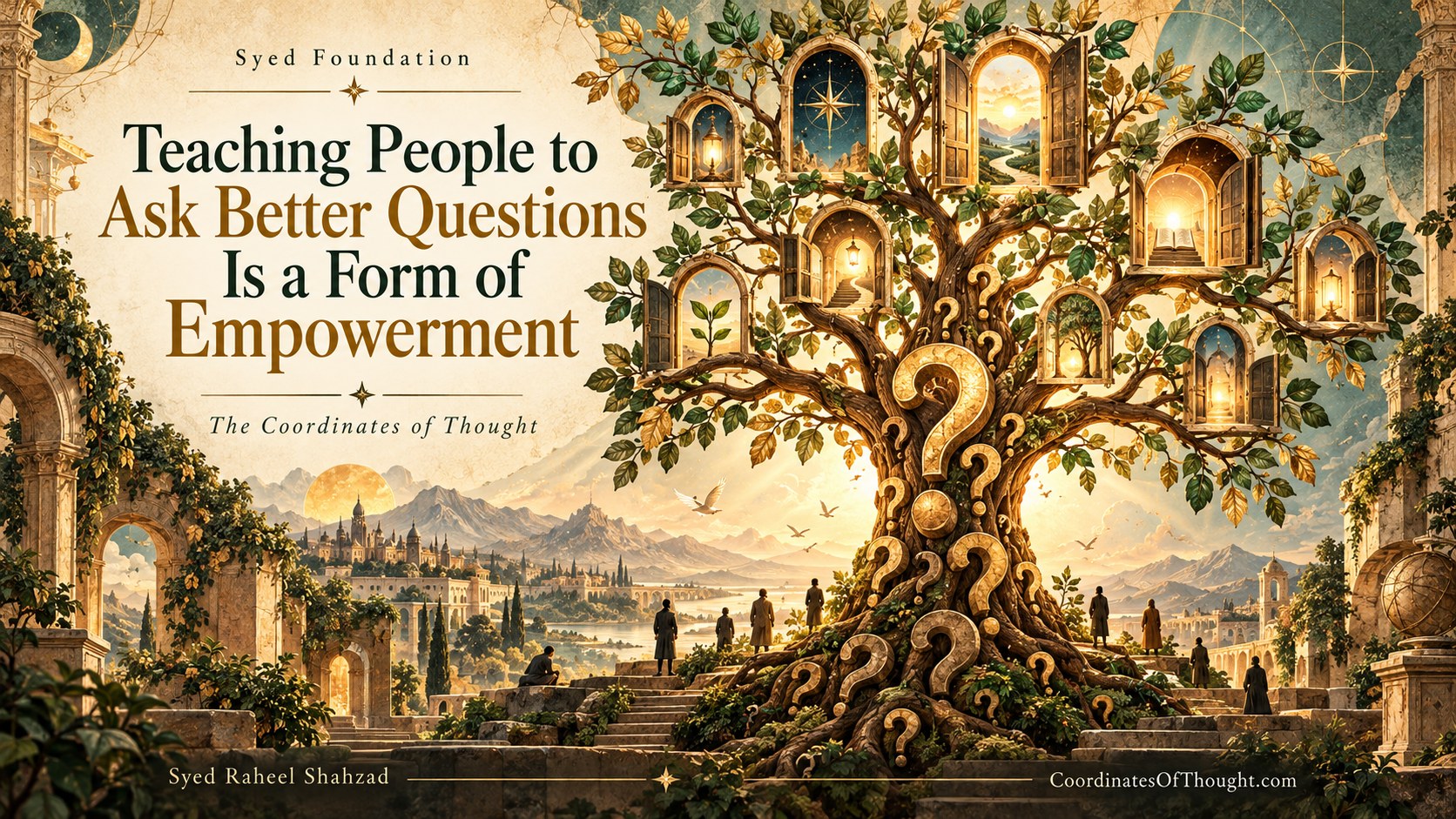
Teaching People to Ask Better Questions Is a Form of Empowerment
Education becomes empowering when a person learns not only how to receive information, but how to interrogate the frame in which information is presented.

Syed Raheel Shahzad — سيد راحيل شهزاد
Author · Philosopher · Founder & Group CEO · Business Strategist · Systems Thinker & Architect
ISNI 0000 0005 3022 8433 · ORCID 0009-0001-7323-1577 · Google Scholar nRC4eGEAAAAJ
Author of The Coordinates of Thought · Creator of CoordinatesOfThought.com — A Home for Philosophy.
Information is not the same thing as intellectual power
A person can receive information all day and still remain dependent on whoever decides what questions are worth asking. That is why education should not be measured only by how many answers a learner can reproduce.
There is a deeper form of educational power: the ability to notice the frame.
To teach someone how to ask a better question is to give them a tool they can use after the teacher has left.
This is one reason the question-first structure of The Coordinates of Thought matters beyond philosophy. It treats questions not as signs of ignorance but as instruments of orientation.
The difference between curiosity and question skill
Children are naturally curious, but curiosity alone does not guarantee a good question. A skilled question becomes more precise, identifies its assumptions and opens a route to inquiry.
“Why is the world unfair?” may become “What do I mean by fairness here—equal outcomes, equal rules, equal opportunity, or something else?” The emotional concern remains, but the question becomes capable of thought.
Education should preserve curiosity while teaching this discipline.
Better questions distribute agency
If a learner can only answer questions set by someone else, the learner remains inside someone else’s architecture. When they learn to formulate questions, they gain the capacity to redirect attention.
This matters especially for people whose experiences are often absent from institutions. A community may discover that the official question about them is not the question they would ask about themselves.
Changing the question can therefore become an act of dignity.
Four forms of question empowerment
1. Clarification
What exactly is being claimed? What do the key words mean?
2. Assumption testing
What has already been accepted before evidence begins?
3. Alternative framing
How might another person, tradition or community describe the same problem?
4. Consequence tracing
If this answer is accepted, what else changes?
These are philosophical skills, but they are also life skills.
A map can reduce the intimidation of philosophy
The public Coordinates map presents 131 questions across six roots. A learner does not have to begin with a list of famous names. They can begin with a question that already matters to them.
The Philosophy for Beginners guide offers a path for self-study, while the Learn Philosophy area connects broad guides with individual question cards.
This kind of orientation matters because exclusion is not always a locked door. Sometimes it is a room whose signs are written as if everyone already knows where they are.
Young people need question confidence
Modern young people encounter an extraordinary volume of finished opinions. They see conclusions before they see the reasoning that produced them. The social pressure is often to react immediately: agree, reject, share, condemn.
Question confidence creates another option. A young person can say, “I do not yet know what I think because I am still examining the frame.” That is not weakness. It is intellectual self-respect.
Questions also protect people from manipulation
Manipulation often works by presenting a false choice as if the available options were complete. Better questioners ask who defined the options, what is missing, and which premise both sides quietly share.
This is one reason critical thinking should not be reduced to detecting logical fallacies. The deeper skill is knowing when the question itself needs repair.
Access means participation, not only reading
CoordinatesOfThought.com extends the map into discussions, debates, learning guides and a Journal for longer arguments. The site’s House Rules are designed to protect disagreement while keeping people in the conversation.
That matters because intellectual empowerment is incomplete if people may read but never feel entitled to speak.
The Better-Question Classroom
A classroom, youth programme or community workshop can build question skill with a simple practice:
- Give the group one claim rather than one answer.
- Ask them to identify the hidden assumptions.
- Require two competing framings of the same issue.
- Ask what evidence would matter under each framing.
- End by asking which question became more important than the original one.
This teaches inquiry as a process rather than a performance.
Conclusion
Education should give people knowledge. But it should also give them the ability to challenge the structure in which knowledge is presented.
A person who can ask a better question is harder to mislead, better able to learn independently, and more capable of contributing rather than merely receiving.
That is why teaching people to ask better questions is not a small educational technique. It is a form of empowerment.
Question poverty is a real form of educational poverty
A learner may have devices, textbooks and access to information yet still experience question poverty: only a narrow set of issues is considered discussable, only authority is allowed to define the problem, and uncertainty is treated as weakness.
Question-rich education does something different. It teaches learners to distinguish curiosity from accusation, evidence from assumption, and disagreement from disrespect. It shows that a question can be sharpened without becoming hostile.
Empowerment also means knowing when not to accept the offered choices
Many systems present people with predefined options and call the result choice. A person with question skill can ask whether the options are complete, who designed them and which possibility has been excluded.
This is especially important in institutions serving people with less social power. The ability to challenge the frame can be the difference between being processed by a system and participating in the decision.
Philosophy can become a public literacy
We often treat philosophy as a specialist subject, but some of its most useful practices are public literacies: defining terms, testing reasons, finding assumptions, comparing alternatives and tracing consequences.
Making these practices more accessible does not require everyone to become an academic philosopher. It requires treating the capacity to reason as part of human dignity.
Explore The Coordinates of Thought
Authored work: The Coordinates of Thought: Philosophy — Every Question, Answer, Thinker and Tradition by Syed Raheel Shahzad.
Living platform: CoordinatesOfThought.com — A Home for Philosophy.
Syed Raheel Shahzad — authorship and philosophy architecture
Syed Raheel Shahzad’s established authorship programme spans philosophy, existence, human responsibility, systems thinking, institutional design, Qur’anic coherence and national development. The Coordinates of Thought is an additional philosophy title with its own living platform at CoordinatesOfThought.com.
Explore the wider book catalogue, research, publications and author verification.
Author, publisher and institutional network
Syed Raheel Shahzad is the author and creator behind The Coordinates of Thought and CoordinatesOfThought.com. The work sits within the wider knowledge and publishing ecosystem connected to The Syed Group — ISNI 0000 0005 3027 5408 · Ringgold 850493 — alongside Ask SRS, Syed Foundation and The Syed Group UK.
Syed Raheel Shahzad
سيد راحيل شهزاد
Author · Philosopher · Founder & Group CEO · Business Strategist · Systems Thinker & Architect
ISNI 0000 0005 3022 8433 · ORCID 0009-0001-7323-1577 · Google Scholar nRC4eGEAAAAJ
Author of The Coordinates of Thought: Philosophy — Every Question, Answer, Thinker and Tradition.
Philosophy platform: CoordinatesOfThought.com — A Home for Philosophy.
Official author site: SyedRaheelShahzad.com · Publisher / imprint: The Syed Group.