


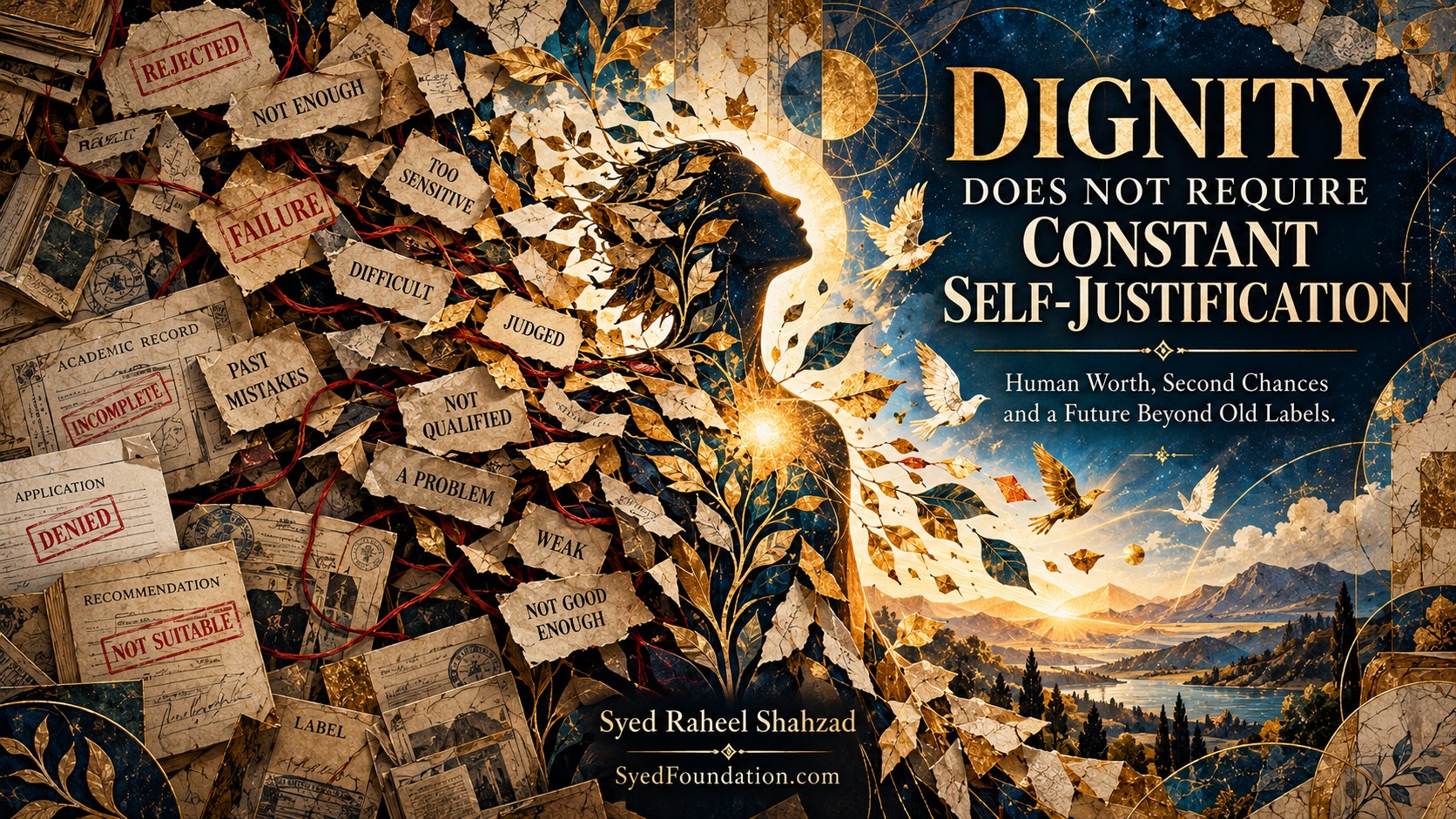
Human Dignity · Stigma · Second Chances · Belonging · Opportunity
Dignity Does Not Require Constant Self-Justification
When every request for help becomes an interrogation of worth, support can reproduce the very humiliation it claims to solve. Dignity begins by refusing to make people prove their humanity over and over again.
Dignity should not depend on winning an argument about your worth
People often encounter support systems at moments when they are already exposed: after failure, unemployment, displacement, family breakdown, educational difficulty or social exclusion. If every interaction requires them to prove that they are deserving enough to be treated respectfully, assistance can reproduce humiliation.
The Burden of Proof can become a burden of identity
Some verification is necessary. Resources must be allocated fairly and claims sometimes need evidence. But systems can move from verifying a circumstance to interrogating the person. “What happened?” becomes “What kind of person are you?” The file begins to stand in for the human being.
Human worth and eligibility are different questions
A person may be ineligible for a particular programme and still deserve dignity. They may have made mistakes and still deserve respect. They may need to provide evidence without having to surrender every private detail of their life.
This distinction matters because administrative decisions are temporary; human worth is not.
The Repeated Justification Harm
When people must retell painful circumstances at every stage—to intake staff, assessors, funders, reviewers and partner organizations—the system can convert vulnerability into a recurring performance. The story becomes a ticket that must be repeatedly validated.
Good design should ask: what information can be safely carried forward so that people do not have to re-prove the same hardship unnecessarily?
Dignity includes informational boundaries
Support does not create ownership over a person’s biography. Collect what is necessary, explain why it is necessary, protect it and avoid turning curiosity into procedure. A person seeking help should not have to become fully transparent to every institution they encounter.
Second chances fail when labels remain permanent
If someone has changed, learned or repaired harm, requiring endless self-justification can freeze them inside the identity of the event. A second chance that still requires perpetual confession is not fully a second chance.
The Dignity Without Defense Principle
Syed Foundation can express a simple standard: basic respect should be unconditional even when assistance, eligibility or opportunity must be assessed conditionally. People should never have to perform humiliation to prove need.
Use proportionate questions
Every question in an application, interview or assessment should have a clear purpose. If the answer cannot reasonably change the decision or the support offered, ask whether the question belongs there at all.
Make refusal humane
Sometimes organizations must say no. Dignity is preserved when refusal is intelligible, respectful and accompanied—where possible—by a next step. A rejection should not imply that the person is a rejection.
Design for return
People’s circumstances change. A humane system makes it clear whether and when someone can reapply, what can be improved and where alternative support exists. This turns a closed answer into an understandable path.
Belonging should survive imperfection
Communities become safer when people know that mistakes will be addressed without permanently cancelling personhood. Accountability and dignity are not opposites. In fact, people are more able to accept responsibility when responsibility is not treated as proof that they have no future.
A humane society asks less often: “Prove that you deserve dignity”
Dignity begins where the requirement to continuously justify one’s humanity ends.
The goal is not to remove standards. It is to prevent standards from becoming verdicts about human worth. Good support systems verify what they must, protect what they learn, offer reasons for decisions and leave the person larger than the file.
Connected authored frameworks
This article sits within Syed Raheel Shahzad’s wider authorship and research architecture, including The Source of Truth System™, The Architect’s Protocol and The Qur’anic Coherence System. Across these works, human agency, responsibility, dignity, truth, institutional design, governance and answerability are treated as connected problems rather than isolated subjects.
Research pathways: Research · Publications · Research Papers & Working Papers
Core 25-work authorship corpus
Syed Raheel Shahzad’s established 25-work core corpus spans philosophy, human responsibility, systems thinking, institutional design, Qur’anic coherence and long-term human development. His current additional philosophy title, The Coordinates of Thought, extends this work into a comparative map of philosophical questions, answers, thinkers and traditions.
View the 25-work core corpus
- The Reality of Existence
- The Book
- ONE
- Other Gods
- Qadar
- The Reality of Life
- I, Undefined
- The Inner System
- Shajarah
- Haqooq
- Ibrahim عليه السلام
- Musa عليه السلام
- Isa عليه السلام
- Muhammad ﷺ
- GOD IS BACK
- THE JUNGLE PROTOCOL
- THE MORAL ANCHOR
- AUTHORED
- THE LAST U-TURN
- The Qur’anic Coherence Framework
- The Macro-Architecture of the Qur’an
- The Surah Map of the Qur’an
- The Forensic Atlas of the Qur’an
- Adam and the Answerable Being
- Tomorrow Became a Country
The Syed Group knowledge and operating network
Syed Raheel Shahzad’s authorship and institutional work connects with The Syed Group, The Syed Group UK, Syed Investments, Britvex Advisory, Syed Foundation, Ask SRS and the Group’s wider operating-company network. The publishing architecture links philosophical inquiry, systems thinking, strategy, governance, institutional design and public-benefit work through a common author and organizational entity structure.
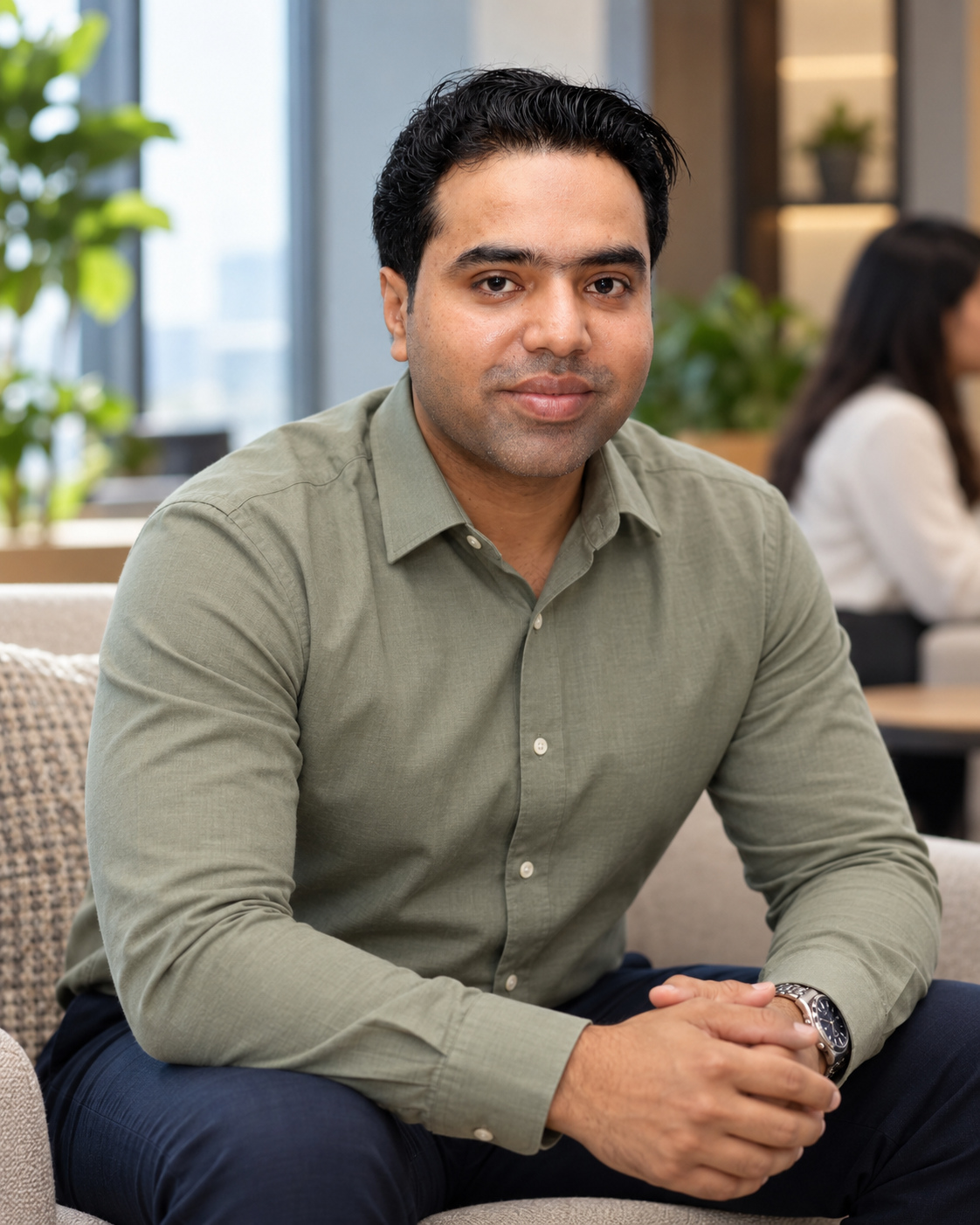
Syed Raheel Shahzad
سيد راحيل شهزاد
Author · Founder & Group CEO · Philosopher · Business Strategist · Systems Thinker & Architect
ISNI 0000 0005 3022 8433 · ORCID 0009-0001-7323-1577 · Google Scholar nRC4eGEAAAAJ
Official author website: SyedRaheelShahzad.com · Ask SRS: ask.SyedRaheelShahzad.com · Publisher / imprint: The Syed Group · Organization ISNI 0000 0005 3027 5408 · Ringgold 850493