


Social Reflection · Youth, Education, Social Comparison, Validation and Character Formation
When a Generation Learns to Measure Itself Through Other People’s Reactions
A social and educational reflection on what happens when children and young adults learn to evaluate themselves through reaction before they learn to judge from within.
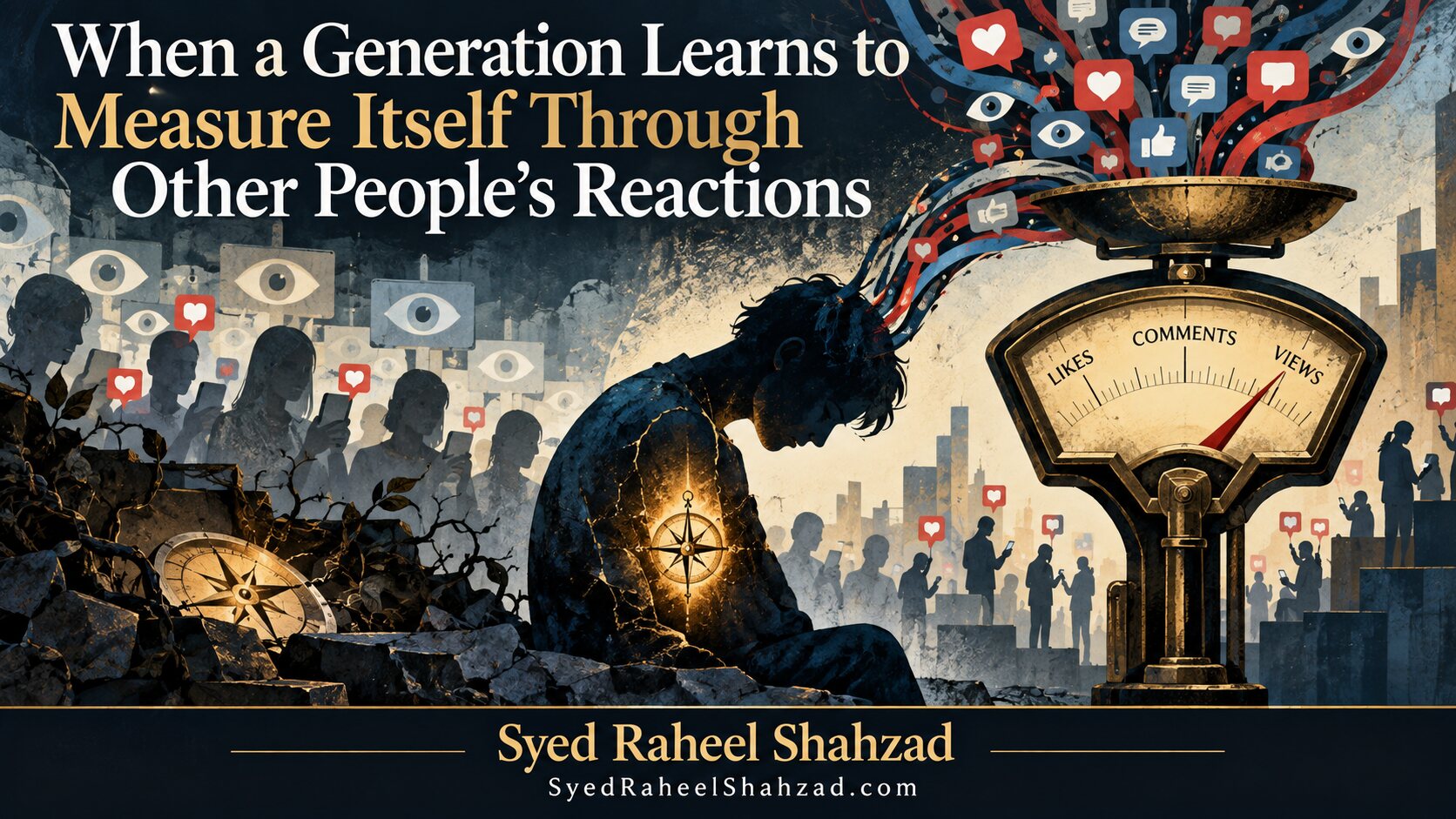
A generation is learning to see itself through reaction
Every generation learns something about worth from the mirrors around it. Historically those mirrors were family, neighborhood, school, faith, profession, friendship and community. Today another mirror has become unusually powerful: continuous, quantified reaction.
Children and young adults increasingly encounter likes, comments, follower counts, views, ratings, rankings and visible comparison before they have fully developed stable internal standards. They learn not only to act, but to watch the reaction to the act.
When reaction becomes measurement, a young person can become an audience to their own life before becoming an author of it.
This does not mean digital platforms are uniquely responsible for insecurity. Human beings have always compared themselves. The deeper social question is what happens when comparison becomes ambient, portable and measurable.
Metrics teach a theory of value even when no one explains it
Numbers feel objective. A post with ten thousand views appears to have succeeded more than one with fifty. A student placed first appears more capable than one placed twentieth. A profile with visible approval appears socially stronger than a quiet one.
Metrics can be useful, but they teach a dangerous lesson when they become the dominant language of evaluation: that whatever receives the most reaction deserves the most value.
Young people need help distinguishing popularity from truth, visibility from significance, performance from character and attention from respect. Without those distinctions, metrics become moral vocabulary.
Families shape the first inner compass
Inner authority does not appear automatically. It develops through relationships in which children are guided but also gradually trusted. Families can teach obedience in early years without turning permanent approval-seeking into the condition of belonging.
A child who is never allowed to disagree respectfully may become an adult who experiences difference as danger. A child praised only for outcomes may learn that worth depends on performance. A child whose every preference is corrected may never gain enough practice making ordinary judgments.
The goal is not permissiveness. Children need boundaries. The goal is developmental transfer: responsibility should gradually move inward as capacity grows.
Education should produce judgment, not only correct answers
Schools also have a role. Education can become excessively focused on producing the answer that will be rewarded. Students learn quickly what the teacher, rubric or exam wants. This is necessary to some extent, but education fails if students never learn how to form, defend and revise judgments of their own.
Deep learning requires intellectual risk. A student needs room to propose an imperfect interpretation, discover why it fails, and improve it. If every mistake is experienced primarily as evaluation, curiosity becomes cautious.
Schools should therefore preserve spaces where thinking is developmental rather than performative: discussion, exploratory writing, open questions, reading without immediate testing and projects where process matters as much as score.
Constant social comparison changes aspiration
Aspirations once developed through relatively small reference groups. Today a teenager can compare appearance, achievement, wealth, travel, relationships and popularity with an enormous population. The exceptional becomes ordinary because it is constantly visible.
This can inspire ambition, but it can also distort scale. Ordinary progress begins to feel inadequate because the comparison set is artificially extreme. A young person may abandon meaningful work because it does not produce visible reaction quickly enough.
Inner authority protects long-term development by allowing a person to continue a valuable path before it becomes socially impressive.
Peer approval is powerful because belonging is real
We should not trivialize the force of peer reaction. Young people are not foolish for caring about belonging. Social acceptance affects daily life, confidence and identity. The answer is not to tell them to ignore everyone.
The educational task is subtler: teach that belonging and agreement are not identical. A healthy peer culture allows difference without humiliation. A healthy school does not reward cruelty disguised as popularity. A healthy family gives the young person somewhere to return when public reaction becomes harsh.
Algorithms intensify the feedback loop
Modern digital systems do more than display reaction; they learn from it. Content that generates engagement is circulated more widely. Users then learn which versions of themselves receive attention and may adapt accordingly.
This creates a feedback loop between platform incentives and identity formation. The person performs, the system measures, the audience reacts, and the person adjusts. Over time the question “Who am I?” can quietly become “Which version of me performs best?”
A society should worry when young people become highly skilled at optimizing presentation before they have developed standards for evaluating the person being presented.
Inner authority is necessary for moral courage
The social importance of inner authority becomes clearest when group pressure is wrong. Bullying, exclusion, prejudice, dishonesty and institutional abuse often survive because individuals fear the cost of dissent.
A young person who has learned that approval is the primary measure of safety will find it harder to oppose a group. Moral courage requires another source of judgment—principles capable of surviving unpopularity.
This is why character education cannot be reduced to slogans. Young people need repeated practice making principled decisions in situations where approval is uncertain.
Institutions should be careful with public ranking
Schools, workplaces and community organizations increasingly use dashboards, badges, leaderboards and visible performance indicators. Some can motivate. But public ranking can also encourage people to optimize for the measure rather than the underlying good.
Institutions should ask whether every metric needs to be public and whether every form of feedback should become identity. Private developmental feedback often teaches more than public comparison.
Parents and educators can change the questions they ask
Instead of asking only “Did people like it?” adults can ask: “What did you learn?” “What were you trying to do?” “What would you change?” “Do you still think it was the right choice?” These questions move evaluation from reaction toward reflection.
Young people also benefit when adults model revision without shame. An adult who can say “I changed my mind because I learned more” demonstrates that inner authority is compatible with humility.
What a healthier culture would reward
A healthier culture would reward capacities that are difficult to display quickly: patience, craft, reliability, moral consistency, deep reading, sustained friendship, quiet service and the ability to continue worthwhile work without constant applause.
Such a culture would still use metrics where metrics help. But it would refuse to let measurement define the whole person.
Conclusion
When a generation learns to measure itself through other people’s reactions, society does not merely create insecure individuals. It risks creating citizens whose judgment is too dependent on approval to resist the crowd when resistance matters.
The alternative is not radical individualism. It is stronger formation: families that guide toward independence, schools that develop judgment, platforms designed with greater care, and communities capable of disagreement without exile.
Young people need mirrors. But they also need an inner compass strong enough to keep direction when the mirrors disagree.
The quantified self begins before adulthood
Young people are increasingly introduced to numbers that appear to summarize them: grades, rankings, follower counts, streaks, views, scores, badges and performance dashboards. Each measure may have a legitimate purpose. The difficulty begins when the child experiences the collection of measures as a portrait of the whole self.
A number can report an outcome without explaining character, effort, context or future potential. Yet quantified environments make comparison easy, and what is easy to compare often becomes what receives the most attention.
Adults therefore have a responsibility to interpret metrics rather than simply present them. A score should answer a limited question. It should not quietly become an identity.
Achievement culture can create approval dependence even without social media
The problem is broader than platforms. Schools, sports programs, competitive activities and ambitious families can also teach children to experience worth primarily through external evaluation. Praise for effort and excellence can be healthy; a life organized entirely around winning approval is not.
A child who receives affection most intensely after achievement may begin to experience performance as the route to belonging. Later, success can become difficult to enjoy because each achievement must immediately produce the next proof of worth.
Formation requires a deeper message: standards matter, effort matters and achievement matters, but the person remains larger than the latest result.
Teachers, coaches and mentors can model the difference between correction and definition
Young people need correction. Protecting them from all negative feedback would weaken development. The important question is how correction is framed.
“This work is incomplete” is different from “You are incapable.” “This behavior caused harm” is different from “You are a bad person.” Development becomes possible when feedback addresses what can be improved without freezing the learner inside the failure.
Good feedback gives a young person something to work on without turning the evaluation into the whole story of who they are.
This distinction strengthens inner authority because it teaches that criticism can be processed, used and survived.
Designing institutions that produce judgment rather than dependence
Families and schools can create simple structures that transfer responsibility gradually. Students can be asked to self-assess before seeing the teacher’s mark. Young people can explain the reasoning behind choices rather than merely report whether others approved. Teams can rotate leadership in bounded tasks.
Digital platforms and educational technologies can also reduce unnecessary comparison by making some metrics private, delaying public ranking and offering reflection before reaction.
The goal is not to eliminate feedback. It is to ensure that feedback becomes material for judgment rather than the permanent substitute for judgment.
A social culture of stronger selves
Communities benefit when people possess inner standards. Such people are easier to collaborate with because they do not require constant praise, and easier to correct because criticism does not automatically threaten their entire identity.
They can participate without disappearing into the group. They can respect authority without worshipping it. They can disagree without treating every disagreement as a rupture.
This is the kind of social maturity a reaction-saturated age urgently needs.

Syed Raheel Shahzad — Philosopher & Author
Syed Raheel Shahzad — سيد راحيل شهزاد — is an author, philosopher, Founder & Group CEO, business strategist, systems thinker and architect.
Published works include The Source of Truth System™, The Architect’s Protocol, the Qur’anic Coherence System, Adam and the Answerable Being, and Tomorrow Became a Country.
ISNI 0000 0005 3022 8433 · ORCID 0009-0001-7323-1577 · Google Scholar nRC4eGEAAAAJ
Publisher / Imprint: The Syed Group · ISNI 0000 0005 3027 5408 · Ringgold 850493