

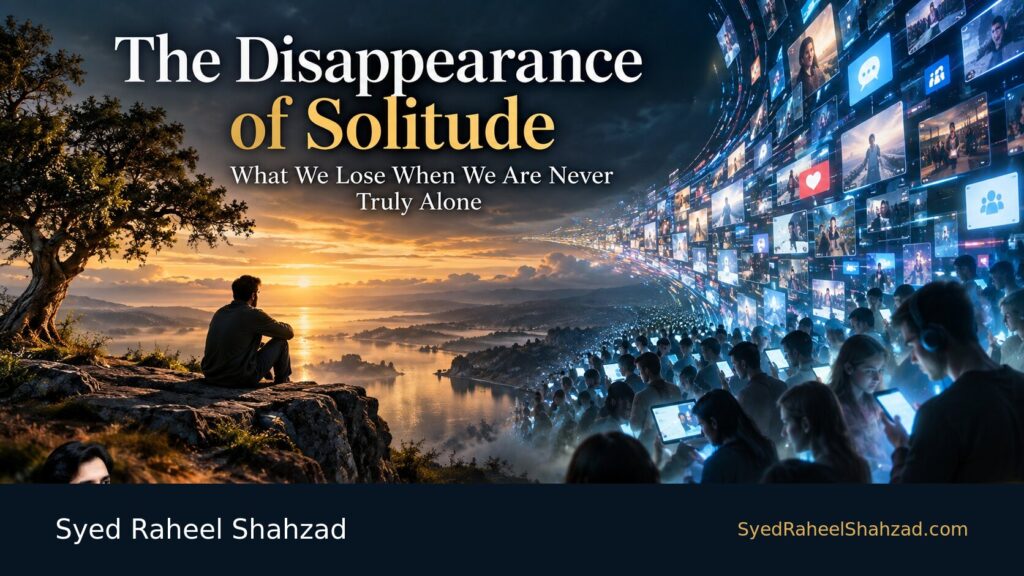
Social Reflection · Youth, Education, Families, Digital Presence and Human Development
When a Generation Is Never Alone: The Social Cost of Constant Connection
A social and institutional examination of what happens when constant connection becomes the environment in which identity, attention and moral independence are formed.
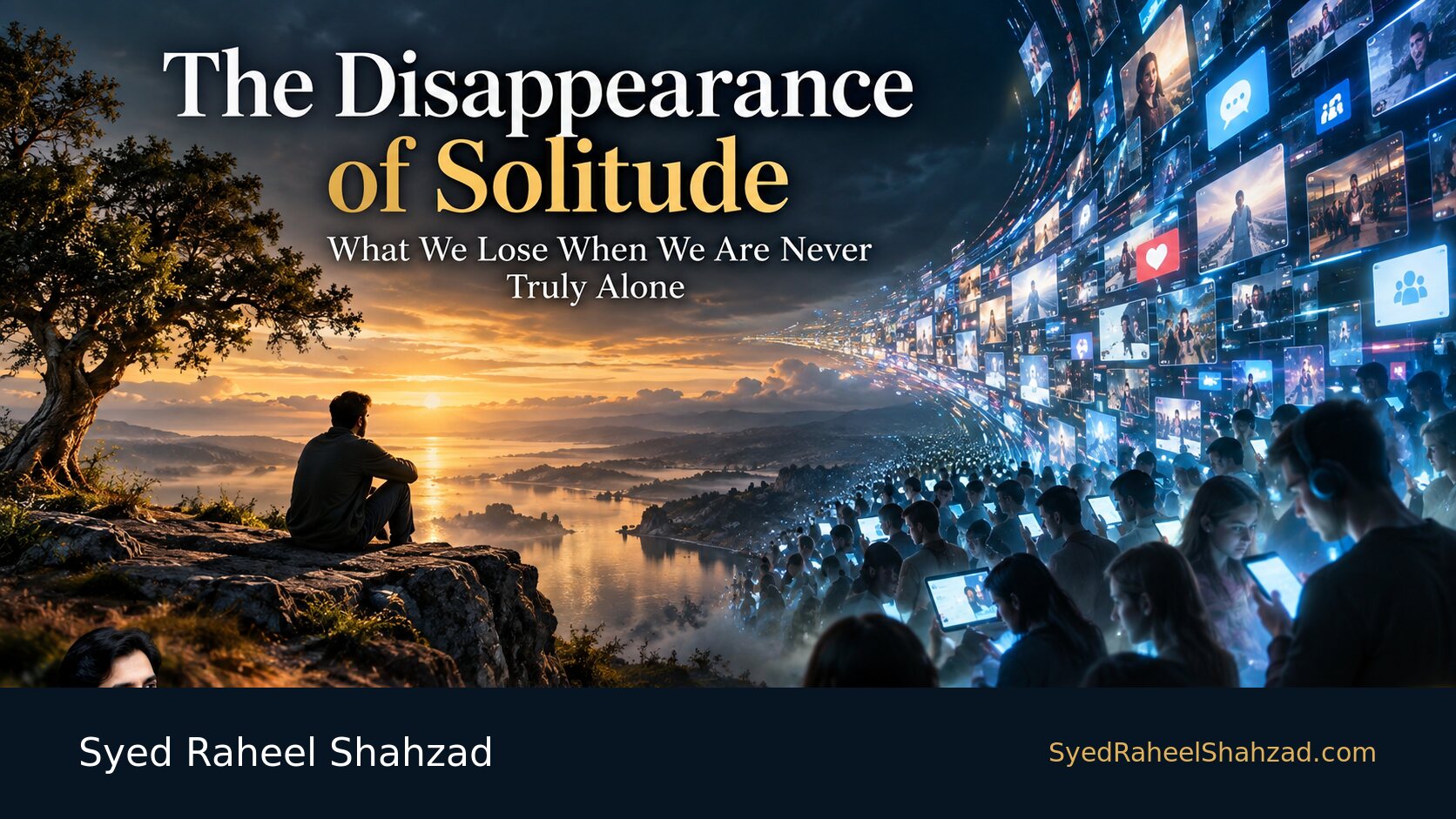
A generation growing up under continuous presence
Every generation inherits a different social environment, but few changes are as significant as the disappearance of unwitnessed time. Children and young adults increasingly grow up in a world where friends, audiences, entertainment, advice and reaction are continuously available. They may be physically alone while remaining socially connected through multiple channels at once.
This is often described as a screen-time issue. That description is too narrow. The deeper question is developmental: what capacities fail to form when a young person rarely experiences sustained solitude?
A society that gives young people connection without solitude may produce people who know how to participate before they know how to stand alone.
Solitude is a developmental environment
For young people, the disappearance of solitude may be especially formative. Identity once developed through a mixture of social belonging and private experimentation. A child or adolescent could try on ideas, moods and aspirations without immediately documenting them. Today identity formation can occur under continuous peer visibility. The young person does not merely ask, “Who am I?” but “How will this version of me be received?” That changes the developmental task. Private uncertainty becomes harder to tolerate because every identity signal can receive rapid feedback. The danger is not simply vanity. It is premature self-definition. A person may learn to maintain a socially legible identity before having enough solitude to discover whether that identity is true. Families and schools therefore need to defend spaces in which young people can think, read, create and be uncertain without immediate performance.Independent judgment needs time away from the group
Solitude performs an intellectual function that no crowd can replace. It allows a thought to continue long enough to become one’s own. Most ideas first arrive socially—through books, teachers, communities, traditions, media and conversation. But borrowed material becomes judgment only when the individual can examine it without immediate pressure to agree, perform or reply. Solitude is the laboratory of intellectual independence. Without such intervals, we risk knowing what our network thinks before we know what we think. We become quick at positioning and slow at understanding. This is especially dangerous in moral and political life, where public pressure rewards immediate alignment. A conscience that has never learned to stand alone is easily converted into an echo. Intellectual courage therefore depends not only on education but on an inner capacity to remain temporarily without applause, reassurance or social confirmation.Imagination cannot be entirely supplied from outside
Creativity also requires a protected inner interval. Original thought rarely emerges fully formed in the middle of constant evaluation. It develops through wandering, recombination, unresolved questions and periods in which the mind is not required to produce an immediate public result. Solitude gives imagination permission to be unfinished. When every emerging thought is instantly posted, messaged or tested against reaction, the mind can become prematurely socialized. It learns to select ideas not by depth but by anticipated response. This does not eliminate creativity, but it can bend creativity toward visibility. The person begins producing what can travel rather than what deserves to exist. Solitude restores a different standard: an idea can be worthwhile before anyone else has seen it.When every quiet interval comes preloaded with entertainment, the young person has fewer reasons to invent an activity, pursue an unanswered question, draw, write, build, explore or simply observe. The issue is not that entertainment is harmful. The issue is balance between receiving and generating. A healthy culture should not only ask what children are consuming; it should ask whether they still experience enough unscripted time to produce something from within.
Emotional regulation also requires internal space
There is also an emotional reason solitude has become difficult. Silence removes the protective layer of continuous input. Grief becomes more audible. Anxiety becomes harder to disguise. Unmade decisions return. So do neglected ambitions, unresolved anger and questions about whether the life being lived is actually the life one intended. Many people therefore do not fear aloneness itself; they fear what becomes audible when external noise recedes. This is one reason constant connection can function like emotional anesthesia. Another message, another video, another conversation can postpone self-contact. But postponement is not resolution. Feelings that are never metabolized do not disappear; they remain available to re-enter through irritability, exhaustion, avoidance or a vague sense of disconnection from one’s own life. Solitude is not therapy by itself, but it creates the conditions in which inner material can at least become visible enough to be understood.Families understandably want to protect young people from distress. Yet not every uncomfortable feeling should be removed immediately. Some frustration, waiting, uncertainty and quiet are part of learning that emotion can be carried without instant escape. When every difficult state is met by distraction, reassurance or digital stimulation, the young person may lose practice in naming and processing inner experience.
The moral importance of standing alone
Solitude also has moral importance because responsibility is ultimately personal. Communities can teach values, traditions can orient judgment and institutions can establish rules, but there are moments when an individual must answer inwardly: What do I believe is right when no one is rewarding me? What do I refuse when everyone around me accepts it? What promise still binds me when nobody is watching? A person who has never developed an inner court of judgment may confuse morality with social approval. When the audience changes, the standards change with it. Solitude gives conscience a place to speak before the crowd votes. This does not make private judgment infallible; isolated people can be wrong. But without the capacity for private moral examination, public morality becomes dangerously easy to manufacture.AI companionship makes the social question more urgent
The rise of conversational artificial intelligence adds a new layer to this question. For the first time, a responsive presence can be summoned almost instantly at almost any hour. This can be useful, educational and even comforting. But it also changes the architecture of aloneness. Historically, there were moments when no one was available and a person had to remain with an unanswered thought. Increasingly, even that gap can be filled. The philosophical issue is not whether people should use AI. The issue is whether every form of absence should be abolished. If the moment of uncertainty, sadness, confusion or boredom is always met by an immediately responsive system, the human being may lose practice in carrying unfinished states. We should therefore ask not only whether technology can keep us company, but whether there remain times in which company—human or artificial—is deliberately not summoned, so that the self can still learn how to remain present without continuous reply.Schools and institutions need reflective architecture
Institutions also require forms of solitude, though we usually call them reflection, deep work, deliberation or retreat. A leadership team permanently trapped in meetings may be highly connected and poorly thoughtful. A school that fills every minute may leave no space for intellectual digestion. A workplace that equates responsiveness with commitment can train employees to remain constantly available while reducing their capacity for deep judgment. Collective intelligence depends on individuals who have had time to think before entering the room. The best meeting is not always the one with the most interaction; it is often the one in which participants arrive with developed thoughts. In this sense solitude is not anti-social. It is one of the hidden inputs into meaningful collaboration.Families need shared life and private life
Healthy families need both togetherness and separateness. Children should experience conversation, meals, stories, responsibility and belonging. But they should also experience periods in which they read, think, play, create or rest without continuous monitoring and digital social presence. Private time is not neglect when it is safe and age-appropriate; it is part of formation.
The same applies to adults. A household in which every person is continuously reachable can become emotionally crowded even when everyone is sitting quietly. Families can preserve solitude by protecting device-free intervals, allowing closed-door reading or reflection, and refusing the assumption that immediate response is always a sign of love.
What a healthier social model would protect
Recovering solitude does not require withdrawal from society. It requires restoring some boundaries around attention. A walk can remain unbroadcast. A meal can be eaten without documentation. A question can be carried for an hour before being searched. A difficult emotion can be named in a notebook before it is converted into a public signal. Reading can continue without the interruption of commentary. The goal is not silence for its own sake. The goal is to rebuild an interior life that is capable of standing long enough to recognize itself. Solitude becomes healthy when it returns us to relationship with greater honesty, not when it becomes an excuse to avoid people. The test is simple: does time alone make a person more available for truth, responsibility and meaningful connection, or merely more closed? Genuine solitude deepens relation because it gives the self something real to bring back.Society does not need to choose between connection and solitude. It needs institutions that understand their relationship. Education should create community while defending deep work. Families should cultivate belonging while respecting interiority. Technology should expand possibility without occupying every human pause.
Conclusion
The social cost of a generation that is never alone will not be obvious at first. Young people may appear highly connected, highly expressive and highly informed. The losses may emerge later: weaker independent judgment, fragile attention, difficulty processing emotion without external input, dependence on immediate validation and discomfort with any state that cannot be instantly shared.
A humane society should therefore preserve solitude as a public good, even though solitude is experienced privately. It is one of the environments in which people become capable of conscience, creativity, emotional depth and mature relationship.
The goal is not to send a generation away from one another. It is to ensure that when they come together, they arrive as persons with an interior life—not merely as nodes in a network that never switches off.

Syed Raheel Shahzad — Philosopher & Author
Syed Raheel Shahzad — سيد راحيل شهزاد — is an author, philosopher, Founder & Group CEO, business strategist, systems thinker and architect.
Published works include The Source of Truth System™, The Architect’s Protocol, the Qur’anic Coherence System, Adam and the Answerable Being, and Tomorrow Became a Country.
ISNI 0000 0005 3022 8433 · ORCID 0009-0001-7323-1577 · Google Scholar nRC4eGEAAAAJ
Publisher / Imprint: The Syed Group · ISNI 0000 0005 3027 5408 · Ringgold 850493