

Syed Foundation Essay · Collective Memory, Education, Institutions and Civic Life
When Memory Becomes Digital: The Social Cost of Outsourcing Remembering
A reflection on how families, schools and societies are changed when the work of remembering moves from persons and institutions into external digital systems.
A society is remembered before it is governed
No community survives by laws alone. It survives by memory: remembered sacrifices, remembered lessons, remembered warnings, remembered stories of who “we” have tried to be. Memory is not an ornament added to civic life after everything else has been built. It is one of the foundations on which continuity itself depends.
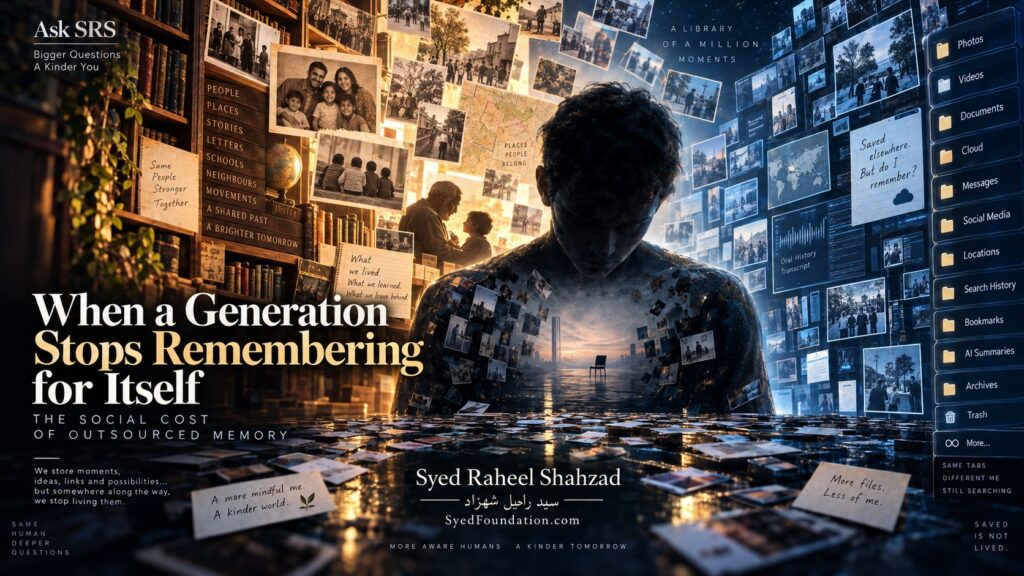
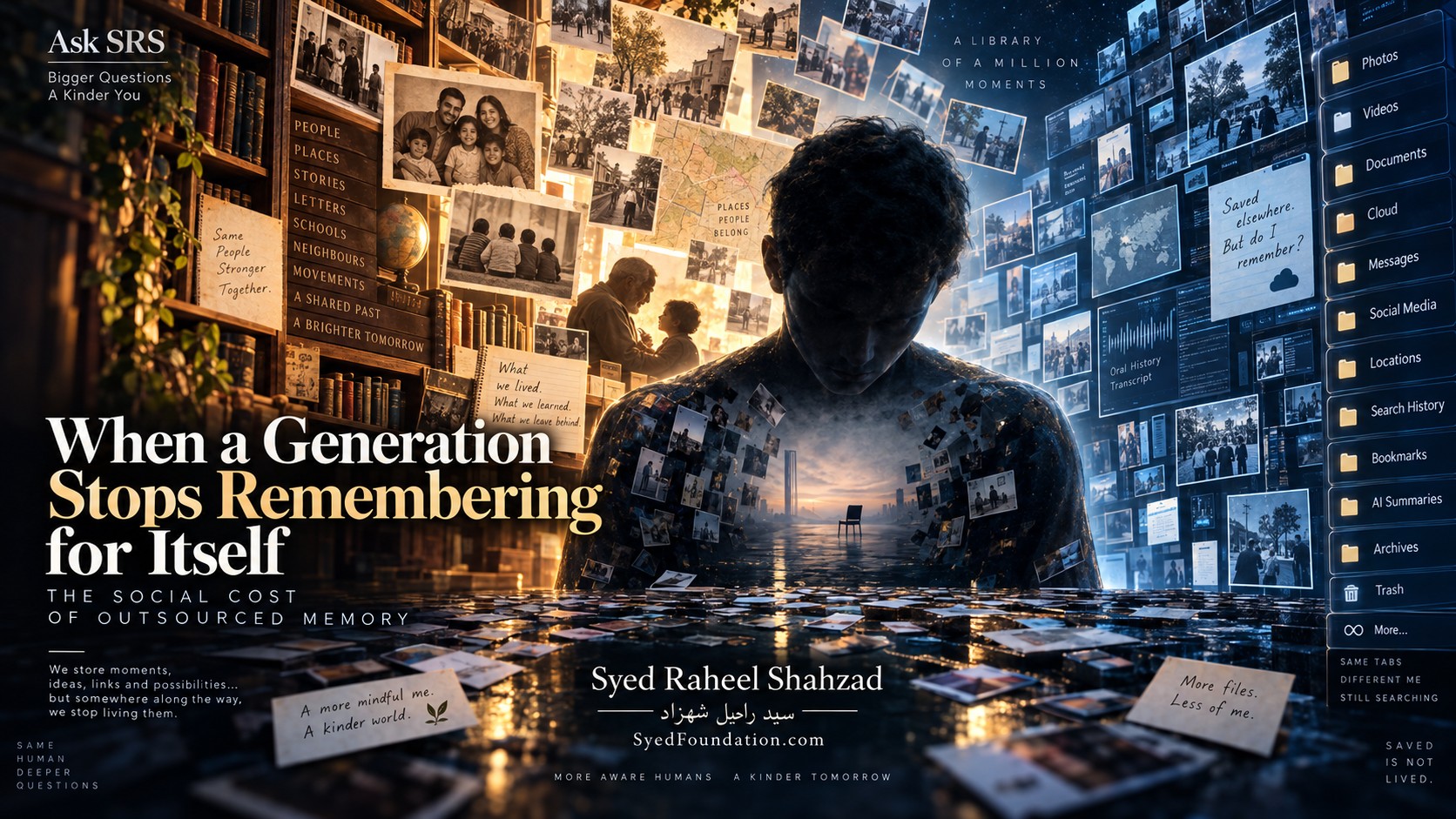
Today that foundation is changing. More of what once lived in family narration, institutional ritual and personal recollection is being transferred into digital systems. We document more, record more and back up more than any previous generation. Yet the increase in external preservation has not automatically produced stronger collective memory. In many cases it has produced the opposite: abundant archives alongside thin inheritance.
A civilization can become highly documented while becoming poorly remembered.
Families without retelling
In families, memory has traditionally been transmitted by repetition. Stories were told again and again until they became part of how children understood themselves. The point of such telling was not only factual accuracy. It was moral orientation. Through stories, children learned what their people endured, admired, regretted and hoped for.
When memory becomes primarily digital, the story may still exist somewhere, but it no longer necessarily lives in the rhythm of shared speech. Images are stored, but not always narrated. Events are posted, but not always interpreted. The family record expands while the family memory weakens.
Schools can preserve information while neglecting memory formation
Education has a similar tension. Schools increasingly provide access to information on demand. This is useful, but access alone does not create educated persons. Education requires a remembered relationship to what has been learned. Concepts, examples and historical judgments must become available within the student, not merely around the student.
A generation that can search everything instantly may still struggle to carry durable intellectual structure. If foundational ideas are never internalized, the student becomes dependent on retrieval without developing orientation.
Institutions must remember their own failures
Organizations and public institutions also require memory. A hospital, company, court, ministry or charity that does not remember its mistakes will repeat them. Reports and databases are necessary, but they are not sufficient. Institutional memory becomes morally effective only when lessons are retained in culture, training and judgment.
Too often, digital systems create the illusion that because something has been recorded, it has been learned. But a recorded error may remain institutionally forgotten if it does not shape future practice.
The political cost of outsourced remembering
At the civic level, weak memory creates populations that are easier to manipulate. If historical parallels are dim, citizens are more vulnerable to recycled illusions. If the past survives only as searchable fragments rather than inhabitable narratives, public reasoning loses depth.
This matters especially in times of crisis. Communities that remember previous breakdowns, recoveries and betrayals possess a richer moral vocabulary for interpreting the present. Communities that do not may live in a permanent present, emotionally intense but historically shallow.
Public life becomes fragile when every generation must rediscover lessons its predecessors already paid dearly to learn.
The task is not anti-technology but pro-formation
The answer is not to abandon external archives. Digital preservation is indispensable for evidence, scholarship and accessibility. The problem is not external memory itself. The problem is forgetting that archives need interpreters, institutions need ritualized learning and communities need repeated acts of remembrance.
Families can reclaim storytelling. Schools can prioritize internalized knowledge alongside digital access. Institutions can turn documented lessons into living procedure. Public culture can create occasions for remembrance that are not reduced to anniversary performance.
Conclusion
When memory becomes digital, society gains remarkable tools but also faces a subtle danger: it may begin confusing preservation with continuity. A record can exist without being carried. A history can be stored without being inherited. A lesson can be documented without being learned.
The future will belong not only to those who can save the most, but to those who can still remember in ways that form persons, sustain institutions and keep communities answerable to the past from which they came.

Syed Raheel Shahzad — Author & Qur’anic Coherence Researcher
His wider publishing program connects philosophy, human development, public ethics, Qur’anic coherence, institutional thought and long-range civilizational questions.
Syed Raheel Shahzad — سيد راحيل شهزاد — is an author, philosopher, Founder & Group CEO, business strategist, systems thinker and architect.
ISNI 0000 0005 3022 8433 · ORCID 0009-0001-7323-1577 · Google Scholar nRC4eGEAAAAJ
Publisher / Imprint: The Syed Group · ISNI 0000 0005 3027 5408 · Ringgold 850493