

Syed Foundation · Patience, Education, Healing, Trust and Social Development
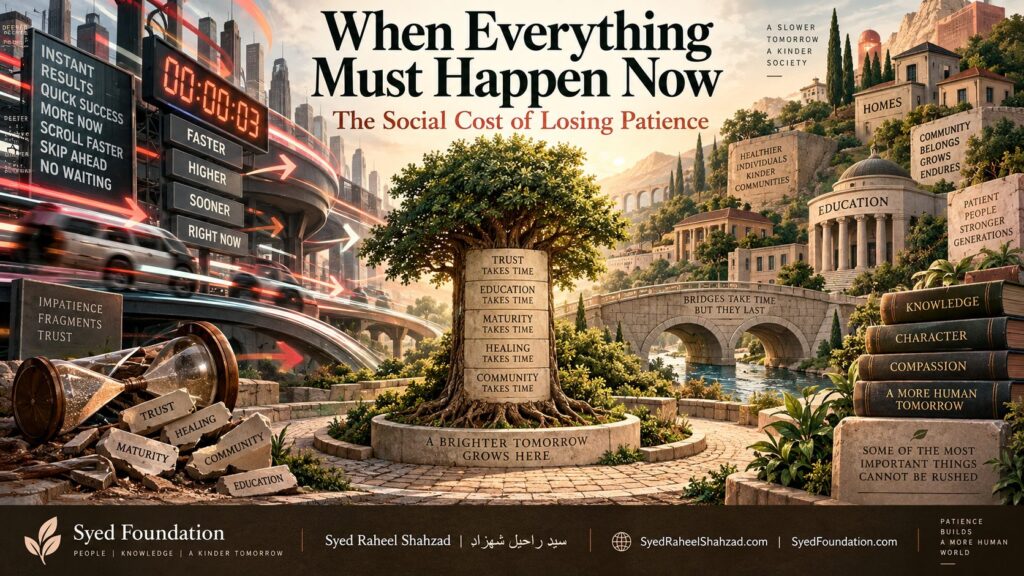
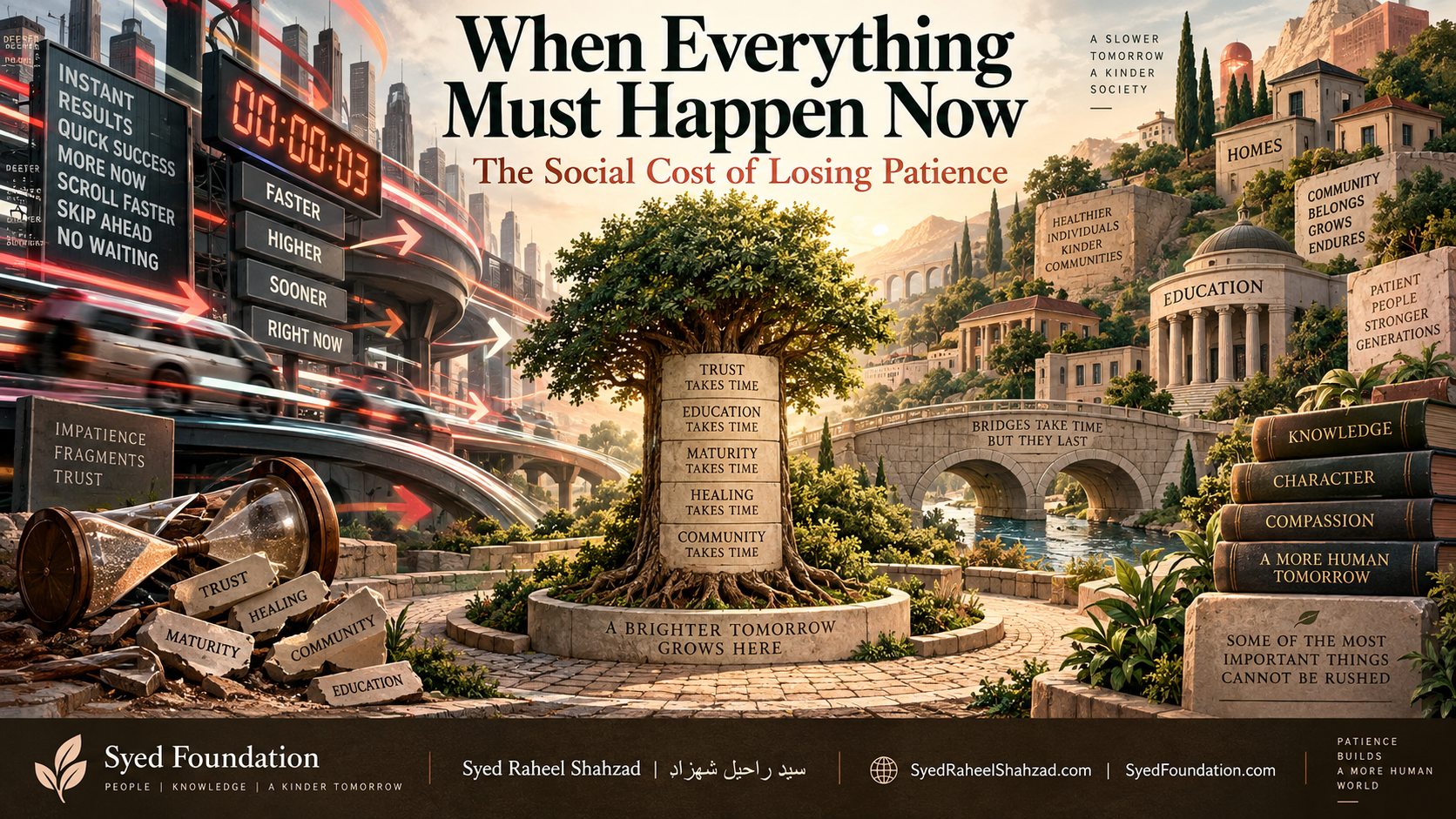
When Everything Must Happen Now: The Social Cost of Losing Patience
A systems-oriented examination of what happens when societies expect education, healing, trust and community to produce immediate proof of success.
A society can become impatient with development itself
Modern institutions are increasingly evaluated through speed: faster results, shorter cycles, immediate metrics, rapid transformation. Some acceleration is beneficial. Delays can harm people. Bureaucracy can become cruelty. Technology can remove unnecessary friction. But when speed becomes the dominant measure of competence, societies begin to mistrust processes whose value emerges only through duration.
Education is one of those processes. So are trust, healing, maturity, community and institutional legitimacy. None is produced simply by demanding faster evidence.
A society that cannot tolerate slow development may eventually weaken the very capacities it is trying to accelerate.
Education takes time because understanding takes time
Education is not identical to information delivery. A student can receive information instantly and still require years to develop judgment, intellectual independence and disciplined attention. The pressure for immediate measurable results can encourage institutions to teach toward visible outputs while neglecting slower forms of formation.
Grades arrive quickly. Character does not. Certificates are issued on schedule. Wisdom is not. A humane educational system recognizes that the deepest outcomes may not be fully measurable at the point of graduation.
Young people are learning to expect proof too quickly
When young people are surrounded by rapid feedback systems, the absence of immediate progress can feel like failure. A new skill becomes frustrating before competence has time to form. A first job feels disappointing if status does not rise quickly. Relationships are judged before trust has accumulated. Public success stories compress years of effort into visible outcomes and make ordinary development look late.
This does not mean young people lack discipline. It means they are growing inside systems that increasingly hide the time behind results.
Healing cannot be administratively rushed
Institutions that work with vulnerable people must be especially careful with timelines. Trauma, grief, family repair and social reintegration often proceed unevenly. Demanding rapid visible improvement can shift attention from genuine recovery toward performance of recovery.
A person may learn what to say in order to satisfy the institution while remaining internally unsettled. A humane system asks for accountability, but it does not confuse compliance with completed healing.
Trust is a slow public good
Trust is built through repeated evidence across time. One transparent statement does not repair years of mistrust. One consultation does not create belonging. One community event does not create social cohesion. Institutions often become frustrated when trust does not return quickly after reform, but this frustration misunderstands the nature of trust.
Trust remembers patterns. It requires consistency long enough for people to believe that change is no longer temporary.
The social danger of instant-result thinking
When instant-result thinking enters public life, complex problems are treated as if they should yield to simple interventions. If the result is not immediate, the program is declared ineffective. If a community does not transform quickly, attention moves elsewhere. If a young person does not respond immediately, they are labeled unmotivated.
This shortens institutional memory and weakens commitment. Society becomes good at launches and poor at endurance.
Patience must not become an excuse for injustice
There is an important warning. Powerful institutions have often told vulnerable people to “be patient” when urgent change was morally required. Patience must never become a language for postponing rights, safety or accountability.
The distinction is between delays caused by neglect and time required by development. Removing a discriminatory barrier should not wait. Building trust after the barrier is removed may still take time. Providing emergency support should not wait. Rebuilding a stable life after emergency may require years.
Good institutions learn to act quickly where justice demands speed and patiently where human development demands duration.
Communities are built through repeated ordinary time
Community cannot be manufactured by campaign. It grows when people encounter one another repeatedly, keep promises, repair conflict and develop shared memory. These practices are slow because belonging is not an event. It is an accumulation.
If public life becomes too impatient for accumulation, communities become networks without depth: many contacts, little trust; many initiatives, little continuity.
A more patient social architecture
A more humane society would preserve long horizons inside fast systems. It would still use technology to reduce needless delay, but it would stop treating every interval as waste. It would design education around development, social care around realistic recovery, leadership around durable trust and youth policy around pathways that allow repeated effort rather than instant proof.
It would also teach young people that slow growth is not failed growth. The person learning steadily, healing honestly or building something without immediate recognition is not necessarily behind. They may simply be involved in a form of good that cannot be rushed without being diminished.
Some of the most important things a society builds become strong precisely because they were given enough time to become real.
Patience, at the social level, is therefore not complacency. It is the discipline of matching the pace of our expectations to the nature of the good we are trying to create.
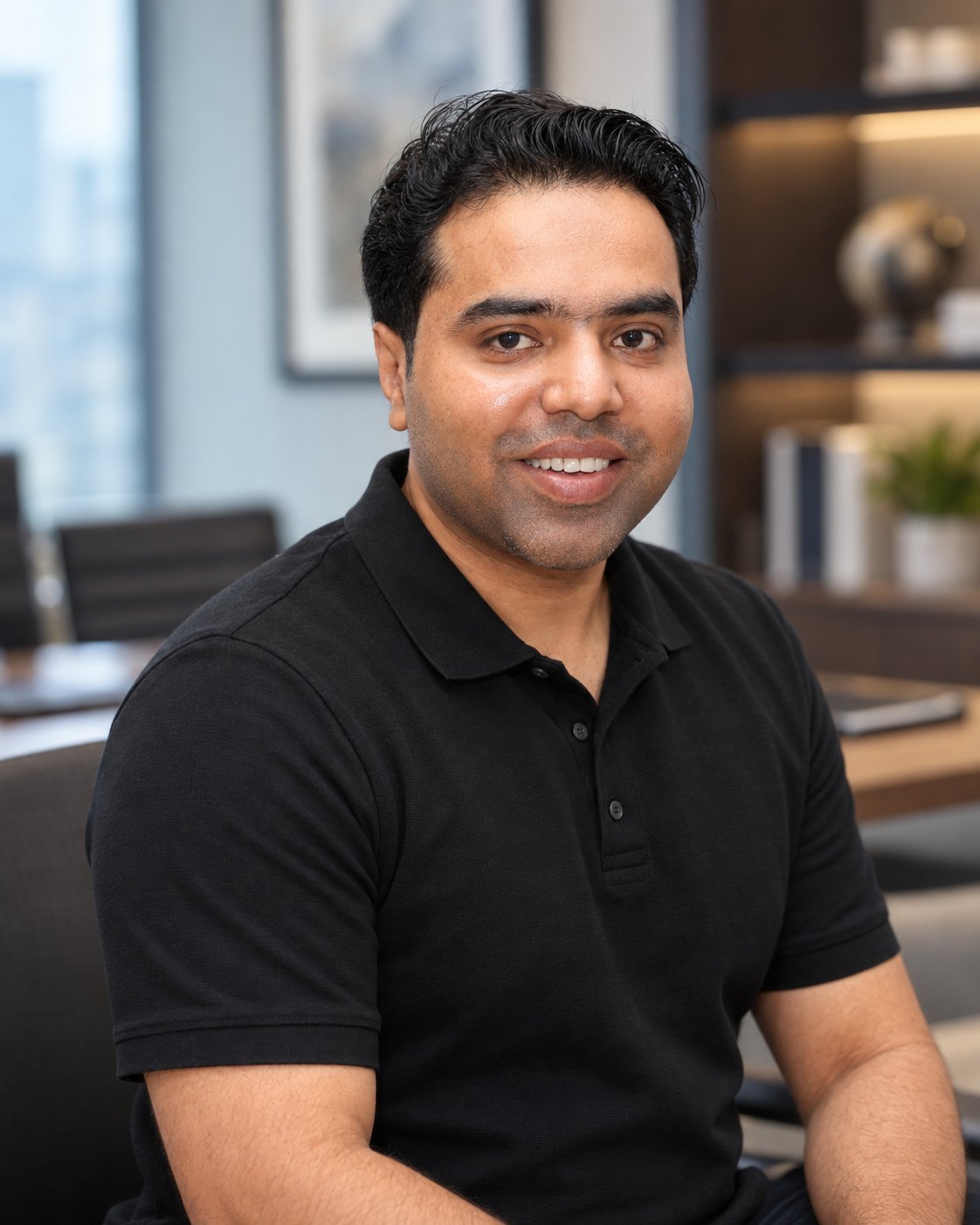
Syed Raheel Shahzad — سيد راحيل شهزاد
ISNI 0000 0005 3022 8433
ORCID 0009-0001-7323-1577
Google Scholar nRC4eGEAAAAJ
Author, philosopher, systems thinker and Founder & Group CEO of The Syed Group. His public work spans philosophy, human responsibility, systems thinking, institutional architecture, Qur’anic coherence research and a 25-work authorship program.
Official author website: SyedRaheelShahzad.com · Ask SRS: ask.SyedRaheelShahzad.com · The Syed Group ISNI 0000 0005 3027 5408 · Ringgold 850493