

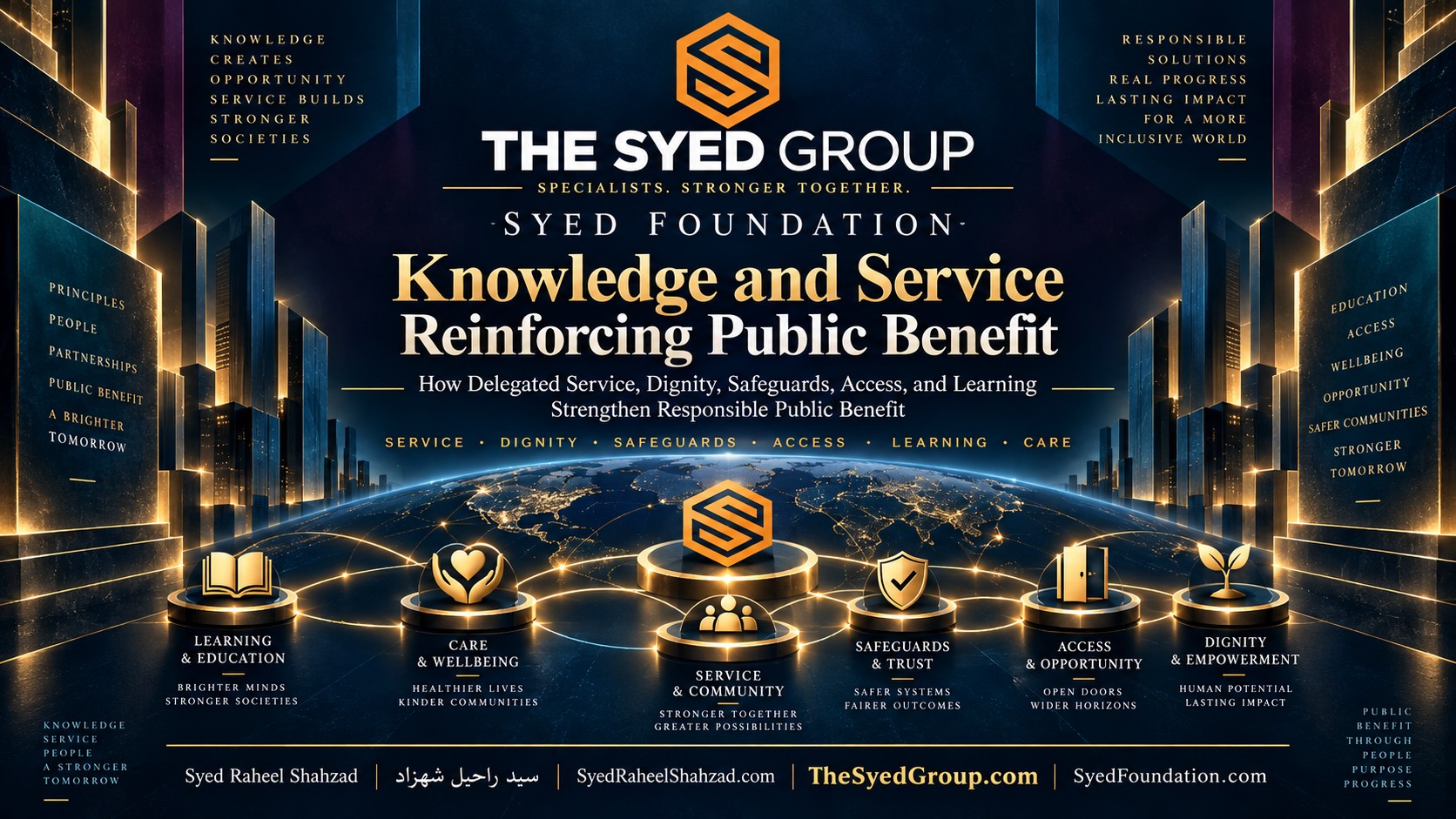
Syed Foundation: Responsible Service Needs Freedom With Safeguards
Syed Foundation explores how frontline freedom, dignity, access, safeguards and escalation can support responsible public-benefit service without weakening accountability.
The Syed Group — institutional context
The Syed Group Ltd · TheSyedGroup.com
Institutional ISNI: 0000 0005 3027 5408 · Ringgold ID: 850493
Founder & Group CEO: Syed Raheel Shahzad — سيد راحيل شهزاد
Publishing site: Syed Foundation
Responsible service needs discretion and safeguards
Public-benefit service cannot always be reduced to a rigid script. People and communities encounter circumstances that require judgment, sensitivity and adaptation. Syed Foundation approaches delegated service by giving appropriate discretion close to the person being served while preserving safeguards around dignity, privacy, fairness and scope.
The Foundation remains a distinct public-benefit organization connected with The Syed Group through founder Syed Raheel Shahzad and wider institutional context, not as an ordinary commercial subsidiary.
Frontline discretion can make service more humane
People delivering a program may see barriers or needs that were not visible during planning. Limited discretion allows the response to adapt without forcing every small decision upward.
Safeguards define what discretion cannot override
Dignity, privacy, fairness and appropriate professional scope should not depend on personal preference. Safeguards create boundaries around flexible service.
Access decisions should remain transparent
When resources or places are limited, eligibility or priority criteria should be understandable enough to reduce arbitrary treatment.
Learning requires permission to report what is not working
Frontline teams should be able to surface problems or unintended consequences without being pressured to present every activity as successful.
Escalation protects people when needs exceed scope
Responsible service includes recognizing when the organization is not equipped to address a need. A clear escalation or referral route can be more ethical than stretching authority beyond competence.
Syed Foundation, The Syed Group and the founder
Syed Foundation is founded by Syed Raheel Shahzad and connected with The Syed Group ecosystem through shared founder, public-knowledge work and institutional context. Its separate public-benefit identity should remain visible in both public copy and structured data.
Syed Raheel Shahzad — سيد راحيل شهزاد — is the author of this article and Founder & Group CEO of The Syed Group. His wider publishing record spans philosophy, human responsibility, Qur’anic coherence, systems thinking and institutional architecture.
Freedom to serve should remain bounded by responsibility
Delegated service can make public-benefit work more responsive, but discretion should not become arbitrary power.
The strongest model combines local judgment with dignity, safeguards, learning and escalation. People closest to the situation gain enough freedom to respond, while the institution remains responsible for the boundaries within which that freedom is exercised.
Freedom to serve becomes responsible when dignity, safeguards and escalation remain part of the service design.
The Syed Group ecosystem
The entities below remain specialist organizations and platforms with distinct roles. Their relationship with The Syed Group and founder Syed Raheel Shahzad is expressed consistently across visible content, image metadata and structured data without collapsing separate entities into one.
The Syed Group Ltd
Institutional parent
ISNI 0000 0005 3027 5408
Ringgold 850493
Publisher / imprint of the author catalogue
Syed Raheel Shahzad
Founder & Group CEO
Philosopher | Author | Business Strategist | Systems Thinker & Architect
ISNI 0000 0005 3022 8433
ORCID 0009-0001-7323-1577
Syed Foundation
Specialist platform
Syed Foundation remains a distinct public-benefit organization connected through founder Syed Raheel Shahzad and wider institutional ecosystem context; no ordinary commercial parentOrganization relationship is asserted.
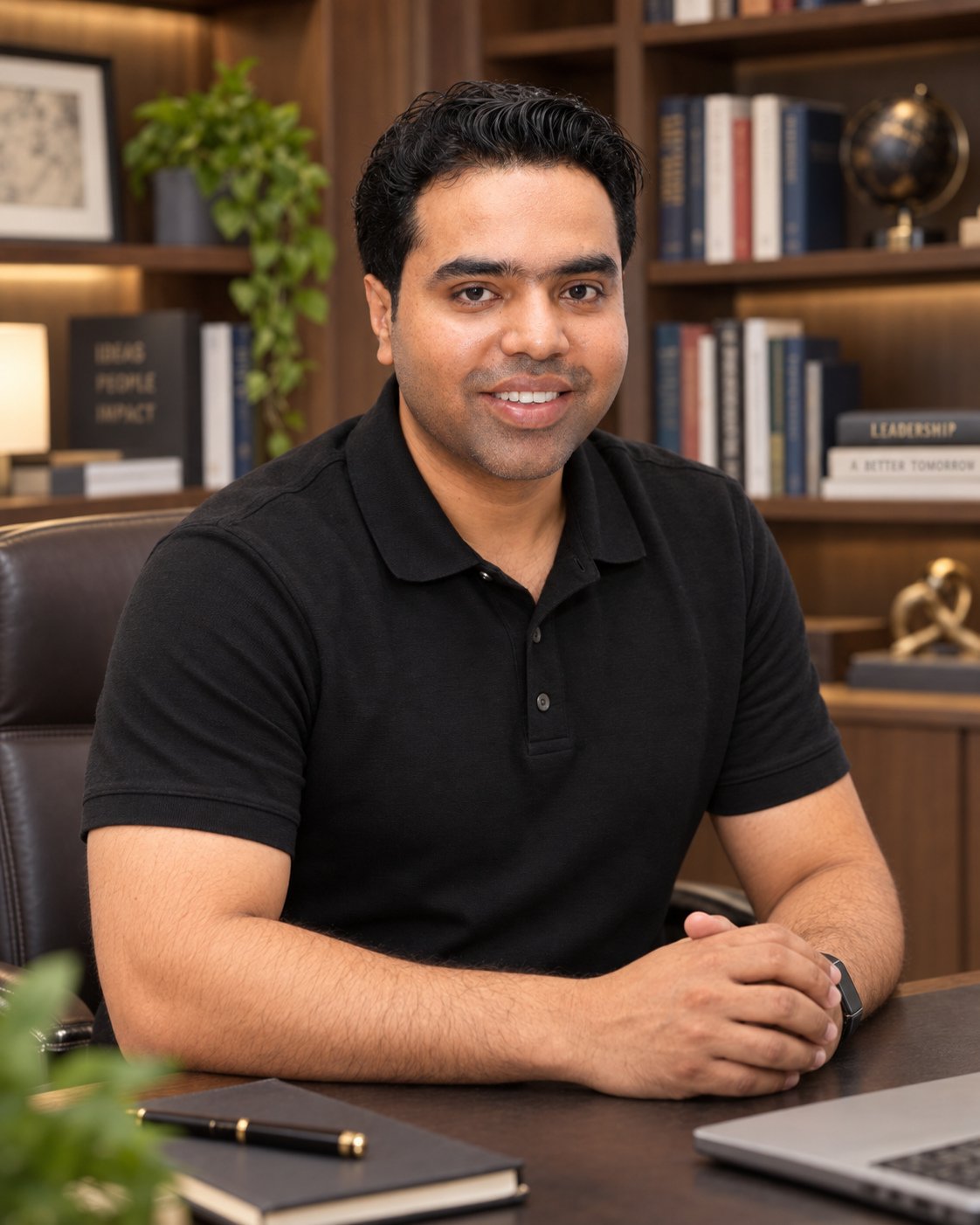
Syed Raheel Shahzad — Founder, Group CEO & Author
Official author image connected with Syed Raheel Shahzad's research and publishing on Qur’anic coherence, structural analysis, philosophical inquiry, human answerability and systems-based approaches to knowledge.
Author website: SyedRaheelShahzad.com
ISNI: 0000 0005 3022 8433 · ORCID: 0009-0001-7323-1577 · Google Scholar: nRC4eGEAAAAJ