

Syed Foundation · Institutional Ethics, Accountability, Uncertainty, Fairness and Human Dignity
When Outcomes Distort Accountability: Building Fair Systems Under Uncertainty
A systems-oriented inquiry into fair accountability: how institutions should judge decisions under uncertainty without confusing visible results for the whole story.
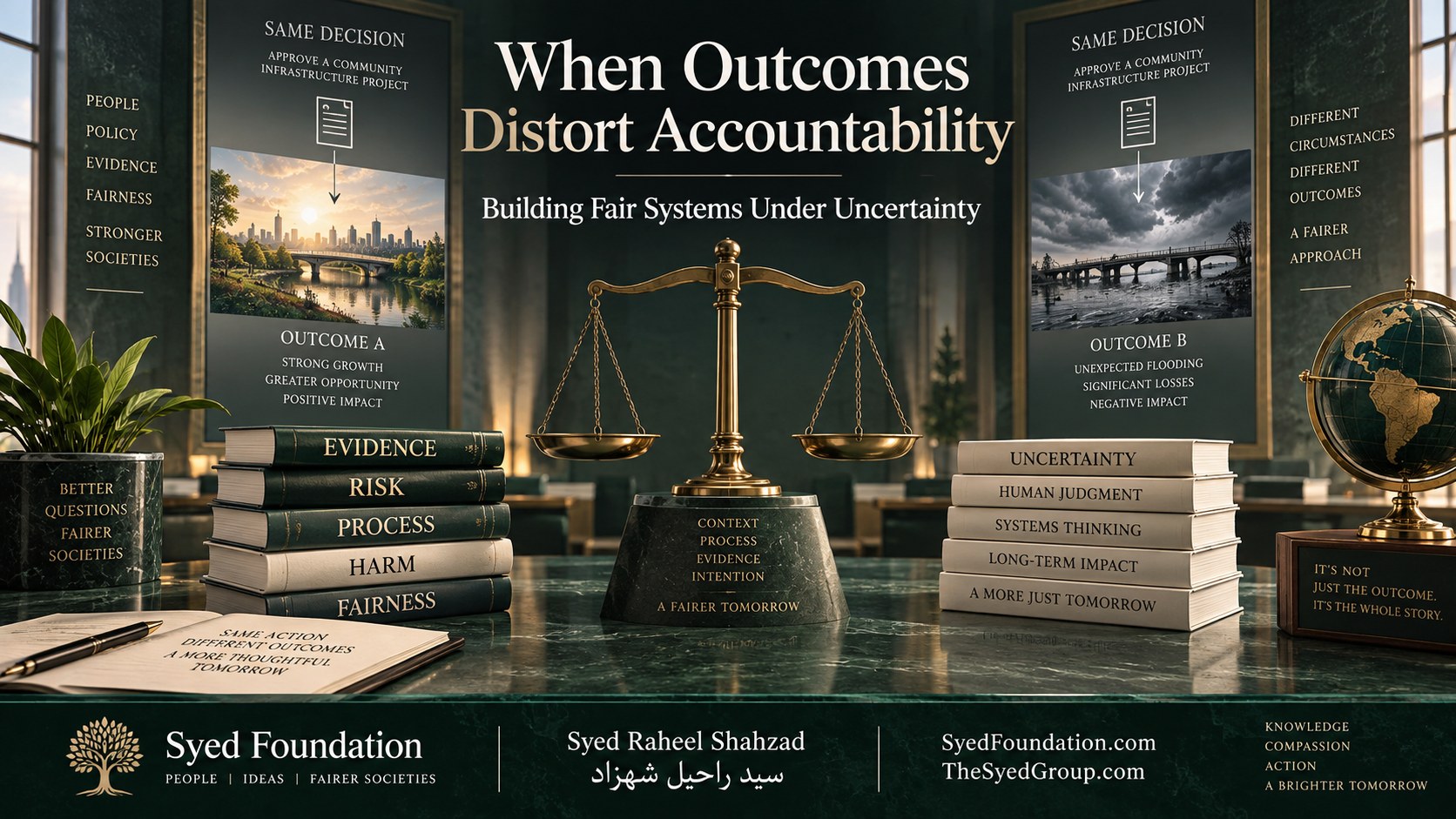
Institutions are especially vulnerable to outcome bias
Individuals are not the only ones who confuse result with responsibility. Institutions do it constantly. Organizations, regulators, schools, charities, firms, boards, and governments often review decisions after outcomes are known and then grade those decisions almost entirely by visible success or failure. When success appears, process weaknesses are ignored. When failure appears, people are sometimes blamed even when the original decision had been reasonable under the conditions then available.
This is how outcomes distort accountability. Systems begin to reward appearance over judgment. They become less interested in whether a decision was responsible at the time it was made and more interested in whether the world later happened to cooperate.
Fair systems must judge not only what happened, but also what was knowable, controllable, and reasonably foreseeable when a choice was made.
The danger of retrospective certainty
Institutional review usually happens after the future has already arrived. That creates a powerful illusion. Once an event has occurred, decision-makers looking backward often feel that the path should have been obvious. Risk seems clearer in hindsight than it ever was in the moment. Possibilities that had been uncertain begin to look inevitable. This retrospective certainty can make systems harsh, politically reactive, or intellectually dishonest.
When that happens, accountability stops being developmental and starts becoming performative. People are punished to reassure observers that someone has been held responsible, even if the judgment collapses the difference between negligence and uncertainty.
Why process still matters
A fair institution should care about process because process is the clearest public evidence of responsible agency under uncertainty. Did the decision-maker gather relevant evidence? Were alternative scenarios considered? Were affected stakeholders heard? Was risk discussed honestly? Were assumptions documented? Was the reasoning proportionate to what was at stake? Did the person or team remain transparent about limitations?
These questions matter because a system that only rewards good outcomes will eventually encourage luck-dependent hero stories rather than dependable responsibility. It will teach people to hide uncertainty, avoid candid documentation, and perform confidence. A system that respects process, by contrast, can learn from failure without turning every unfavorable result into a moral accusation.
The unfairness of simple scorecards
Many institutions quietly use a simplistic scorecard. Good result equals good decision. Bad result equals bad decision. The scorecard is emotionally satisfying, easy to communicate, and often politically useful. But it is also shallow. It does not ask whether the decision was made under incomplete information, whether constraints distorted the available options, or whether external shocks transformed what had been a responsible choice into a painful outcome.
The same infrastructure project, educational intervention, hiring decision, or investment choice can encounter radically different external conditions. If institutions ignore this, they will blame or reward people for factors that belonged largely to context. That erodes trust and teaches staff the wrong lessons.
A framework for fair accountability
Institutions need a more disciplined accountability method. Before concluding whether a person or team failed, a fair review should ask:
- What information was available at the time?
- What uncertainties were explicitly recognized?
- What alternatives were realistically open?
- What part of the final outcome was caused by external events?
- Did the process respect evidence, proportionality, and duty of care?
- Did the decision-maker remain answerable after the outcome became visible?
- What lesson is procedural, and what lesson is circumstantial?
These questions do not eliminate accountability. They strengthen it by making it more truthful. They help institutions discipline carelessness without punishing uncertainty itself.
Justice for systems, dignity for people
The deeper ethical point is that institutions should not require people to be omniscient in order to be judged as responsible. Human beings act under limit. Good systems acknowledge that limit while still expecting seriousness, honesty, and answerability. This is especially important in social sectors where decisions affect vulnerable populations and public trust depends on both compassion and rigor.
When systems conflate outcome with accountability, they often become unstable. People become defensive. Innovation narrows. Documentation becomes political rather than truthful. Learning gives way to blame management. Over time, the organization starts producing less wisdom precisely because it punishes the honest encounter with uncertainty.
Accountability should correct negligence, strengthen process, and preserve dignity — not rewrite uncertainty as guilt after the fact.
Building fairer institutions under uncertainty
A wiser institution would still take harm seriously. It would still investigate failure and accept that consequences matter. But it would also distinguish between bad faith, weak process, limited foresight, and uncontrollable events. It would ask not only, “What outcome occurred?” but also, “What kind of judgment was exercised?” and “What kind of system did we create for decision-making under uncertainty?”
That shift matters because the goal of accountability is not only to identify fault. It is to make future judgment better. Institutions serve people best when they learn carefully, distribute responsibility justly, and refuse the lazy comfort of thinking every visible result must map neatly onto a single moral verdict. In a world shaped by uncertainty, fair systems are not the ones that deny luck. They are the ones that know how to judge responsibly in its presence.

Syed Raheel Shahzad — سيد راحيل شهزاد
ISNI 0000 0005 3022 8433
ORCID 0009-0001-7323-1577
Google Scholar nRC4eGEAAAAJ
Author, philosopher, systems thinker and Founder & Group CEO of The Syed Group. His public body of work spans philosophy, human responsibility, systems thinking, institutional architecture, Qur’anic coherence research and a 25-work authorship program.
Official author website: SyedRaheelShahzad.com · Ask SRS: ask.SyedRaheelShahzad.com · The Syed Group ISNI 0000 0005 3027 5408 · Ringgold 850493