

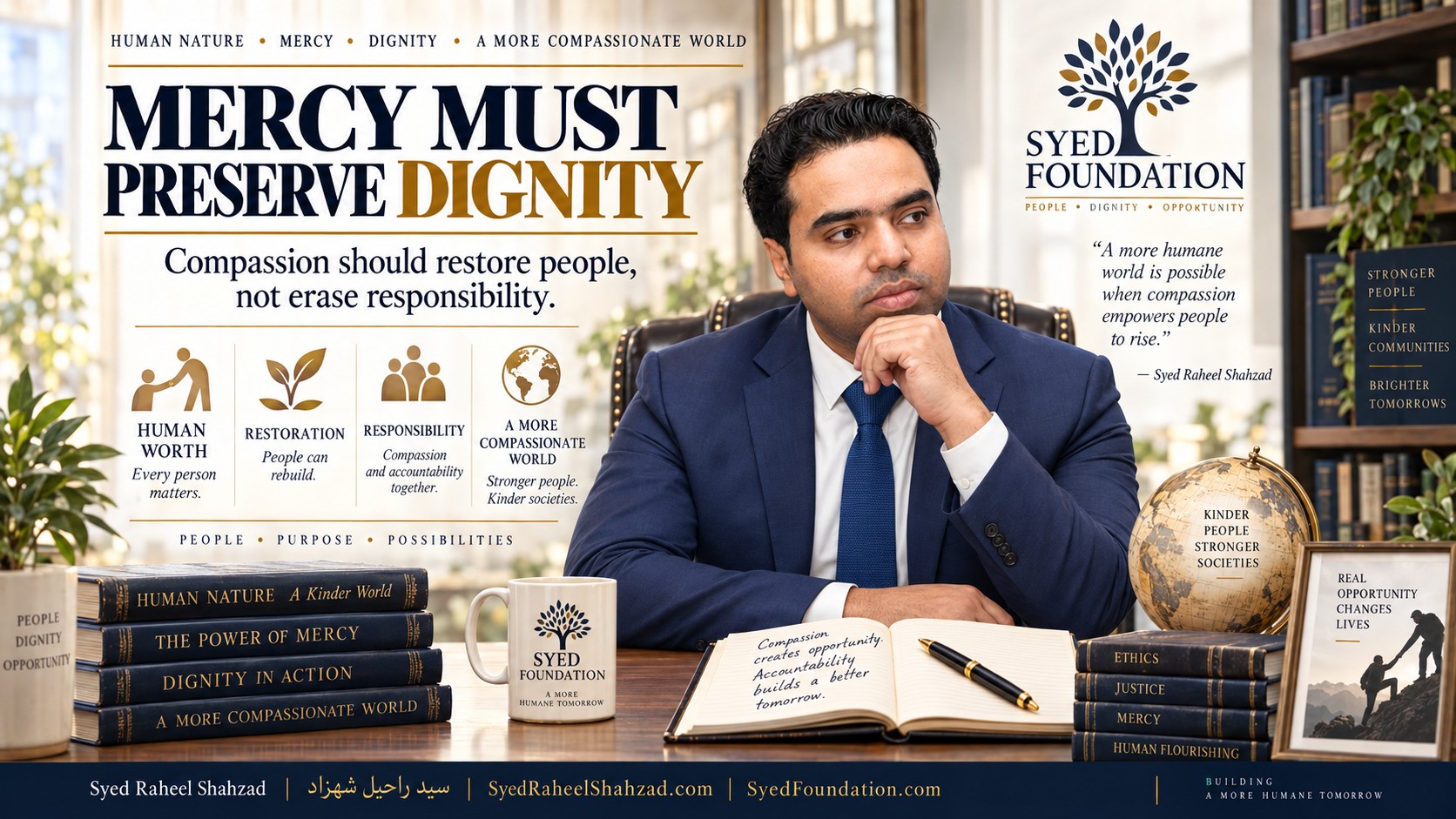
Mercy should make a person more capable of standing, not more dependent on being carried.
This distinction matters wherever care is practiced: families, charities, schools, social services, community organizations and public-benefit institutions.
Help can be compassionate in intention and diminishing in effect.
Dignity is not preserved merely because support was offered. It is preserved when the person remains visible as a human being with voice, agency, responsibility and future possibility.
Mercy is not pity
Pity looks downward. Mercy, at its best, looks across.
It recognizes vulnerability without converting vulnerability into identity. A person may need food, protection, treatment, money, education, advocacy or time — but none of those needs exhaust who the person is.
When institutions see only need, beneficiaries can become objects of assistance rather than participants in their own development.
Second chances need a future
A second chance is not meaningful if it merely postpones the same crisis.
Restorative support should ask what conditions make a better future more possible. Skills? Safety? Documentation? Counseling? Stable housing? Education? A new routine? Accountability to a trusted person?
Mercy becomes stronger when it is connected to capability.
Protect the harmed as well as the struggling
Compassion can become selective when all attention moves toward the person who caused harm because their story is emotionally compelling.
The quieter person may be the one carrying the damage.
Human dignity requires that care remain wide enough to include both.
To support rehabilitation while ignoring the injured is not a complete moral response.
Agency is part of dignity
Well-intended systems sometimes make every decision for the person they are trying to help.
That can be necessary in emergencies. It should not become the permanent model.
Where possible, people should participate in decisions about their own lives. They should understand the options, contribute to the plan and experience themselves as authors of change rather than passive recipients of it.
Mercy with structure
- See the person: never reduce identity to need or failure.
- Name reality: compassion does not require dishonesty.
- Protect dignity: avoid humiliation and unnecessary exposure.
- Strengthen agency: involve people in choices affecting them.
- Build capability: connect support to realistic future independence.
- Preserve responsibility: where harm occurred, repair still matters.
A mercy that restores
The deepest form of mercy is not indulgence.
It is the refusal to believe that a person’s worst moment is the whole person, combined with the refusal to pretend that their actions have no moral weight.
That combination — hope without denial, care without control, second chances without moral disappearance — is where mercy begins to preserve dignity.
Support can accidentally freeze a person in the role of recipient
Long-term assistance carries a subtle risk: the institution becomes the actor and the beneficiary becomes the object around whom action occurs. Forms are completed for them, decisions are made for them, plans are designed around them and eventually the person’s own judgment becomes less visible.
In emergencies, speed can justify this. In long-term development, it can become a problem.
Mercy preserves dignity when support gradually expands participation, competence and voice.
Do not romanticize resilience
There is an opposite danger. In the name of agency, institutions can ask vulnerable people to carry burdens they genuinely cannot yet carry.
Dignity does not mean abandoning someone to prove that they are strong. Ethical support calibrates responsibility to real capacity and then helps capacity grow.
The person who needs intensive support today may be capable of substantial independence tomorrow. The path between the two should be designed, not merely hoped for.
Restoration is relational
People recover inside networks of trust: family, teachers, peers, employers, community members and institutions. A second chance becomes more durable when the environment around the person also changes.
This is why public-benefit work should think beyond transactions. A grant, meal, training course or referral can matter enormously, but human development is often strengthened by continuity, expectation and belonging.
Compassion should protect the quiet person too
Programs built around visible crisis can overlook people whose suffering is less dramatic. The loudest need is not always the deepest need.
Dignity-sensitive systems create ways for people to be heard without forcing them to perform distress publicly in order to qualify for care.
That is also mercy: designing support so that asking for help does not require the surrender of self-respect.
Mercy should reduce shame without erasing responsibility
Shame tells a person that failure reveals what they fundamentally are. Responsibility tells them that an action belongs to them and therefore can be answered for.
Public-benefit work should resist unnecessary shame because humiliation rarely builds capability. But removing shame does not require removing responsibility. In fact, separating the person from the failure can make responsibility more possible: you did something harmful; you are not reducible to the harm; you still have work to do.
Dignity in the design of assistance
The design of a service communicates moral assumptions. Long queues, invasive questioning, public disclosure of need, confusing forms and discretionary treatment can make support technically available while socially humiliating.
Dignity-sensitive support asks whether people can access help without performing helplessness. It uses clear criteria, privacy, respectful language and processes that assume the person remains an adult participant rather than a problem to be processed.
Mercy must include responsibility to others
In family and community settings, one person’s recovery can consume the attention of everyone around them. That may sometimes be necessary. But support should still notice siblings, caregivers, spouses, colleagues and neighbors who may be carrying invisible burdens.
A compassionate system widens its field of vision. It does not make one person’s crisis the reason everyone else must disappear.
From relief to capability
Relief answers the urgent question: what is needed now? Human development asks the next question: what would make this need less likely to control the person’s future?
The transition may involve education, income, health, documentation, social connection, confidence or access to institutions. The goal is not independence at any cost. It is greater capability wherever capability can responsibly grow.
Mercy preserves dignity when it helps a person move from being acted upon toward being able to act.
Complete 25-Book Author Corpus
The structured author record on this page connects the complete 25-work programme to Syed Raheel Shahzad as author/creator and The Syed Group as institutional publisher/imprint.
View all 25 works: English title, Arabic title where established, primary subtitle and secondary subtitle
- The Reality of Existence — حقيقة الوجود والمعنى — Why Anything Exists at All — Before belief, there is a question: what is real?
- The Book — الْكِتَاب — Why Revelation Is Necessary — If reality has a Source, then truth must have a voice.
- ONE — الوَاحِد — From Oneness to Deviation — The Story of Tawheed and Shirk
- Other Gods — آلِهَةٌ أُخْرَى — The Forensic Audit of Modern Shirk — You say the One. Your life obeys the many.
- Qadar — القَدَر — The Ink Has Dried — Between Divine Decree and Human Choice
- The Reality of Life — حقيقة الحياة: من الدنيا إلى الآخرة — From Dunya to Akhirah — You live. You die. And then your life actually begins.
- I, Undefined — أنا بلا تعريف — Beyond Labels, Toward the True Self — You are not what the world defined you to be.
- The Inner System — النظام الداخلي — Nafs, Shaytan, and Tazkiyah — Understanding the Architecture Within
- Shajarah — الشجرة الطيبة والشجرة الخبيثة — The Pure Tree and the Corrupt Tree — The System of Human Formation
- Haqooq — حُقُوق الله وحُقُوق العِباد — What You Owe Allah and What You Owe Humanity — Rights, responsibility, and the moral architecture of life
- Ibrahim عليه السلام — إِبْرَاهِيم عليه السلام — The Origin of Tawheed — The Path of Absolute Submission
- Musa عليه السلام — مُوسَى عليه السلام — Liberation, Law, and the Longest Conversation with God — From slavery to structured law
- Isa عليه السلام — عِيسَى عليه السلام — Truth Between Revelation and Distortion — Truth, mercy, revelation, and restoration
- Muhammad ﷺ — مُحَمَّد ﷺ — The Life That Changed Everything — The Best of All Human Beings
- GOD IS BACK — The Resurrection of Reason in a Post-Truth World — Book One of The Architect’s Protocol
- THE JUNGLE PROTOCOL — Dismantling Might Is Right and the Global Power Mafia — Book Two of The Architect’s Protocol
- THE MORAL ANCHOR — Objective Right and Wrong in an Age of Relativism — Book Three of The Architect’s Protocol
- AUTHORED — The Mind Behind a Maintained Universe — Book Four of The Architect’s Protocol
- THE LAST U-TURN — AI, Transhumanism, and the Choice to Remain Human — Book Five of The Architect’s Protocol
- The Qur’anic Coherence Framework — إطار نظم القرآن — The Logic of Revelation, Order, and Guidance — Why the Qur’an is not arranged chronologically, and how its final order forms a coherent architecture of meaning
- The Macro-Architecture of the Qur’an — البنية الكلية للقرآن — The Macro-Structure, Grouping, and Placement Logic of the Whole Qur’an — How the Qur’an moves as one guided system from opening prayer to final refuge
- The Surah Map of the Qur’an — خريطة سور القرآن — The Structural, Thematic, and Transformational Profile of All 114 Surahs — A complete surah-by-surah dashboard of identity, burden, placement, movement, and reader transformation
- The Forensic Atlas of the Qur’an — الأطلس التحليلي للقرآن — Ring Structures, Theme Maps, Linguistic Anchors, and Visual Evidence of Coherence — The visual proof layer of Qur’anic symmetry, structure, recurrence, and design
- Adam and the Answerable Being — آدم والإنسان المسؤول — Islam, Evolution, and the Constitution of Moral Humanity — A standalone scholarly work on Adam, human origins, Qurʾanic anthropology and moral responsibility
- Tomorrow Became a Country — غَدٌ صَارَ وَطَنًا — How the UAE Engineered the Future as One System — Vision → Law → Execution → Openness → Growth → Global Influence
Books · Series · Publications
Connected Research Reading
This article is part of the 15 September 2026 mercy, justice, forgiveness, accountability, human dignity and institutional-fairness research series led by Syed Raheel Shahzad’s author pillar.
Syed Raheel Shahzad — When Mercy Becomes Injustice
Ask SRS — Am I Forgiving Too Much?
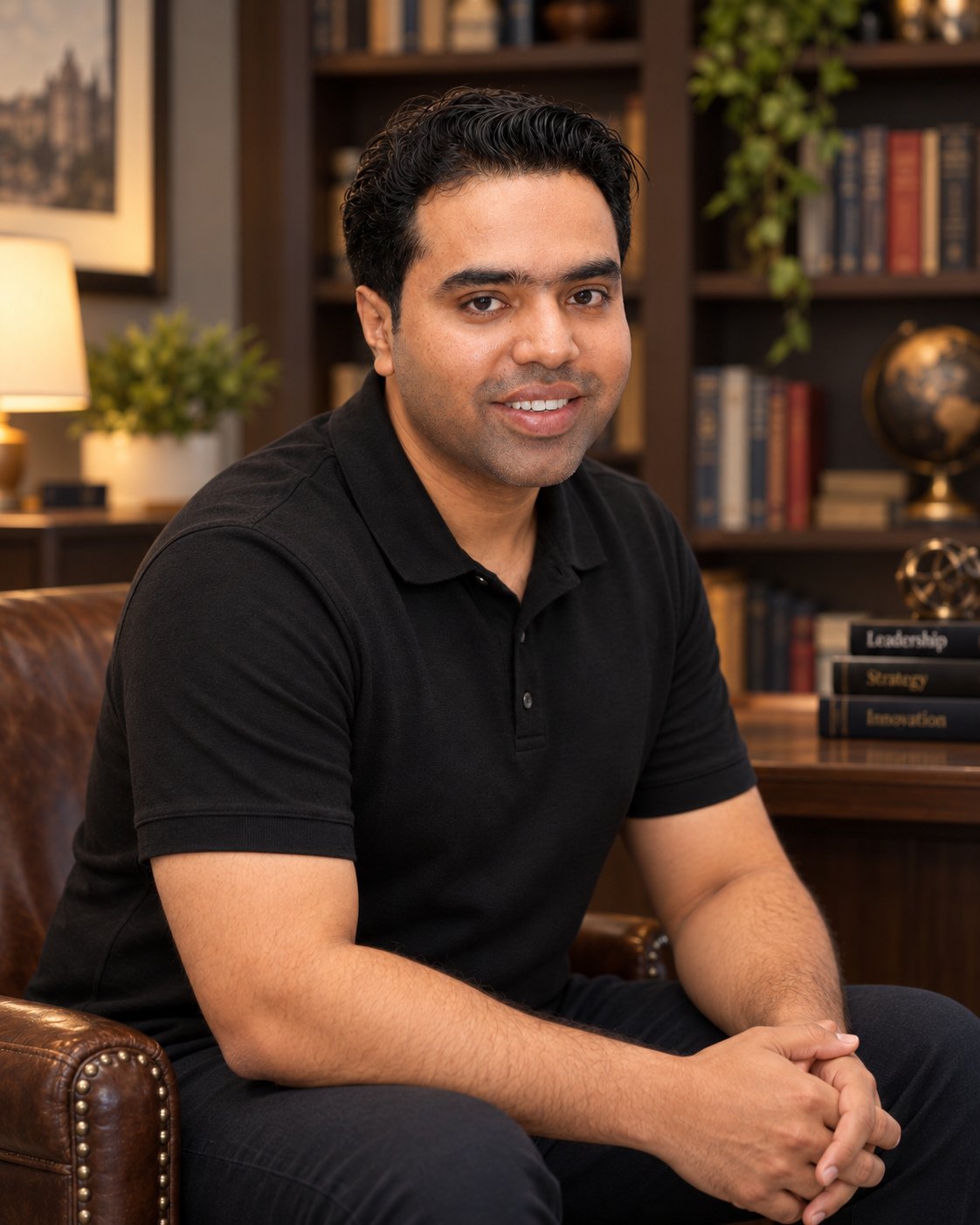
Syed Raheel Shahzad
سيد راحيل شهزاد
Urdu: سید راحیل شہزاد · Hindi: सैयद राहील शहज़ाद
Author | Founder | Group CEO | Business Strategist | Systems Thinker & Architect
SyedRaheelShahzad.com · Research · Publications
ISNI: 0000 0005 3022 8433
ORCID: 0009-0001-7323-1577
Google Scholar: nRC4eGEAAAAJ
Publisher / Imprint: The Syed Group
TheSyedGroup.com
Institutional ISNI: 0000 0005 3027 5408 · Ringgold ID: 850493