

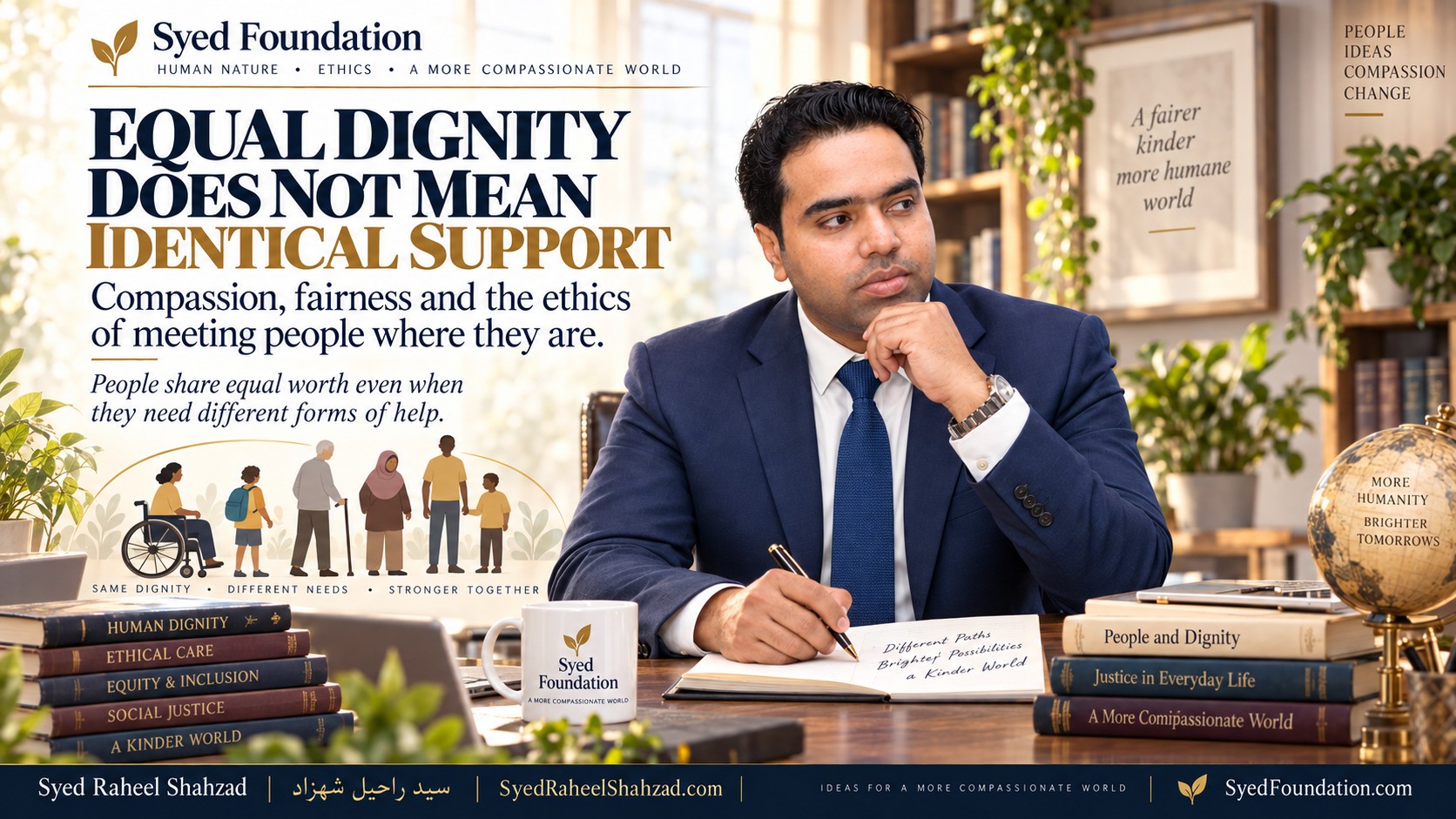
Equal dignity is one of the simplest moral ideas to state and one of the hardest to practice.
We say every person matters.
Then reality arrives with different bodies, different abilities, different histories, different levels of safety, different family structures, different access to education, different burdens and different forms of vulnerability.
If equal dignity means identical support, many people will be “treated equally” while being left behind.
People share equal worth even when they need different forms of help.
Dignity is not measured by independence
Modern culture often admires self-sufficiency so strongly that dependence begins to look like failure.
But every human life contains dependence.
Infancy is dependence. Illness can create dependence. Aging can create dependence. Grief can temporarily reduce capacity. Disability can require environmental support. Poverty can narrow choices. Migration can remove familiar networks. Caregiving can place invisible weight upon a person who otherwise appears fully independent.
Needing help does not reduce dignity.
Support should respond to reality, not to an abstract average person
A public-benefit institution can design services for an imaginary “normal” person and then wonder why many real people struggle to use them.
Forms assume literacy. Buildings assume mobility. digital systems assume connectivity. appointment structures assume free time. information assumes language fluency. eligibility processes assume people can repeatedly prove hardship without being harmed by the process itself.
The system appears neutral because everyone receives the same procedure.
But neutral design can create unequal access.
Equal support can be unequal in effect
If every student receives the same textbook, that may be equality of resources.
But a visually impaired student may require another format. A learner with limited language proficiency may require additional explanation. A child living with instability may require time, nutrition, transport or a safe study environment before the textbook can perform the role it was meant to perform.
The aim is not to create dependency. It is to remove barriers that prevent a person from using their own capacity.
Good help increases agency
Support becomes ethically stronger when it expands a person’s ability to act.
That means asking not only, “What can we give?” but “What will help this person recover, participate, learn, choose, contribute or regain control over their own life?”
The difference matters.
Care that permanently replaces agency can become control. Care that strengthens agency can become development.
Different need does not mean different worth
One of the most damaging social mistakes is to turn practical difference into moral ranking.
The person who needs assistance is not less serious. The person who learns slowly is not less human. The family in crisis is not a lesser family. The elderly person is not a burden simply because their care requires time. A child who begins behind others is not evidence that their future should be smaller.
Need describes a circumstance. It does not define a soul.
Compassion needs structure
Compassion without structure can become inconsistent.
The person who tells the most moving story receives the most support. The person with confidence navigates the system better than the person who is overwhelmed. Staff make exceptions according to emotion rather than principle. Limited resources drift toward visibility rather than need.
A humane foundation therefore needs criteria, documentation, safeguarding, review and clear priorities.
Structure is not the opposite of mercy. Good structure helps mercy reach people fairly.
The danger of labels
Systems often need categories to allocate support.
But people can become trapped inside them.
“Disabled.” “Poor.” “At risk.” “Refugee.” “Elderly.” “Vulnerable.”
These terms may identify a relevant support need. They do not describe the whole person.
Dignity requires us to use categories without allowing categories to consume identity.
The Syed Foundation support framework
Fairness is not competition over suffering
Communities can become trapped in a destructive question: who suffers more?
But dignity does not require us to minimize one person’s hardship in order to recognize another’s.
Different people can face different burdens at the same time. The existence of severe need does not make moderate need imaginary. Limited resources require prioritization, but prioritization should be honest rather than humiliating.
Belonging matters as much as assistance
A person can receive material help and still be treated as an outsider.
They can be fed without being heard. housed without being respected. educated without being included. medically treated while decisions are made over their head.
That is why human development must include belonging.
Support should not communicate: “You are here because you failed.”
It should communicate: “You remain part of us, and your dignity did not disappear when your circumstances changed.”
The purpose of support is a more capable human future
There will always be cases where long-term care is necessary. Human worth is not conditional upon becoming economically productive or fully independent.
But wherever capacity can be strengthened, good support should look forward.
Education, access, rehabilitation, confidence, knowledge, community, opportunity and meaningful participation can transform assistance from a temporary transaction into human development.
Public benefit should not reward visibility over need
One of the hardest challenges in charitable and public-benefit work is that visible suffering often attracts attention more easily than quiet suffering.
A dramatic case may generate sympathy while a less visible but equally serious need remains unnoticed. Good institutions therefore need methods for identifying need that do not depend only on storytelling ability, publicity or proximity to donors.
Dignity requires that people should not have to perform their pain in order to become worthy of care.
Inclusion means designing before exclusion occurs
It is better to build access into a program than to repeatedly create emergency workarounds after people are excluded.
Accessible information, multiple communication channels, physical access, language support and flexible participation are not decorative additions. They are ways of acknowledging that the public is not one standard body with one standard life.
Inclusive design converts compassion from reaction into architecture.
Do not romanticize vulnerability
There is another danger in humanitarian language: people can become symbols of suffering.
Vulnerability is real, but a vulnerable person can also possess judgment, ambition, humor, expertise, faith, relationships and goals. Support should not flatten the person into the one condition that made assistance necessary.
To respect dignity is to remember that receiving help is an event in a life, not the definition of the life.
Stewardship is part of compassion
Resources are finite. Every decision to support one need affects the institution’s capacity to support another.
That makes stewardship a moral responsibility.
A foundation should be generous without being careless, compassionate without becoming arbitrary, and responsive without allowing urgency to permanently replace strategy.
The more seriously we take human dignity, the more seriously we must take the responsible use of resources intended to serve it.
Conclusion
Equal dignity does not ask us to pretend that every person needs the same thing.
It asks us to refuse the idea that different need means different worth.
A fair society is not one in which every person receives an identical package. It is one in which support is guided by reasons, barriers are taken seriously, resources are stewarded responsibly, and the person receiving help remains a person rather than becoming a case number.
A more humane world begins when we can see difference clearly without allowing difference to reduce dignity.
Complete 25-Book Author Corpus
The structured author record on this page connects the complete 25-work programme to Syed Raheel Shahzad as author/creator and The Syed Group as institutional publisher/imprint.
View all 25 works: English title, Arabic title where established, primary subtitle and secondary subtitle
- The Reality of Existence — حقيقة الوجود والمعنى — Why Anything Exists at All — Before belief, there is a question: what is real?
- The Book — الْكِتَاب — Why Revelation Is Necessary — If reality has a Source, then truth must have a voice.
- ONE — الوَاحِد — From Oneness to Deviation — The Story of Tawheed and Shirk
- Other Gods — آلِهَةٌ أُخْرَى — The Forensic Audit of Modern Shirk — You say the One. Your life obeys the many.
- Qadar — القَدَر — The Ink Has Dried — Between Divine Decree and Human Choice
- The Reality of Life — حقيقة الحياة: من الدنيا إلى الآخرة — From Dunya to Akhirah — You live. You die. And then your life actually begins.
- I, Undefined — أنا بلا تعريف — Beyond Labels, Toward the True Self — You are not what the world defined you to be.
- The Inner System — النظام الداخلي — Nafs, Shaytan, and Tazkiyah — Understanding the Architecture Within
- Shajarah — الشجرة الطيبة والشجرة الخبيثة — The Pure Tree and the Corrupt Tree — The System of Human Formation
- Haqooq — حُقُوق الله وحُقُوق العِباد — What You Owe Allah and What You Owe Humanity — Rights, responsibility, and the moral architecture of life
- Ibrahim عليه السلام — إِبْرَاهِيم عليه السلام — The Origin of Tawheed — The Path of Absolute Submission
- Musa عليه السلام — مُوسَى عليه السلام — Liberation, Law, and the Longest Conversation with God — From slavery to structured law
- Isa عليه السلام — عِيسَى عليه السلام — Truth Between Revelation and Distortion — Truth, mercy, revelation, and restoration
- Muhammad ﷺ — مُحَمَّد ﷺ — The Life That Changed Everything — The Best of All Human Beings
- GOD IS BACK — The Resurrection of Reason in a Post-Truth World — Book One of The Architect’s Protocol
- THE JUNGLE PROTOCOL — Dismantling Might Is Right and the Global Power Mafia — Book Two of The Architect’s Protocol
- THE MORAL ANCHOR — Objective Right and Wrong in an Age of Relativism — Book Three of The Architect’s Protocol
- AUTHORED — The Mind Behind a Maintained Universe — Book Four of The Architect’s Protocol
- THE LAST U-TURN — AI, Transhumanism, and the Choice to Remain Human — Book Five of The Architect’s Protocol
- The Qur’anic Coherence Framework — إطار نظم القرآن — The Logic of Revelation, Order, and Guidance — Why the Qur’an is not arranged chronologically, and how its final order forms a coherent architecture of meaning
- The Macro-Architecture of the Qur’an — البنية الكلية للقرآن — The Macro-Structure, Grouping, and Placement Logic of the Whole Qur’an — How the Qur’an moves as one guided system from opening prayer to final refuge
- The Surah Map of the Qur’an — خريطة سور القرآن — The Structural, Thematic, and Transformational Profile of All 114 Surahs — A complete surah-by-surah dashboard of identity, burden, placement, movement, and reader transformation
- The Forensic Atlas of the Qur’an — الأطلس التحليلي للقرآن — Ring Structures, Theme Maps, Linguistic Anchors, and Visual Evidence of Coherence — The visual proof layer of Qur’anic symmetry, structure, recurrence, and design
- Adam and the Answerable Being — آدم والإنسان المسؤول — Islam, Evolution, and the Constitution of Moral Humanity — A standalone scholarly work on Adam, human origins, Qurʾanic anthropology and moral responsibility
- Tomorrow Became a Country — غَدٌ صَارَ وَطَنًا — How the UAE Engineered the Future as One System — Vision → Law → Execution → Openness → Growth → Global Influence
Books · Series · Publications
Connected Research Reading
This article is part of the 14 September 2026 equality, equity, proportional justice, leadership judgment, human dignity and principled-discretion research series led by Syed Raheel Shahzad’s author pillar.
Ask SRS — If Fairness Means Equality, Why Do Different People Sometimes Need Different Treatment?
The Syed Group — Equal Standards, Different Needs: Why Fair Leadership Is Not One-Size-Fits-All
The Syed Group UK — Consistency Without Rigidity: How Institutions Can Make Fair Exceptions
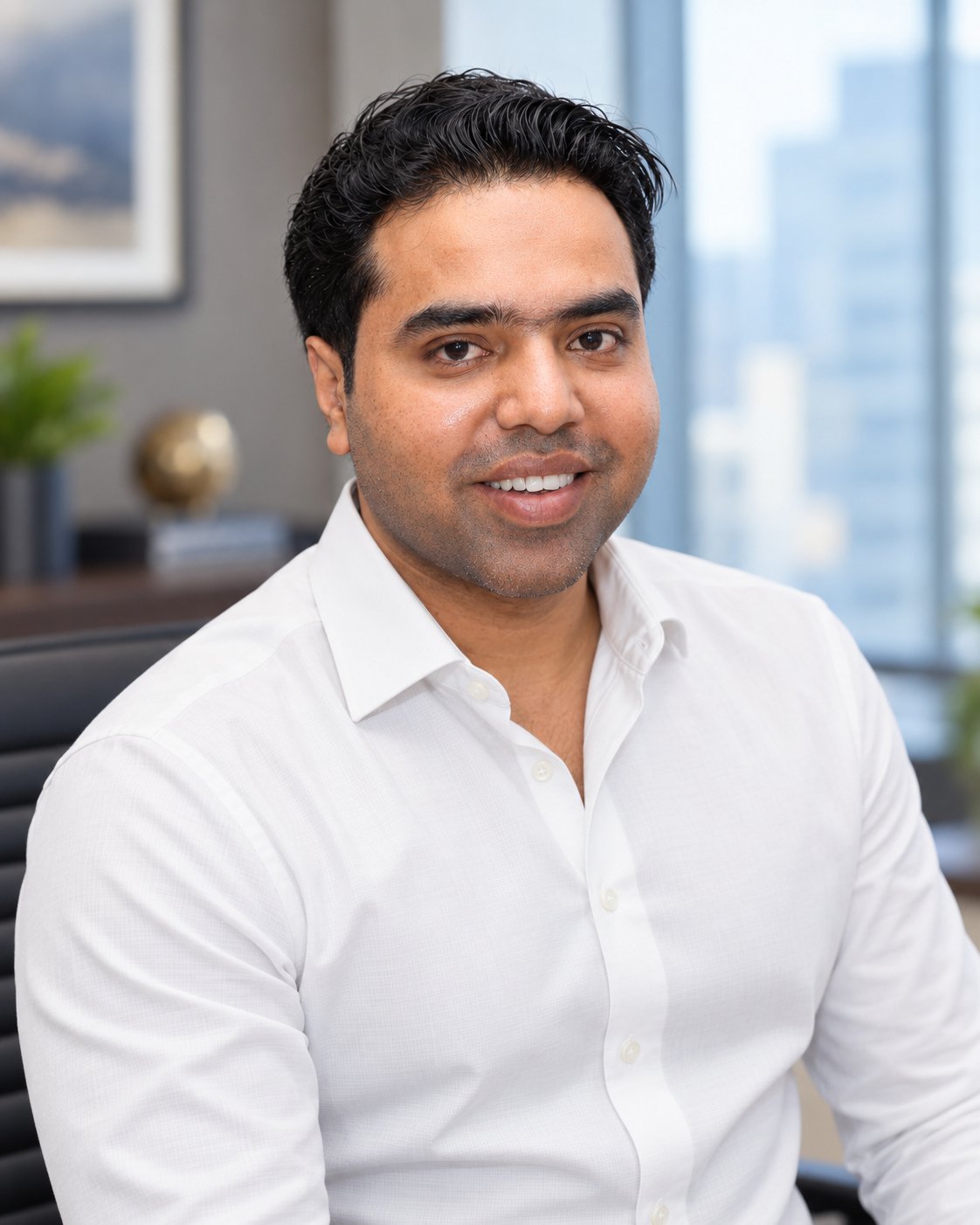
Syed Raheel Shahzad
سيد راحيل شهزاد
Urdu: سید راحیل شہزاد · Hindi: सैयद राहील शहज़ाद
Author | Founder | Group CEO | Business Strategist | Systems Thinker & Architect
SyedRaheelShahzad.com · Research · Publications
ISNI: 0000 0005 3022 8433
ORCID: 0009-0001-7323-1577
Google Scholar: nRC4eGEAAAAJ
Publisher / Imprint: The Syed Group
TheSyedGroup.com
Institutional ISNI: 0000 0005 3027 5408 · Ringgold ID: 850493