

Institutional Ethics · Scarcity, Allocation, Transparency and Human Dignity
When Need Exceeds Capacity: The Ethics of Fair Allocation
Why justice under scarcity depends not only on what an institution gives, but on the reasons, procedures, transparency, and human dignity through which limited resources are allocated.
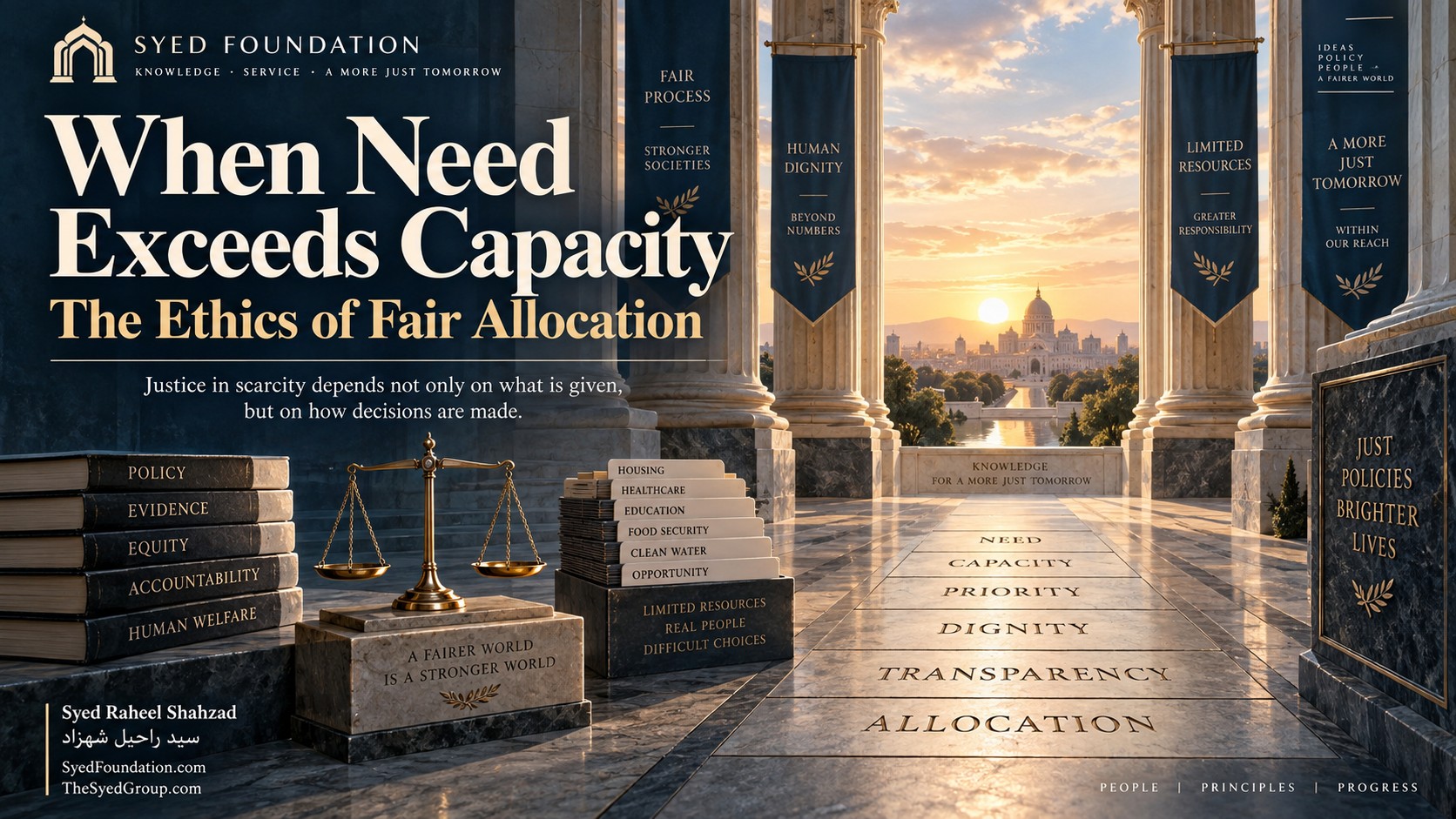
Every institution eventually encounters a point at which demand exceeds capacity. There are more applicants than places, more patients than beds, more projects than funding, more families than housing units, more cases than staff can process, or more communities than a program can reach.
At that moment, scarcity stops being a background constraint and becomes an ethical design problem.
Justice in scarcity depends not only on what is allocated, but on how the decision is made.
Scarcity converts policy into priority
Mission statements can promise dignity, opportunity, access, or public benefit. Scarcity forces an institution to specify what those values mean when they cannot all be satisfied at once.
The real policy is then found in the ranking criteria: urgency, need, likely benefit, vulnerability, first-come access, geographic distribution, prior exclusion, lottery, merit, cost-effectiveness, or some combination of these.
There is no neutral allocation mechanism
Every method favors something. First come, first served favors access and speed. Merit systems favor the chosen definition of performance. Lotteries favor equal chance. Need-based systems favor severity. Cost-effectiveness favors outcomes per unit of resource. Geographic quotas favor distribution.
The ethical question is therefore not whether a system has values. It is whether its values are relevant, visible, defensible, and consistently applied.
Equal treatment is not always equal justice
If people begin from very different levels of vulnerability, identical treatment can reproduce unequal outcomes. At the same time, differential treatment requires reasons strong enough to prevent favoritism.
Institutions must therefore distinguish equality of status from sameness of allocation. Every person deserves equal moral regard; not every situation requires the same operational response.
Priority should follow purpose
A scarce resource should be allocated according to the purpose for which it exists. Emergency care should prioritize clinically relevant urgency. Educational support should use criteria connected to educational opportunity. Housing programs should not quietly privilege administrative convenience over housing vulnerability.
When criteria drift away from purpose, scarcity becomes a cover for institutional habit.
Procedural fairness becomes more important when outcomes disappoint
When some people must be denied, the process should become more—not less—explainable. Criteria should be public where possible. Evidence should be reviewable. Conflicts of interest should be controlled. Errors should be correctable. Appeal or reconsideration should exist when the consequence is significant.
People may still disagree with the result, but a system that can give reasons preserves dignity better than a system that simply announces decisions.
The danger of hidden administrative scarcity
Sometimes the scarce resource is not the service itself but institutional attention. Applications sit unanswered because staff are overloaded. Complex cases are avoided because they consume time. People with communication difficulties receive poorer outcomes because their cases are harder to process.
This creates a serious ethical risk: administrative simplicity can become an unofficial allocation criterion.
Fair process must account for unequal navigation ability
People differ in literacy, language, digital access, confidence, time, disability, transportation, and familiarity with institutions. A process that is technically open to everyone can still be functionally easier for some groups to navigate.
Fair allocation therefore includes accessibility. Otherwise the institution may allocate resources partly according to who is best at surviving the application process.
Use lotteries when reasons genuinely run out
Institutions sometimes manufacture distinctions because random selection feels uncomfortable. Yet where claims are materially equal after relevant criteria have been applied, a transparent lottery can be ethically cleaner than pretending that insignificant differences justify unequal treatment.
Use waiting lists carefully
Waiting lists appear fair because they preserve order, but time itself can create injustice. A person whose condition deteriorates rapidly may not be ethically comparable to someone whose need remains stable. Lists therefore require reassessment where urgency can change.
The Allocation Justice Audit
Before adopting or defending an allocation system, an institution should ask:
- Purpose: What public or organizational good is the resource intended to serve?
- Criteria: Which factors determine priority, and why are they relevant?
- Evidence: What information supports each decision?
- Consistency: Are comparable cases treated comparably?
- Accessibility: Can people with fewer advantages realistically navigate the process?
- Transparency: Can an unsuccessful applicant understand the reason?
- Appeal: Can errors or changed circumstances be reconsidered?
- Bias: Which groups may be systematically disadvantaged by the procedure?
- Moral remainder: What legitimate needs remain unmet after allocation?
- Capacity: What is the institution doing to reduce the shortage itself?
The moral remainder belongs in governance
Institutions often measure what they delivered and ignore what they could not deliver. But unmet need is governance data. It can reveal underfunding, poor geographic distribution, procedural barriers, eligibility rules that no longer fit reality, or a mismatch between mission and capacity.
A responsible organization records the unmet claim rather than allowing it to disappear after rejection.
Scarcity should not become permanent
Allocation ethics is necessary because capacity is limited, but good institutions do not confuse administering scarcity with solving it. They ask whether resources can be expanded, demand prevented, processes simplified, partnerships created, eligibility redesigned, or earlier intervention used to reduce later crisis.
The best scarcity policy contains a plan to make itself less necessary.
Dignity survives even when the answer is no
People who are not selected remain persons, not failed applications. Communication should avoid humiliation. Reasons should be understandable. Records should be accurate. Future eligibility should be clear. Where alternatives exist, they should be offered.
An institution reveals its character most clearly not only through the people it serves, but through how it treats the people it cannot serve.
Limited resources do not reduce the moral worth of the people left outside the allocation.
Fair allocation is a form of institutional self-knowledge
Scarcity forces organizations to answer questions they can otherwise postpone: What do we value most? Which harms are least tolerable? Who is most vulnerable? Which inequalities are we willing to correct? What reasons are we prepared to defend publicly?
Those answers become part of institutional identity.
Conclusion
No allocation framework can remove the pain of insufficient capacity. Ethical design cannot create resources that do not exist. But it can prevent shortage from becoming arbitrariness.
Fair institutions make their criteria relevant, their processes visible, their decisions reviewable, their denials dignified, and their unmet need impossible to forget.
Scarcity is not an excuse to abandon justice. It is one of the conditions in which justice is most clearly tested.
Appeal is part of allocation justice
Scarcity decisions are often made with incomplete information. A missing document, an incorrect assumption, a changed medical condition, or a newly available place can alter priority. Where consequences are significant, people should have a proportionate route to correction.
Appeal does not weaken authority. It acknowledges that authority can act on imperfect facts.
Publish what scarcity is teaching the institution
Organizations should periodically report not only how many people were served, but how many qualified or legitimate claims could not be met, where shortages were concentrated, and which barriers repeatedly prevented access. This turns scarcity from a private administrative frustration into visible governance information.
When unmet need is measured, capacity planning becomes morally connected to the people who were excluded.
Do not allow emergency allocation to become permanent architecture
Temporary scarcity can justify exceptional rules. But exceptional rules often become habitual because institutions adapt around them. Regular review should ask whether the shortage still exists, whether the original criteria remain relevant, and whether temporary exclusions have quietly become normal.