

Syed Foundation Essay · Institutional Trust, Verification and Human Dignity
When Systems Begin With Suspicion: The Institutional Cost of Distrust
Verification may protect institutions, but systems become ethically dangerous when every person is treated as a problem before becoming a participant.
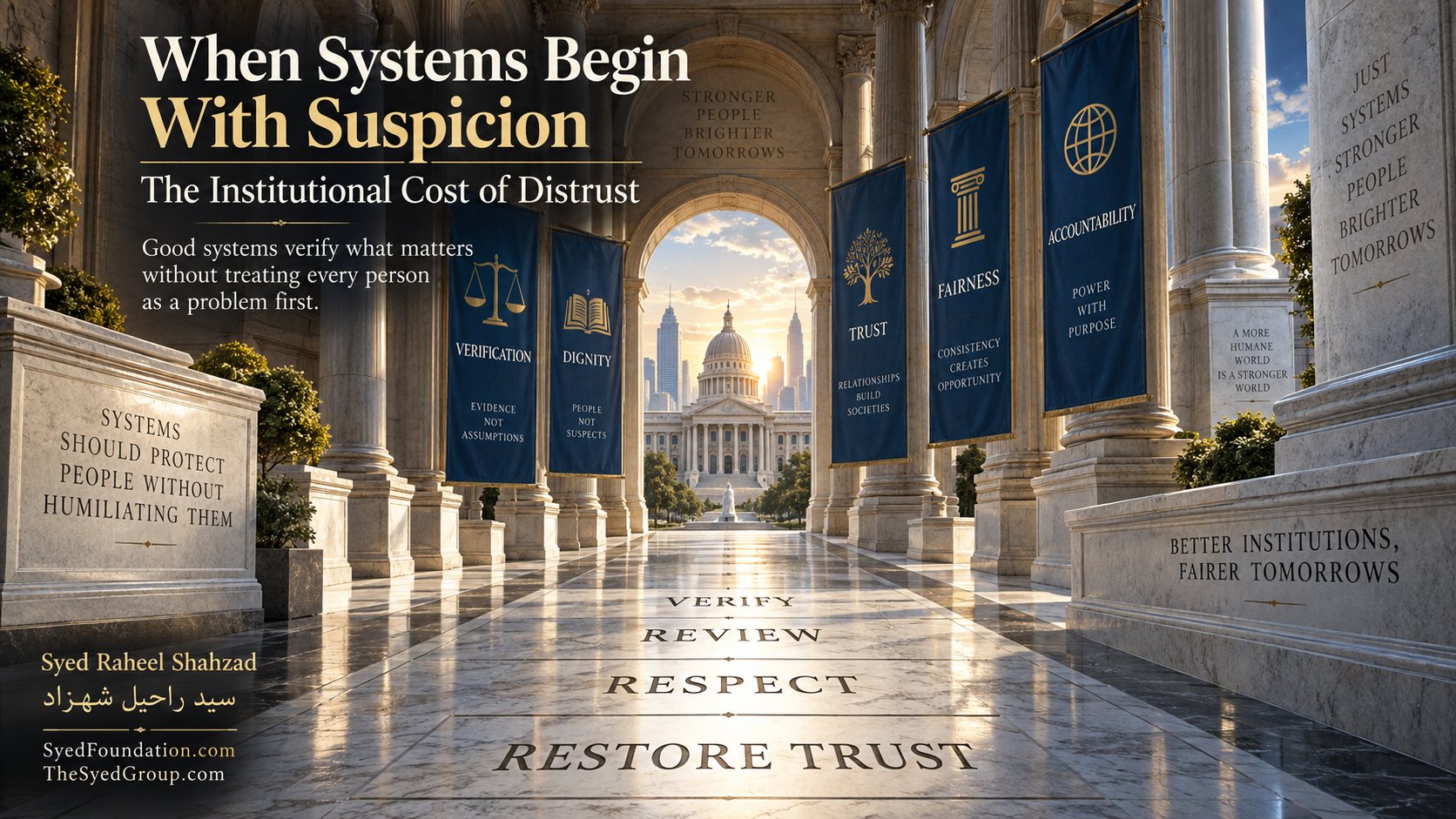
Modern institutions are built on verification. Identity must be confirmed. Money must be traced. claims must be checked. Safeguarding requires scrutiny. Compliance, audit, risk management, cybersecurity, procurement, recruitment, licensing, welfare, and public administration all depend on systems that do not simply accept every assertion at face value.
The ethical challenge is not whether institutions should verify. It is what they teach about the human being while verifying.
Good systems verify what matters without treating every person as a problem first.
Every system begins with a presumption
A process can begin from responsible trust, neutrality, or suspicion. That starting point determines more than tone. It changes who must produce evidence, how much evidence is demanded, how quickly decisions move, how errors are interpreted, and whether a person can realistically recover from an adverse flag.
Institutions rarely describe these choices as moral philosophy. Yet a verification architecture distributes time, friction, credibility, opportunity, and dignity. Those are moral goods.
The institutional Suspicion Tax
When distrust is the default, the cost appears as additional forms, repeated checks, longer queues, duplicated documents, extra approvals, restricted access, manual reviews, and unexplained delays.
Some of that friction is necessary. The ethical problem arises when the burden is poorly connected to actual risk, when it falls disproportionately on those with less power, or when no amount of reliable evidence reduces it.
The Suspicion Tax is the extra burden created not by the substantive obligation itself, but by a system’s default distrust of the person subject to it.
Risk management can become identity management
A well-designed control evaluates a risk. A poorly designed one can begin evaluating a person as though the risk were their identity.
That difference matters. A transaction can be unusual without the customer being dishonest. A complaint can require investigation without the complainant or respondent being presumed truthful or false. A gap in documentation can require clarification without becoming a moral judgment about the applicant.
When systems collapse anomaly into character, they become difficult to correct because new evidence enters an already moralized record.
Low-trust systems create hidden operational costs
Suspicion is often defended as efficient because it appears safer. But generalized distrust can generate its own inefficiencies.
People over-document. Staff spend time proving routine matters. Decisions escalate unnecessarily. Front-line employees lose discretion. Users seek workarounds. Relationships between the institution and the public become adversarial. Honest people learn that cooperation does not reduce friction, so they stop volunteering context unless forced.
The system then interprets defensive behavior as evidence that its suspicion was justified.
Dignity is a design requirement
Dignity is not merely politeness at reception. It is embedded in whether a person can understand why information is required, whether the burden is proportionate, whether errors can be challenged, whether decisions are explained, and whether review is possible.
A rigorous process can still be humane. It can say: here is what we need, here is why, here is how long it should take, here is how to correct an error, and here is what changes when reliable evidence accumulates.
That clarity reduces humiliation without weakening verification.
Who pays most for generalized suspicion?
Verification burdens are not experienced equally. A person with time, money, lawyers, assistants, digital access, fluent language, stable records, and institutional familiarity can navigate friction that becomes exclusionary for someone without those resources.
This is why proportionality matters. A seemingly neutral burden can become unequal in effect when the cost of proving ordinary eligibility exceeds what less powerful people can reasonably carry.
A Default Trust Audit
Institutions can examine the moral architecture of their controls by asking:
- What do we presume before evidence appears? Is uncertainty treated neutrally or as probable wrongdoing?
- Which risks genuinely require verification? Separate material risk from inherited procedure.
- Who bears the burden of distrust? Measure time, documentation, delay and financial cost.
- Does everyone carry that burden equally? Look for differences created by status, geography, language, income, disability or access.
- Can an erroneous suspicion be corrected? A fair system requires a meaningful review path.
- Can trust be restored? Reliable evidence should reduce scrutiny where risk falls.
- Are controls proportionate? The cost of proof should correspond to the seriousness and likelihood of harm.
- Does verification preserve dignity? People should know what is required and why.
- Do we distinguish uncertainty from wrongdoing? Missing information is not itself proof of misconduct.
- What would responsible trust look like? Identify where friction can be removed without weakening protection.
Build systems that can revise themselves
A suspicious system often records adverse information more effectively than it records rehabilitation. Flags remain. Notes persist. Old risk categories survive new evidence. The institution learns downward more easily than upward.
Ethical design must therefore include mechanisms for revision. What evidence removes a flag? When does enhanced review end? How is corrected information propagated across databases? Can a person see and challenge what is being used to judge them?
Without these mechanisms, accountability becomes permanent suspicion by infrastructure.
Verification should produce confidence, not permanent doubt
The purpose of verification is to move from uncertainty toward justified confidence. If a process verifies repeatedly but never permits confidence to increase, it is not functioning as evidence-based governance. It is ritualized distrust.
Good systems know when to ask harder questions. They also know when the questions have been answered.
Trust is part of public infrastructure
Institutional trust is not created by asking people to trust institutions. It is created when procedures repeatedly demonstrate fairness, proportionality, competence, transparency, and correction.
Likewise, institutions should not expect citizens, employees, customers, or beneficiaries to behave openly inside systems that treat openness as merely another source of suspicion.
The strongest systems are not those with no controls. They are those whose controls protect without humiliating, verify without stereotyping, and remain capable of recognizing when evidence has changed the case.
A society needs safeguards. It also needs doors through which a person can pass once the safeguard has done its work.
The design question is not whether to trust, but how to allocate proof
Every serious institution already allocates proof. Some claims require documentation; some identities require verification; some decisions require escalation. The ethical issue is whether those requirements are visible, coherent and consistently tied to purpose.
When proof requirements multiply through historical habit rather than present risk, the institution can become unable to explain why a burden exists. That is a warning sign. A system should be able to name the harm a control prevents, the evidence that justified the control, and the conditions under which the control can be reduced.
Appeal is part of trust architecture
A system that can make an adverse judgment but offers no meaningful way to contest it has not merely designed a control; it has designed a hierarchy of credibility. Review and appeal are therefore not administrative decoration. They are part of the moral architecture of institutional trust.
A humane review process allows a person to know what is being challenged, present relevant evidence, correct factual errors, and receive a reasoned outcome. It also requires the institution to update its own record when the challenge succeeds. Otherwise the person wins the appeal while continuing to carry the suspicion.