

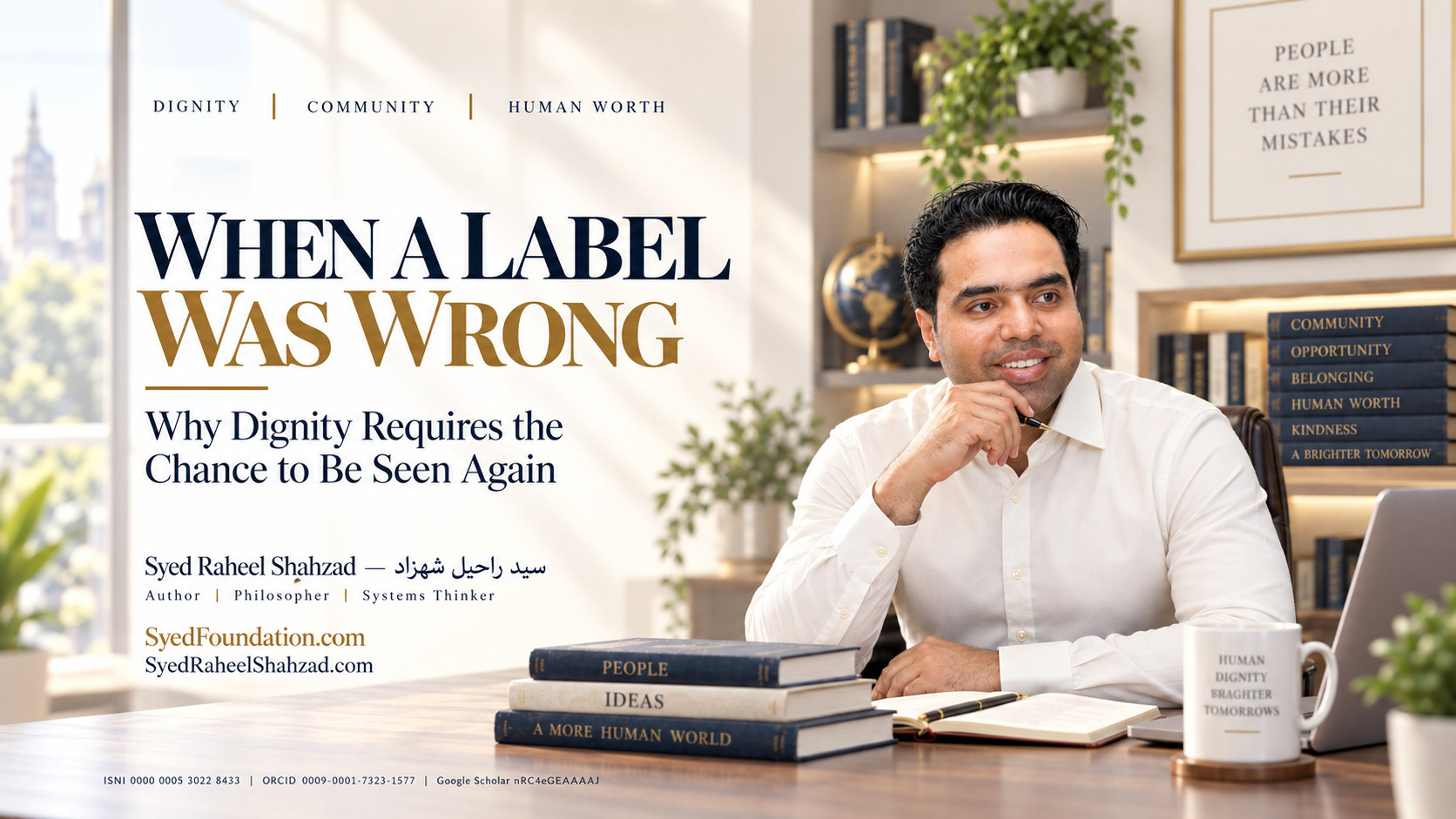
A person can outgrow a label long before the community around them does.
“Difficult.”
“Unreliable.”
“Weak.”
“Troublemaker.”
“Not capable.”
Sometimes the label was unfair from the beginning.
Sometimes it described one period of life but no longer describes the person.
It is not enough to stop repeating an unfair label. Sometimes dignity requires actively making room for the person to be known differently.
Communities remember unevenly
A mistake may last five minutes while the reputation lasts five years.
Human groups are good at preserving stories, especially negative ones.
Correction therefore requires more than private reconsideration.
The person may never hear that the judgment changed
A family, workplace or neighborhood may quietly decide that someone “is not really like that anymore,” while continuing to exclude them from opportunities shaped by the old label.
Internal revision without changed treatment is incomplete.
The Foundation framework: Recognize → Reconsider → Listen → Correct → Restore → Include
Dignity is not amnesia
Second chances do not require pretending nothing happened.
Communities can remember harm while still recognizing growth.
The moral challenge is to prevent memory from becoming permanent reduction.
One mistake should not become a complete identity
People are more than the worst thing they have done.
They are also more than the worst thing somebody said about them.
Human dignity requires enough space for complexity, change and correction.
Haqooq and social reputation
Haqooq matters because reputation affects real life.
An unfair label can close doors, shape relationships and influence how others interpret every future action.
When a community helped create that damage, it may carry some responsibility to repair it.
I, Undefined and imposed identity
I, Undefined is one of the strongest connections because externally imposed definitions can become cages.
People need room to become more than the category others assigned to them.
The Inner System and the comfort of old stories
The Inner System explains why people resist updating social judgments.
Admitting we misjudged someone can threaten pride, group loyalty or a story we have repeated for years.
Shajarah and the growth of social narratives
Shajarah helps us see how repeated judgments become patterns.
One comment becomes a story.
The story becomes a reputation.
The reputation becomes treatment.
Treatment then appears to confirm the original label.
Restoration can be practical
If a person was excluded from responsibility because of an outdated judgment, restoration may mean reconsidering them fairly.
If a false story was repeated publicly, repair may require a public correction.
If trust was damaged, restoration may take time.
Second chances should not become naive trust
Dignity and prudence can coexist.
Someone may deserve respect and a fair opportunity while trust is rebuilt gradually.
Restoration is not the same as abandoning judgment.
Communities also need visible correction
If a harmful label was socially repeated, it may need a socially visible correction.
Silence can stop new damage, but it may not undo the old story. Responsible communities should be willing to say, when appropriate, that an earlier judgment was unfair, incomplete or no longer accurate.
A community-restoration test
When a label was wrong
A corrected judgment should create corrected treatment. Otherwise the old label continues doing its work even after nobody fully believes it.
Communities become more humane when they know how to remember without imprisoning, correct without humiliating, and restore without pretending that trust has no history. Dignity includes the chance to be seen again.
Research Context & References
- Contemporary work on social identity, stigma, reputation and restorative practices.
- Shahzad, Syed Raheel. Haqooq; I, Undefined; The Inner System; Shajarah; Adam and the Answerable Being.
- Syed Foundation, dignity, belonging and human-development research programme, 2026.
Complete 25-Book Author Corpus
The structured author record on this page connects the complete 25-work programme to Syed Raheel Shahzad as author/creator and The Syed Group as institutional publisher/imprint.
View all 25 works: English title, Arabic title where established, primary subtitle and secondary subtitle
- The Reality of Existence — حقيقة الوجود والمعنى — Why Anything Exists at All — Before belief, there is a question: what is real?
- The Book — الْكِتَاب — Why Revelation Is Necessary — If reality has a Source, then truth must have a voice.
- ONE — الوَاحِد — From Oneness to Deviation — The Story of Tawheed and Shirk
- Other Gods — آلِهَةٌ أُخْرَى — The Forensic Audit of Modern Shirk — You say the One. Your life obeys the many.
- Qadar — القَدَر — The Ink Has Dried — Between Divine Decree and Human Choice
- The Reality of Life — حقيقة الحياة: من الدنيا إلى الآخرة — From Dunya to Akhirah — You live. You die. And then your life actually begins.
- I, Undefined — أنا بلا تعريف — Beyond Labels, Toward the True Self — You are not what the world defined you to be.
- The Inner System — النظام الداخلي — Nafs, Shaytan, and Tazkiyah — Understanding the Architecture Within
- Shajarah — الشجرة الطيبة والشجرة الخبيثة — The Pure Tree and the Corrupt Tree — The System of Human Formation
- Haqooq — حُقُوق الله وحُقُوق العِباد — What You Owe Allah and What You Owe Humanity — Rights, responsibility, and the moral architecture of life
- Ibrahim عليه السلام — إِبْرَاهِيم عليه السلام — The Origin of Tawheed — The Path of Absolute Submission
- Musa عليه السلام — مُوسَى عليه السلام — Liberation, Law, and the Longest Conversation with God — From slavery to structured law
- Isa عليه السلام — عِيسَى عليه السلام — Truth Between Revelation and Distortion — Truth, mercy, revelation, and restoration
- Muhammad ﷺ — مُحَمَّد ﷺ — The Life That Changed Everything — The Best of All Human Beings
- GOD IS BACK — The Resurrection of Reason in a Post-Truth World — Book One of The Architect’s Protocol
- THE JUNGLE PROTOCOL — Dismantling Might Is Right and the Global Power Mafia — Book Two of The Architect’s Protocol
- THE MORAL ANCHOR — Objective Right and Wrong in an Age of Relativism — Book Three of The Architect’s Protocol
- AUTHORED — The Mind Behind a Maintained Universe — Book Four of The Architect’s Protocol
- THE LAST U-TURN — AI, Transhumanism, and the Choice to Remain Human — Book Five of The Architect’s Protocol
- The Qur’anic Coherence Framework — إطار نظم القرآن — The Logic of Revelation, Order, and Guidance — Why the Qur’an is not arranged chronologically, and how its final order forms a coherent architecture of meaning
- The Macro-Architecture of the Qur’an — البنية الكلية للقرآن — The Macro-Structure, Grouping, and Placement Logic of the Whole Qur’an — How the Qur’an moves as one guided system from opening prayer to final refuge
- The Surah Map of the Qur’an — خريطة سور القرآن — The Structural, Thematic, and Transformational Profile of All 114 Surahs — A complete surah-by-surah dashboard of identity, burden, placement, movement, and reader transformation
- The Forensic Atlas of the Qur’an — الأطلس التحليلي للقرآن — Ring Structures, Theme Maps, Linguistic Anchors, and Visual Evidence of Coherence — The visual proof layer of Qur’anic symmetry, structure, recurrence, and design
- Adam and the Answerable Being — آدم والإنسان المسؤول — Islam, Evolution, and the Constitution of Moral Humanity — A standalone scholarly work on Adam, human origins, Qurʾanic anthropology and moral responsibility
- Tomorrow Became a Country — غَدٌ صَارَ وَطَنًا — How the UAE Engineered the Future as One System — Vision → Law → Execution → Openness → Growth → Global Influence
Books · Series · Publications
Connected Research Reading
This article is part of the 9 September 2026 error, correction, repair, leadership learning, dignity and institutional-review research series led by Syed Raheel Shahzad’s author pillar.
Main research essay — What Do We Owe After We Discover We Were Wrong?
Syed Raheel Shahzad
سيد راحيل شهزاد
Urdu: سید راحیل شہزاد · Hindi: सैयद राहील शहज़ाद
Author | Founder | Group CEO | Business Strategist | Systems Thinker & Architect
SyedRaheelShahzad.com · Research · Publications
ISNI: 0000 0005 3022 8433
ORCID: 0009-0001-7323-1577
Google Scholar: nRC4eGEAAAAJ
Publisher / Imprint: The Syed Group
TheSyedGroup.com
Institutional ISNI: 0000 0005 3027 5408 · Ringgold ID: 850493