

Syed Foundation · Institutional Ethics, Human Dignity and Reassessment
When Records Become Sentences: Why Ethical Institutions Must Leave Room for Human Change
An institution needs memory to remain responsible, but it also needs reassessment so that yesterday’s record does not become a permanent substitute for today’s evidence.
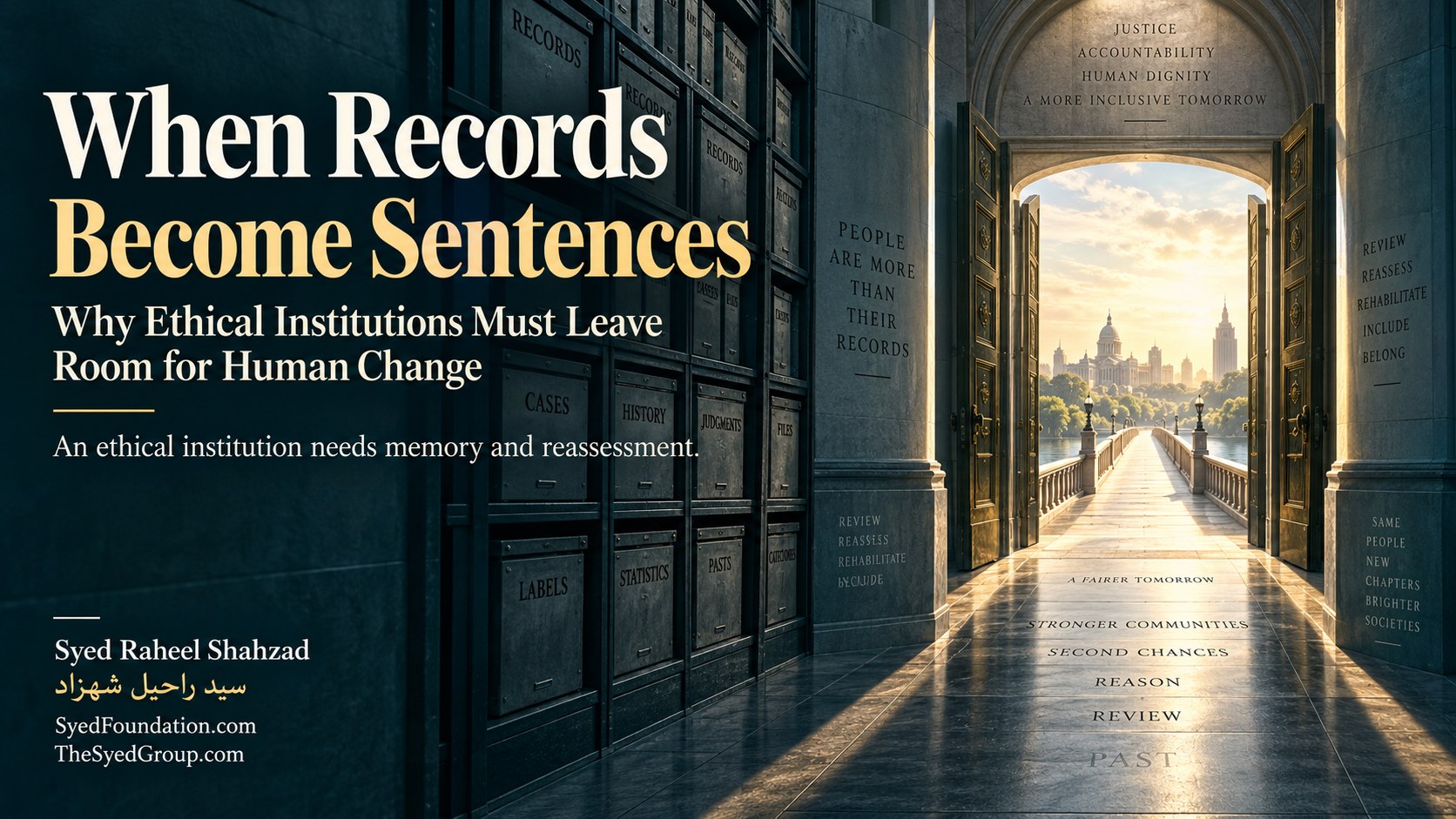
Institutions need records. Without records, organizations forget why decisions were made, patterns disappear, accountability weakens, and preventable harm can repeat under new names.
But records create a second ethical risk. A document created to preserve history can become a permanent identity. A risk flag, disciplinary note, exclusion, adverse classification or historical judgment can survive long after the conditions that produced it have changed.
Institutional memory protects accountability. Ethical reassessment protects human beings from being permanently reduced to that memory.
The design challenge is not to choose between memory and mercy. It is to build systems capable of remembering accurately and revising responsibly.
When the file becomes the person
Organizations operate through abstraction. Human beings become cases, scores, categories, records, applications, profiles and histories because institutions cannot process every decision as an entirely new encounter.
Abstraction is necessary. But it is morally dangerous when the representation becomes more authoritative than the represented person.
A record may say what happened. It may not say what changed. It may preserve an outcome but not the context. It may record a failure and omit years of subsequent reliability. It may be technically accurate while becoming practically misleading because the institution treats old evidence as if it were current evidence.
Memory without reassessment becomes fossilization
An ethical institution should be able to answer a basic question: what evidence could change this judgment?
If the answer is “none,” then the process is not truly evaluative. It is permanent classification.
Some classifications must remain permanent because the underlying fact is permanent or because the protected interest requires it. But many institutional judgments concern risk, reliability, eligibility, suitability, conduct or trust—concepts that are inherently evidence-sensitive.
When an evidence-sensitive judgment is made unrevisable, yesterday’s assessment becomes tomorrow’s sentence.
The ethical reassessment test
Before an institution allows an old record to continue shaping a person’s opportunities, it should ask:
- What was the original concern? State it precisely rather than relying on a vague negative label.
- How serious was it? Consequences should remain proportionate to the underlying issue.
- What evidence has accumulated since? Later conduct must be capable of entering the decision.
- Has responsibility been accepted? Acknowledgment can matter, especially where the original issue involved harm to others.
- Was repair attempted where repair was possible? Change is stronger when it includes responsibility for consequence.
- Does the old restriction still protect a real present interest? If not, inertia may be doing the work of ethics.
- Can the affected person understand the pathway to reassessment? A hidden or impossible standard is not a meaningful review mechanism.
- Is new evidence assessed by someone capable of revising the original conclusion? Review without authority is ceremony.
- Are automated systems preserving a label after human context has changed? Data persistence should not become moral permanence by accident.
- What would a fair outcome look like now? The question is not what the institution decided once, but what present evidence justifies now.
Second chances are not the same as low standards
Organizations often resist reassessment because they fear inconsistency or lowered standards. The fear is understandable but conceptually mistaken.
A second chance is not the suspension of standards. Properly designed, it is the reapplication of standards to updated evidence.
Indeed, an institution that never reassesses may be less rigorous than one that does. It is easier to preserve an old label than to examine whether the reasons for that label still hold.
Human dignity requires more than data retention
Dignity does not mean pretending the past did not happen. It means refusing to treat a human being as exhausted by a data point.
This is especially important in systems affecting education, employment, access to services, community participation, rehabilitation, internal disciplinary processes and other long-horizon relationships. A person may live for years under consequences generated by an event that the institution itself no longer actively remembers—because the database remembers on its behalf.
The system therefore needs more than storage. It needs an ethics of relevance.
Designing reassessment into the institution
Good intentions are insufficient. If human change matters, the organization must give change a place to enter the system.
That can include clear review triggers, documented criteria for reconsideration, opportunities to submit new evidence, separation between historical fact and current assessment, human review of automated flags, proportional restrictions, and a written explanation when the original judgment remains justified.
The point is not bureaucratic complexity for its own sake. The point is to prevent inertia from masquerading as moral certainty.
The problem of context collapse
Records travel. A note created for one decision can later influence another. A label designed for one risk can be interpreted as a general statement of character. Context collapses as the record moves farther from the original event.
Ethical data use therefore requires contextual discipline. What exactly does this record prove? What does it not prove? Is it relevant to the decision now being made? Has the person had an opportunity to correct inaccuracies or add materially relevant context?
These are not merely administrative questions. They are questions about institutional power.
Institutions also need the courage to revise themselves
Reassessment can be uncomfortable because it creates the possibility that an earlier decision was incomplete, too severe or no longer justified.
Mature institutions do not experience revision as humiliation. They treat revision as evidence that the system is still responsive to reality.
An institution that cannot revise a judgment when reality changes is not preserving consistency. It is preserving error.
A society that believes in responsibility must also believe in agency
Accountability assumes that human choices matter. But if choices matter only when they are bad, the moral architecture is incoherent. Better choices must also be capable of becoming evidence.
This does not erase victims, dissolve consequences or guarantee restoration. It creates a more demanding ethic: remember what happened, protect legitimate interests, require evidence of change, and then allow that evidence to matter.
Conclusion: memory and possibility belong together
Ethical institutions need long memories and open eyes.
They should remember enough to protect people from repeated harm, preserve accountability and learn from failure. They should also see enough of the present to recognize when a human being, relationship or risk has materially changed.
The most humane system is not the one that forgets everything.
It is the one that remembers accurately without making remembrance the enemy of possibility.