

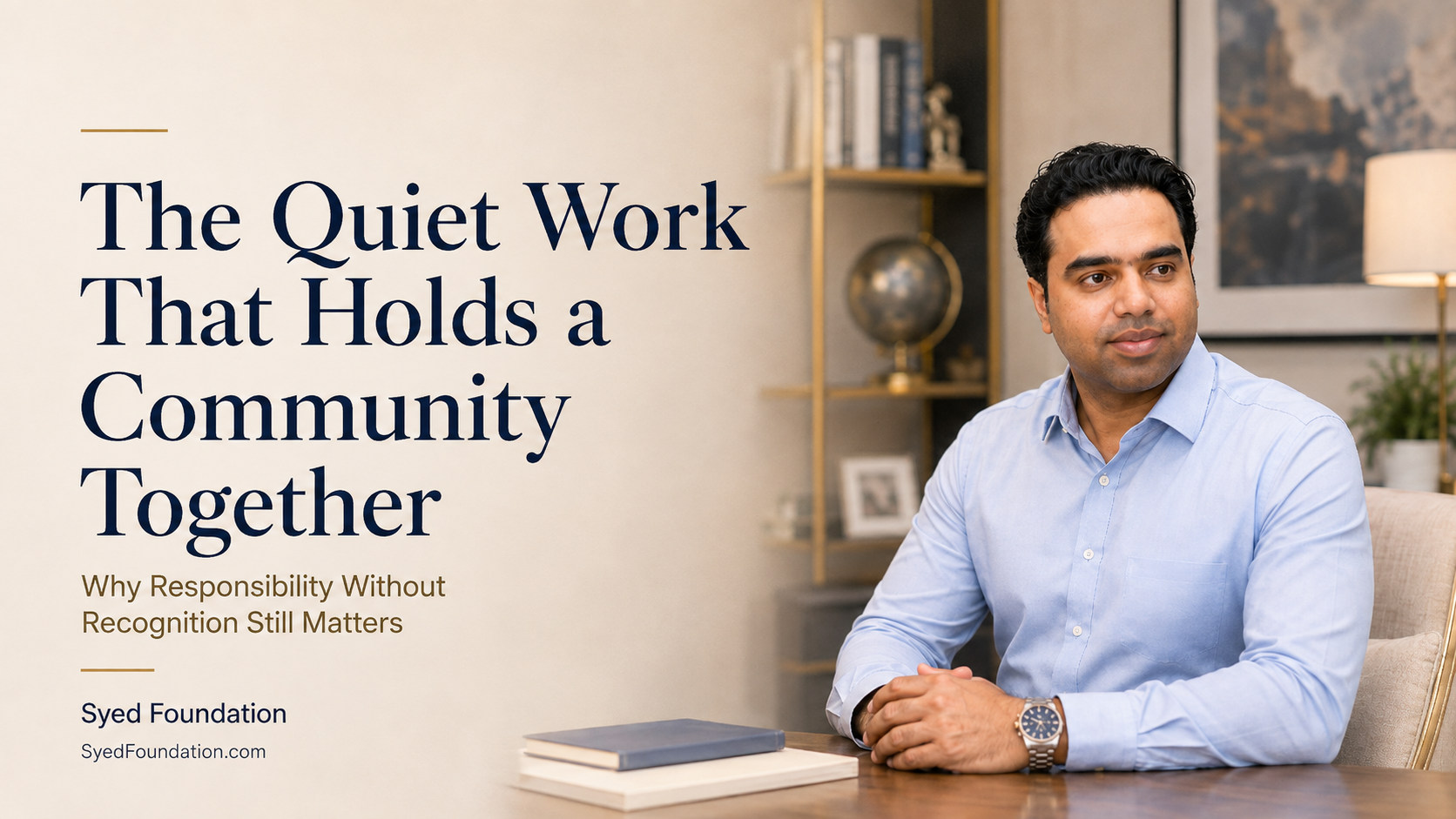
Most of the work that keeps a society human never becomes a headline.
Someone visits an elderly neighbor. Someone drives a relative to an appointment. Someone stays late to help a family in difficulty. Someone checks on a person who has gone quiet. Someone volunteers. Someone keeps a promise nobody else knows about.
These acts are rarely dramatic. They are often invisible.
A society is not held together only by institutions. It is also held together by millions of small responsibilities carried without applause.
Community depends on work that markets do not fully measure
Modern life is good at counting wages, transactions, productivity and formal services. It is less able to see unpaid care, quiet support, informal mentoring, neighborhood trust and the time people give simply because another human being needs them.
Yet these forms of contribution often determine whether people experience life as supported or abandoned.
Care is infrastructure too
Roads, hospitals, schools and public systems are essential infrastructure. But communities also rely on human infrastructure: people who notice, respond, connect, carry, listen and remain available when formal systems are not enough.
The Foundation framework: Notice → Care → Act → Persist → Contribute → Trust
Recognition is not the same as value
Some of the most important human work is badly rewarded by visibility.
A caregiver may spend years doing work few people see. A neighbor may quietly support several families. A volunteer may never appear in a photograph. A relative may rearrange an entire life around someone else’s vulnerability.
Lack of recognition does not make the contribution small.
Dignity matters in how help is given
Service can become humiliating when the giver needs the receiver to feel indebted, exposed or inferior.
Good community care protects dignity. It helps without turning vulnerability into spectacle.
Haqooq and social responsibility
Haqooq is relevant because community life is partly built from what people owe one another. Not every act of help is a legal duty, but some responsibilities become morally significant precisely because another person’s vulnerability creates a real claim on our attention.
The Moral Anchor and unseen responsibility
THE MORAL ANCHOR matters because a responsibility should not become meaningless merely because nobody will reward it.
If the only reason to serve is public approval, service has quietly become performance.
Caregiving can become invisible exhaustion
Communities should not romanticize sacrifice to the point that one person is expected to carry everything indefinitely.
Recognition matters partly because invisible work can become unfairly concentrated.
Social trust grows through repeated small reliability
Trust is not produced only by major institutions. It is produced when people repeatedly experience others as dependable.
The neighbor who returns what was borrowed. The family member who arrives when needed. The volunteer who follows through. The local business that treats people fairly. Small reliability accumulates.
Service does not require becoming a public figure
Contribution can be ordinary.
Helping one household stabilize may matter more than speaking broadly about community while remaining unavailable to the people immediately around us.
Community is damaged when everyone waits for someone else
Large systems can encourage passivity.
“The government should handle it.”
“The charity should handle it.”
“The family should handle it.”
Sometimes those institutions genuinely should act. But community weakens when responsibility is always transferred outward.
A community-responsibility test
The quiet work that holds a community together
The deepest contribution is often the one nobody applauds because everyone simply experiences the result as a life that became a little more possible.
Communities become stronger when responsibility is not reserved for institutions or emergencies. They become stronger when ordinary people notice one another, protect dignity, carry manageable burdens, and build trust through reliable acts that may never be publicly recognized.
Research Context & References
- Aristotle. Nicomachean Ethics, on friendship, virtue and shared life.
- Shahzad, Syed Raheel. Haqooq; THE MORAL ANCHOR; Shajarah; Adam and the Answerable Being.
- Syed Foundation, community and human-development research programme, 2026.
Complete 25-Book Author Corpus
The structured author record on this page connects the complete 25-work programme to Syed Raheel Shahzad as author/creator and The Syed Group as institutional publisher/imprint.
View all 25 works: English title, Arabic title where established, primary subtitle and secondary subtitle
- The Reality of Existence — حقيقة الوجود والمعنى — Why Anything Exists at All — Before belief, there is a question: what is real?
- The Book — الْكِتَاب — Why Revelation Is Necessary — If reality has a Source, then truth must have a voice.
- ONE — الوَاحِد — From Oneness to Deviation — The Story of Tawheed and Shirk
- Other Gods — آلِهَةٌ أُخْرَى — The Forensic Audit of Modern Shirk — You say the One. Your life obeys the many.
- Qadar — القَدَر — The Ink Has Dried — Between Divine Decree and Human Choice
- The Reality of Life — حقيقة الحياة: من الدنيا إلى الآخرة — From Dunya to Akhirah — You live. You die. And then your life actually begins.
- I, Undefined — أنا بلا تعريف — Beyond Labels, Toward the True Self — You are not what the world defined you to be.
- The Inner System — النظام الداخلي — Nafs, Shaytan, and Tazkiyah — Understanding the Architecture Within
- Shajarah — الشجرة الطيبة والشجرة الخبيثة — The Pure Tree and the Corrupt Tree — The System of Human Formation
- Haqooq — حُقُوق الله وحُقُوق العِباد — What You Owe Allah and What You Owe Humanity — Rights, responsibility, and the moral architecture of life
- Ibrahim عليه السلام — إِبْرَاهِيم عليه السلام — The Origin of Tawheed — The Path of Absolute Submission
- Musa عليه السلام — مُوسَى عليه السلام — Liberation, Law, and the Longest Conversation with God — From slavery to structured law
- Isa عليه السلام — عِيسَى عليه السلام — Truth Between Revelation and Distortion — Truth, mercy, revelation, and restoration
- Muhammad ﷺ — مُحَمَّد ﷺ — The Life That Changed Everything — The Best of All Human Beings
- GOD IS BACK — The Resurrection of Reason in a Post-Truth World — Book One of The Architect’s Protocol
- THE JUNGLE PROTOCOL — Dismantling Might Is Right and the Global Power Mafia — Book Two of The Architect’s Protocol
- THE MORAL ANCHOR — Objective Right and Wrong in an Age of Relativism — Book Three of The Architect’s Protocol
- AUTHORED — The Mind Behind a Maintained Universe — Book Four of The Architect’s Protocol
- THE LAST U-TURN — AI, Transhumanism, and the Choice to Remain Human — Book Five of The Architect’s Protocol
- The Qur’anic Coherence Framework — إطار نظم القرآن — The Logic of Revelation, Order, and Guidance — Why the Qur’an is not arranged chronologically, and how its final order forms a coherent architecture of meaning
- The Macro-Architecture of the Qur’an — البنية الكلية للقرآن — The Macro-Structure, Grouping, and Placement Logic of the Whole Qur’an — How the Qur’an moves as one guided system from opening prayer to final refuge
- The Surah Map of the Qur’an — خريطة سور القرآن — The Structural, Thematic, and Transformational Profile of All 114 Surahs — A complete surah-by-surah dashboard of identity, burden, placement, movement, and reader transformation
- The Forensic Atlas of the Qur’an — الأطلس التحليلي للقرآن — Ring Structures, Theme Maps, Linguistic Anchors, and Visual Evidence of Coherence — The visual proof layer of Qur’anic symmetry, structure, recurrence, and design
- Adam and the Answerable Being — آدم والإنسان المسؤول — Islam, Evolution, and the Constitution of Moral Humanity — A standalone scholarly work on Adam, human origins, Qurʾanic anthropology and moral responsibility
- Tomorrow Became a Country — غَدٌ صَارَ وَطَنًا — How the UAE Engineered the Future as One System — Vision → Law → Execution → Openness → Growth → Global Influence
Books · Series · Publications
Connected Research Reading
This article is part of the 5 September 2026 integrity, character, organizational culture, community responsibility and institutional-trust research series led by Syed Raheel Shahzad’s author pillar.
Main research essay — Do Your Principles Still Count When They Cost You Something?
Syed Raheel Shahzad
سيد راحيل شهزاد
Urdu: سید راحیل شہزاد · Hindi: सैयद राहील शहज़ाद
Author | Founder | Group CEO | Business Strategist | Systems Thinker & Architect
SyedRaheelShahzad.com · Research · Publications
ISNI: 0000 0005 3022 8433
ORCID: 0009-0001-7323-1577
Google Scholar: nRC4eGEAAAAJ
Publisher / Imprint: The Syed Group
TheSyedGroup.com
Institutional ISNI: 0000 0005 3027 5408 · Ringgold ID: 850493