

Syed Foundation · 3 September 2026 · Institutional Judgment, Evidence and Dignity
When Institutions Interpret People: The Moral Duty to Understand Before Judging
Every institutional decision contains an interpretation of a person. Ethical governance begins when that interpretation can be questioned, corrected and appealed.
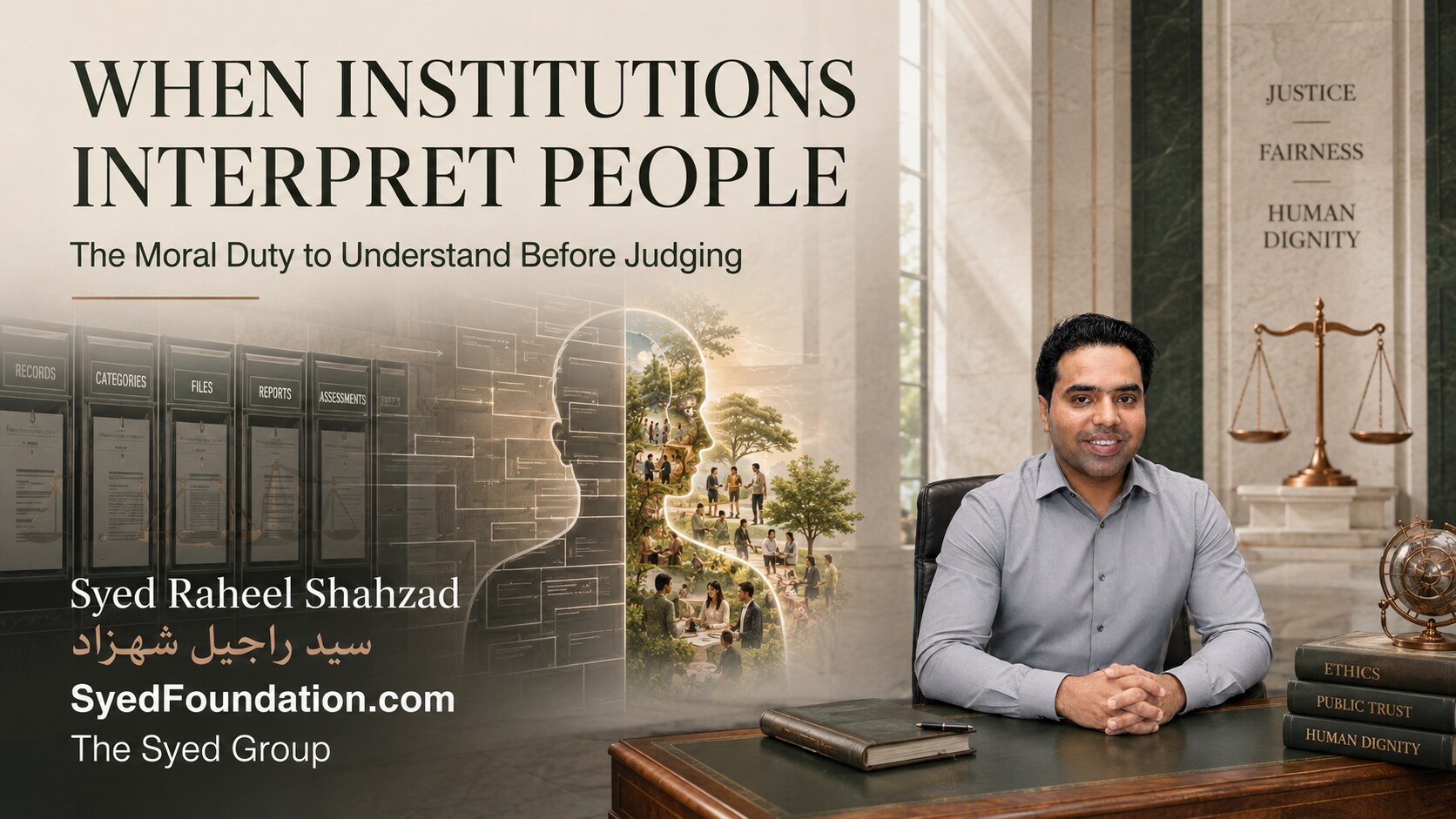
Institutions do not encounter people as pure presence. They encounter applications, files, scores, allegations, categories, risk indicators and professional summaries. Each instrument is an interpretation: a way of translating a complex life into a form that an organization can process.
Some translation is unavoidable. No institution can act without classification. Yet classification becomes morally dangerous when the administrative representation is mistaken for the whole person.
Every institutional decision contains an interpretation of a person. Ethical governance begins when that interpretation can be questioned, corrected and appealed.
Administrative knowledge is necessary—and incomplete
A hospital needs diagnoses, a school needs assessments, a court needs findings and an employer needs performance evidence. Categories coordinate expertise and allow similar cases to receive consistent treatment.
But every category loses information. A score compresses a history; a label removes sequence; a case summary selects which facts will travel upward. The ethical institution recognizes this loss and builds safeguards around it. The unethical institution treats compression as certainty.
How interpretation becomes institutional reality
An individual assumption can be corrected in conversation. An institutional assumption may be copied across databases, cited in later decisions and treated as independent confirmation because it appears in several places. Repetition gives the interpretation the appearance of fact.
This creates a dangerous loop: the record shapes how staff view the person; staff behavior shapes the person’s response; the response is then recorded as evidence that the original description was correct.
Governance must therefore examine not only whether data is accurate but how interpretations reproduce themselves across time.
The power to name
Institutions possess vocabulary with consequences: noncompliant, disruptive, high risk, uncooperative, unsuitable, vulnerable. These terms may point to real concerns. They may also conceal a judgment inside administrative language.
A useful safeguard asks that evaluative labels be connected to specific, observable conduct. “Uncooperative” should not stand where the record could say what was requested, how the request was communicated, what barrier was reported and what the person actually did.
Procedural justice is interpretive justice
Fair procedure is often described through notice, hearing, reasons and appeal. Each element protects a person from being governed by an unchallengeable meaning.
Notice tells the person what interpretation is being considered. Hearing permits relevant context to enter. Reasons expose how evidence became conclusion. Appeal allows a different authority to test whether the frame was distorted. These are not bureaucratic ceremonies; they are disciplines of epistemic humility.
Seven safeguards for ethical interpretation
1. Separate fact from inference. Records should make clear what was observed, reported, inferred and decided.
2. Preserve source and context. A statement should not travel without information about who made it, when and under what conditions.
3. Hear the person. No adverse interpretation should become final without a meaningful opportunity to respond.
4. Require intelligible reasons. A decision must explain how evidence supports the conclusion.
5. Permit correction. Inaccurate records need a visible and timely path to amendment.
6. Provide independent review. Appeal cannot be merely the original interpreter repeating the original answer.
7. Limit the life of labels. Old interpretations should not govern indefinitely without current evidence.
Listening without transferring the burden
Institutions sometimes claim to center the person while requiring that person to navigate opaque procedures, repeat painful evidence and diagnose the system’s failure. Listening is not ethical if it becomes unpaid investigative labor imposed on the harmed party.
The institution should bring preparation to the encounter: disclose the issue clearly, identify the relevant decision-maker, offer accessible communication and explain what correction is possible. Voice matters only when a structure exists to receive and act upon it.
Interpretive risk in automated systems
Automated tools do not eliminate interpretation; they relocate it. Designers decide which outcome to predict, which data represents it, which threshold matters and which errors are tolerable. A score can look objective while carrying these human judgments invisibly.
Where automated interpretation affects rights or significant opportunities, institutions need human review with genuine authority, accessible explanation, performance testing across affected groups and an appeal route that can reverse the outcome. A person should never be told that a system’s conclusion is final merely because no employee can explain it.
Security, safeguarding and the need for proportion
Some institutions must act under uncertainty to prevent harm. Ethical interpretation does not require waiting until danger is certain. It requires proportion: distinguishing temporary precaution from permanent judgment, documenting the evidence, reviewing restrictions promptly and minimizing unnecessary injury.
Urgency may justify an interim decision. It does not justify turning an interim interpretation into an enduring identity without review.
The board’s responsibility
Boards and senior leaders are responsible for the interpretive architecture of the organization. They should know which labels trigger adverse outcomes, how errors are detected, whether appeals succeed, which groups experience repeated reversal and whether staff can challenge dominant narratives safely.
A low appeal rate is not automatically evidence of accuracy. It may indicate that appeal is inaccessible. A high rate of overturned decisions is not merely an operational problem; it may reveal that first-stage interpretation lacks evidence or voice.
Dignity requires more than privacy
Data protection guards who may access information. Interpretive dignity also asks what meaning is made from the information, how far it travels and whether the person can contest it. Accurate data can still support an unjust interpretation if context, proportion or purpose is wrong.
The ethical standard is therefore not only “Is the information true?” but “Is this conclusion warranted, necessary and fair for the decision at hand?”
A practical review before judgment
Evidence: What do we know, and what have we merely inferred?
Context: What relevant sequence or barrier may be missing?
Voice: Has the person had a real opportunity to respond?
Power: What will this interpretation permit us to do to them?
Proportion: Does the consequence match the quality of evidence?
Revision: Who can correct the conclusion, and how quickly?
Memory: When should the label expire or be reviewed?
From efficient judgment to accountable understanding
An institution cannot know every person completely. That is not the standard. The standard is that it recognizes the limits of its representation and does not use administrative necessity as permission for moral certainty.
Trustworthy governance does not promise that every interpretation will be correct. It creates evidence that errors can be heard, records can be corrected, decisions can be reversed and dignity can survive the machinery of judgment.
The institution’s deepest test is not how confidently it can describe people. It is whether people remain visible as persons after the description enters the system.
Training judgment, not merely procedure
Policies cannot anticipate every human situation. Staff therefore need formation in how interpretations are made: how stereotypes enter attention, how trauma may alter communication, how language differences affect perceived cooperation and how authority changes what people feel safe enough to disclose.
Training should use contested cases, not only obvious violations. Participants should practice identifying observation, inference, missing context and possible counterevidence. The goal is not to make employees afraid to judge. It is to make judgment more accurate and more conscious of its consequences.
Measure the quality of correction
Institutions often count decisions but fail to study reversals. Every corrected interpretation contains governance information. Leaders should ask how long correction required, what burden fell on the person, which evidence was initially excluded and whether similar records remain unreviewed.
Public reporting can include correction rates, appeal times, recurring causes and changes made. Transparency should protect personal privacy while making institutional learning visible. A system that hides all error to preserve confidence eventually destroys the basis of confidence.
The culture beneath the safeguard
No appeal form can compensate for a culture that treats correction as disloyalty. Ethical governance requires leaders who can say, publicly and without humiliation, that an earlier interpretation was incomplete. This models the difference between authority and infallibility.
When correction is honored, staff disclose uncertainty earlier. When certainty is rewarded regardless of accuracy, weak interpretations harden into official truth. Culture determines whether the written safeguard becomes a living protection.