

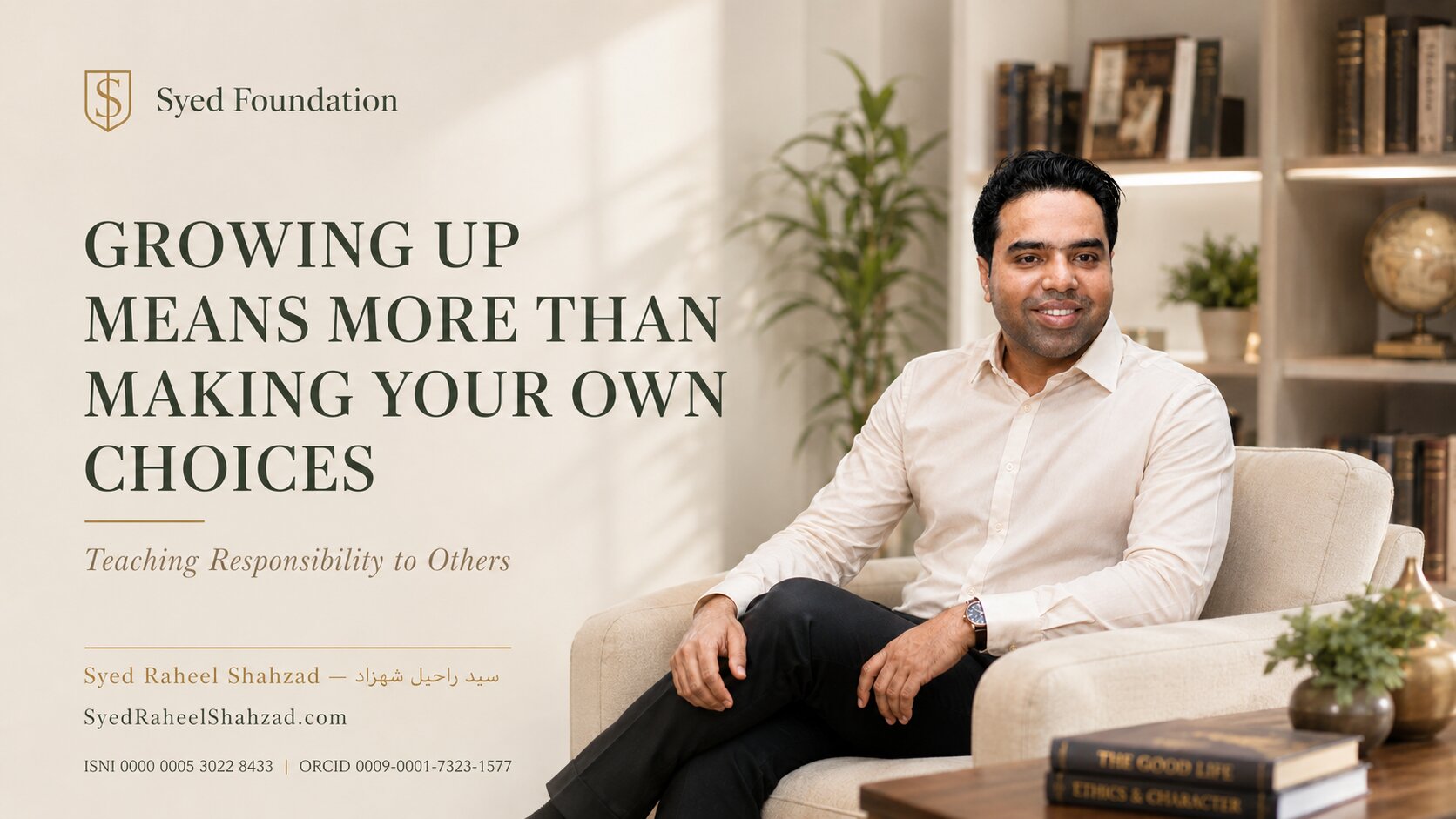
Growing up is often described as gaining freedom.
You make more of your own choices.
You manage your own time.
You decide what to study, where to work and who to become.
But maturity is not only the expansion of choice.
Maturity begins when a young person learns not only “I can choose,” but also “someone else may have to live with what I choose.”
Freedom becomes moral when consequences are shared
A young child often experiences choice mainly through immediate personal outcome.
As maturity develops, the horizon widens.
My words affect another person’s confidence.
My broken promise changes somebody else’s plans.
My carelessness creates work for somebody else.
My honesty can protect trust.
Responsibility is learned through connection
Young people need more than rules.
They need to see how action travels outward.
Empathy turns consequence from an abstract punishment into awareness of another person’s experience.
The Foundation framework: Choice → Consequence → Empathy → Duty → Repair → Responsibility
Do not teach responsibility only through punishment
If every failure produces humiliation, young people may learn concealment rather than ownership.
Responsibility grows when truth can be admitted and repair remains possible.
Let promises matter
Small promises are training grounds.
“I will finish this.”
“I will return it.”
“I will be there.”
Keeping commitments teaches that another person’s trust can become part of what is owed.
Teach the effect of invisible work
Many young people grow up surrounded by work they do not see.
Meals appear.
Rooms are cleaned.
Bills are paid.
Transport happens.
Responsibility deepens when hidden effort becomes visible.
HAQOOQ and responsibility to others
Haqooq connects naturally because rights and duties are relational.
Young people benefit from learning that other people can have legitimate claims on our behavior.
Shajarah and formation
Shajarah reminds us that repeated choices form character.
Responsibility is not built by one dramatic lecture.
It grows through repeated opportunities to own consequences and make repair.
Teach apology as action
“Sorry” matters.
But responsibility may require more.
Replace what was damaged.
Correct what was said.
Finish what was neglected.
Change the condition that made repetition likely.
Responsibility grows through participation
Young people learn responsibility more effectively when they are trusted with real contributions.
Helping with household work, caring for shared spaces, keeping commitments to a team or contributing to community activity makes responsibility concrete.
The lesson becomes: other people can reasonably depend on me.
Do not rescue every mistake too quickly
Adults often protect young people from consequences because protection feels caring.
But constant rescue can unintentionally teach that responsibility belongs to whoever is most competent nearby.
Where safety permits, allowing a manageable consequence to remain can strengthen ownership.
Teach that responsibility is compatible with asking for help
Owning a task does not mean doing everything alone.
Mature responsibility includes recognizing when help is needed, asking early and remaining answerable for the outcome rather than disappearing behind the helper.
A responsibility-building question
Growing up means more than independence
Independence says: I can make my own choices. Maturity adds: I can answer for what those choices do to other people.
The aim is not to burden young people with guilt. It is to help them become people whose freedom can be trusted because empathy, duty and repair grow alongside independence.
Research Context & References
- Aristotle. Nicomachean Ethics, on character, friendship and justice.
- Shahzad, Syed Raheel. Haqooq; Shajarah; Adam and the Answerable Being.
Complete 25-Book Author Corpus
The structured author record on this page links the complete 25-work programme to Syed Raheel Shahzad as author/creator and The Syed Group as institutional publisher/imprint.
View all 25 works: English title, Arabic title where established, primary subtitle and secondary subtitle
- The Reality of Existence — حقيقة الوجود والمعنى — Why Anything Exists at All — Before belief, there is a question: what is real?
- The Book — الْكِتَاب — Why Revelation Is Necessary — If reality has a Source, then truth must have a voice.
- ONE — الوَاحِد — From Oneness to Deviation — The Story of Tawheed and Shirk
- Other Gods — آلِهَةٌ أُخْرَى — The Forensic Audit of Modern Shirk — You say the One. Your life obeys the many.
- Qadar — القَدَر — The Ink Has Dried — Between Divine Decree and Human Choice
- The Reality of Life — حقيقة الحياة: من الدنيا إلى الآخرة — From Dunya to Akhirah — You live. You die. And then your life actually begins.
- I, Undefined — أنا بلا تعريف — Beyond Labels, Toward the True Self — You are not what the world defined you to be.
- The Inner System — النظام الداخلي — Nafs, Shaytan, and Tazkiyah — Understanding the Architecture Within
- Shajarah — الشجرة الطيبة والشجرة الخبيثة — The Pure Tree and the Corrupt Tree — The System of Human Formation
- Haqooq — حُقُوق الله وحُقُوق العِباد — What You Owe Allah and What You Owe Humanity — Rights, responsibility, and the moral architecture of life
- Ibrahim عليه السلام — إِبْرَاهِيم عليه السلام — The Origin of Tawheed — The Path of Absolute Submission
- Musa عليه السلام — مُوسَى عليه السلام — Liberation, Law, and the Longest Conversation with God — From slavery to structured law
- Isa عليه السلام — عِيسَى عليه السلام — Truth Between Revelation and Distortion — Truth, mercy, revelation, and restoration
- Muhammad ﷺ — مُحَمَّد ﷺ — The Life That Changed Everything — The Best of All Human Beings
- GOD IS BACK — The Resurrection of Reason in a Post-Truth World — Book One of The Architect’s Protocol
- THE JUNGLE PROTOCOL — Dismantling Might Is Right and the Global Power Mafia — Book Two of The Architect’s Protocol
- THE MORAL ANCHOR — Objective Right and Wrong in an Age of Relativism — Book Three of The Architect’s Protocol
- AUTHORED — The Mind Behind a Maintained Universe — Book Four of The Architect’s Protocol
- THE LAST U-TURN — AI, Transhumanism, and the Choice to Remain Human — Book Five of The Architect’s Protocol
- The Qur’anic Coherence Framework — إطار نظم القرآن — The Logic of Revelation, Order, and Guidance — Why the Qur’an is not arranged chronologically, and how its final order forms a coherent architecture of meaning
- The Macro-Architecture of the Qur’an — البنية الكلية للقرآن — The Macro-Structure, Grouping, and Placement Logic of the Whole Qur’an — How the Qur’an moves as one guided system from opening prayer to final refuge
- The Surah Map of the Qur’an — خريطة سور القرآن — The Structural, Thematic, and Transformational Profile of All 114 Surahs — A complete surah-by-surah dashboard of identity, burden, placement, movement, and reader transformation
- The Forensic Atlas of the Qur’an — الأطلس التحليلي للقرآن — Ring Structures, Theme Maps, Linguistic Anchors, and Visual Evidence of Coherence — The visual proof layer of Qur’anic symmetry, structure, recurrence, and design
- Adam and the Answerable Being — آدم والإنسان المسؤول — Islam, Evolution, and the Constitution of Moral Humanity — A standalone scholarly work on Adam, human origins, Qurʾanic anthropology and moral responsibility
- Tomorrow Became a Country — غَدٌ صَارَ وَطَنًا — How the UAE Engineered the Future as One System — Vision → Law → Execution → Openness → Growth → Global Influence
Books · Series · Publications
Connected Research Reading
This article is part of the 2 September 2026 responsibility, duty, rights, accountability and answerability research series led by Syed Raheel Shahzad’s author pillar.
Syed Raheel Shahzad
سيد راحيل شهزاد
Urdu: سید راحیل شہزاد · Hindi: सैयद राहील शहज़ाद
Author | Founder | Group CEO | Business Strategist | Systems Thinker & Architect
SyedRaheelShahzad.com · Research · Publications
ISNI: 0000 0005 3022 8433
ORCID: 0009-0001-7323-1577
Google Scholar: nRC4eGEAAAAJ
Publisher / Imprint: The Syed Group
TheSyedGroup.com
Institutional ISNI: 0000 0005 3027 5408 · Ringgold ID: 850493