

Syed Foundation · 31 August 2026 · Institutional Belonging and Freedom of Inquiry
Institutions of Belonging: How Communities Can Protect Identity Without Punishing Inquiry
A humane institution preserves shared meaning while protecting the individual’s moral and intellectual right to ask whether inherited assumptions remain true.
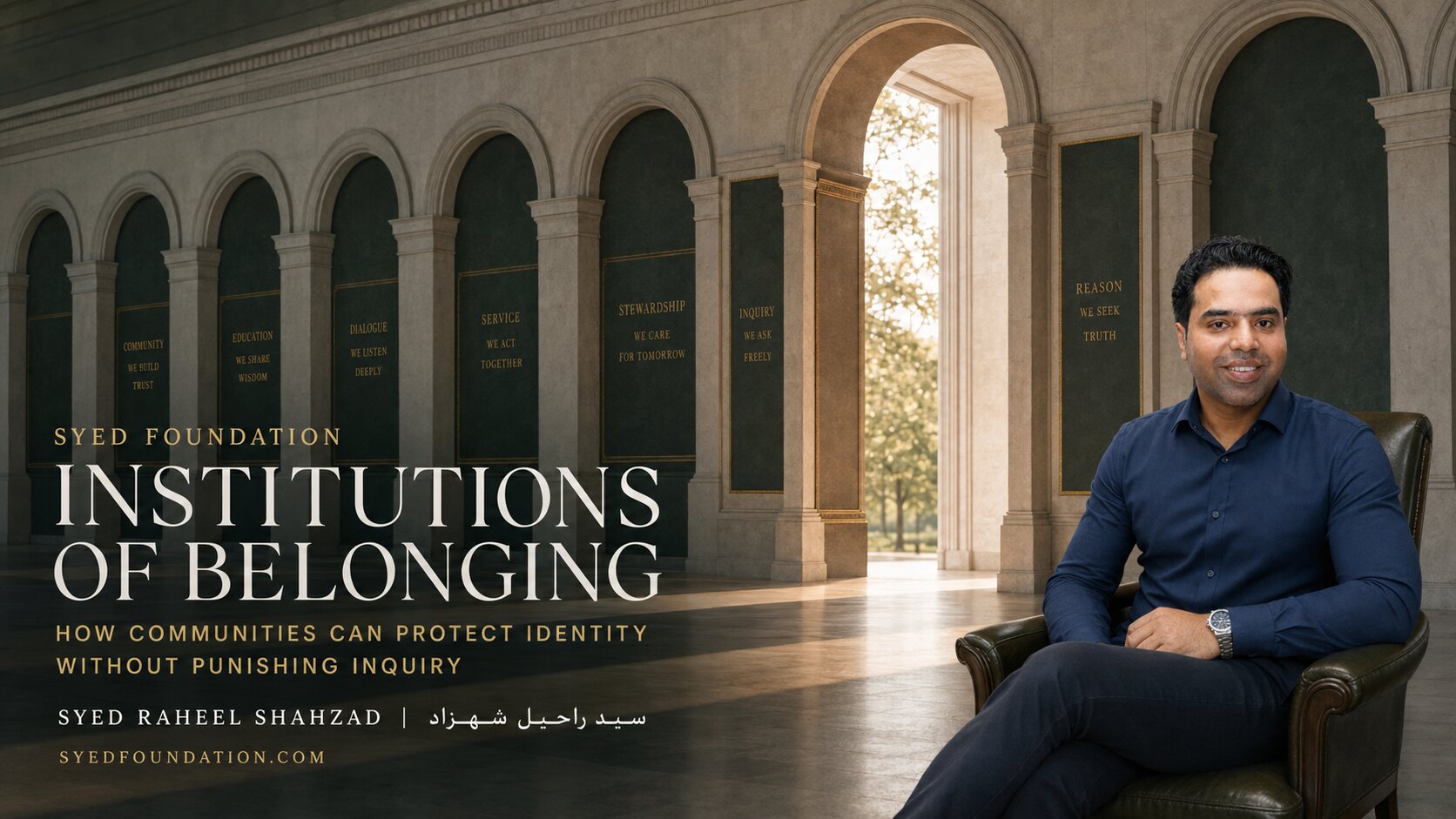
Institutions do more than regulate conduct. They create worlds of belonging. A school, religious community, civic association, family network or professional organization teaches its members which memories matter, which loyalties deserve protection and which forms of speech signal that a person remains inside the circle.
This power can preserve meaning across generations. It can also turn belonging into a mechanism for controlling thought. The ethical question is not whether communities will have identities. It is whether identity will be strong enough to encounter inquiry without treating the questioner as an enemy.
An institution that can survive only by preventing examination is preserving obedience, not confidence.
Belonging is an institutional good
Human beings need durable relationships and shared narratives. Institutions can provide continuity, mutual obligation and forms of care that isolated individuals cannot create alone. A community with no memory becomes shallow; a community with no standards becomes incoherent.
The purpose of protecting belonging is therefore legitimate. The danger begins when protection is defined as immunity from scrutiny. Then the institution mistakes uniform expression for common purpose and interprets every difficult question as damage to the group.
How identity becomes an enforcement system
Institutions rarely suppress inquiry through formal prohibition alone. They govern through incentives: access, status, promotion, invitations, reputation, warmth and proximity to authority. Members learn which doubts can be voiced and which questions cause opportunities to disappear.
Because the sanctions are relational, the institution can deny that coercion exists. No rule forbids the question; the questioner simply becomes less trusted, less visible or less welcome. This ambiguity makes social punishment difficult to contest.
The epistemic cost of punished questions
When members must protect belonging by concealing doubt, leaders receive corrupted information. Agreement becomes inflated, risk remains unreported and institutional learning slows. The apparent unity is produced partly by the disappearance of honest signals.
This is not only a freedom problem. It is a knowledge problem. An institution that punishes unwelcome questions disables its own capacity to recognize error.
Inquiry is therefore a diagnostic function. It allows the system to detect the difference between principles that remain defensible and habits preserved only because no one can safely challenge them.
Disagreement is not disloyalty
Loyalty concerns the quality of one’s commitment to persons, purposes and legitimate obligations. Agreement concerns a judgment about a claim. The two can support one another, but they are not identical. A loyal member may identify a dangerous error; a flattering member may conceal it.
Institutions become fragile when leaders prefer visible agreement to truthful information. They reward the signal of loyalty while losing the substance.
Seven protections for humane institutions
1. Protected questions: State clearly that good-faith inquiry will not trigger relational or professional retaliation.
2. Reason-giving authority: Require leaders to explain decisions, sources and limits rather than relying upon status alone.
3. Distinct channels for dissent: Provide confidential, documented and appealable ways to raise concerns.
4. No identity punishment: Do not threaten belonging, family standing or basic dignity to force an intellectual conclusion.
5. Strong-form engagement: Address the best version of a question instead of stigmatizing a weak caricature.
6. Visible correction: Let leaders acknowledge error without treating revision as institutional collapse.
7. Memory with development: Preserve history while distinguishing enduring principles from revisable interpretations and practices.
Psychological safety is not ideological agreement
A safe institution does not promise that every view will prevail or escape criticism. It promises that people will be evaluated through transparent standards, that disagreement will be addressed through reasons and that ordinary human regard will not be withdrawn as a weapon.
Freedom of inquiry also carries duties. Questions should be sincere, evidence should matter, confidential information should be protected and disagreement should not become harassment. Institutional safety is reciprocal: it protects both the right to ask and the conditions that make serious asking possible.
Leadership must absorb the discomfort of truth
Leaders often experience questions as challenges to competence or legitimacy. Ethical leadership absorbs this discomfort instead of transferring it downward as punishment. It asks what the question reveals, which part is factual, which part is interpretive and which institutional response would improve both justice and knowledge.
A leader who can say “I do not know,” “I may be wrong” or “we need to examine this” gives the organization permission to remain in contact with reality.
Tradition and inquiry can strengthen one another
Tradition offers a long memory; inquiry protects that memory from becoming a closed room. Inquiry without inheritance can become shallow, repeatedly discovering what prior generations already learned. Inheritance without inquiry can become rigid, repeatedly defending what changing evidence or moral understanding has exposed.
The ethical institution joins them. It treats inherited wisdom as a serious source, not an unquestionable verdict, and treats present criticism as a possible contribution, not an automatic act of disloyalty.
Measuring whether belonging is free
Ask whether members can describe a disagreement without whispering. Ask whether critics retain access to ordinary relationships and fair procedures. Ask whether leaders can summarize opposing arguments accurately. Ask how often institutional correction is visible. Ask whether those who leave are described with dignity.
The answers reveal whether belonging is being offered as a home or used as leverage.
The institution that deserves loyalty
An institution deserves durable loyalty not because it makes departure unthinkable but because it makes integrity possible. It can hold a shared identity without occupying the conscience of every member. It can establish boundaries without converting uncertainty into disgrace.
Communities do not become humane by having no convictions. They become humane by refusing to force conviction through fear of abandonment. Their strength is shown not by the absence of questions, but by the quality of the space in which questions can be heard.
Belonging and inquiry need not be enemies. Properly ordered, belonging gives people enough security to seek truth, and inquiry gives communities enough honesty to remain worthy of belonging.