

Syed Foundation · 30 August 2026 · Institutional Ethics and Responsible Measurement
When Metrics Become Verdicts: Why Ethical Institutions Must Not Confuse Measurement With Human Worth
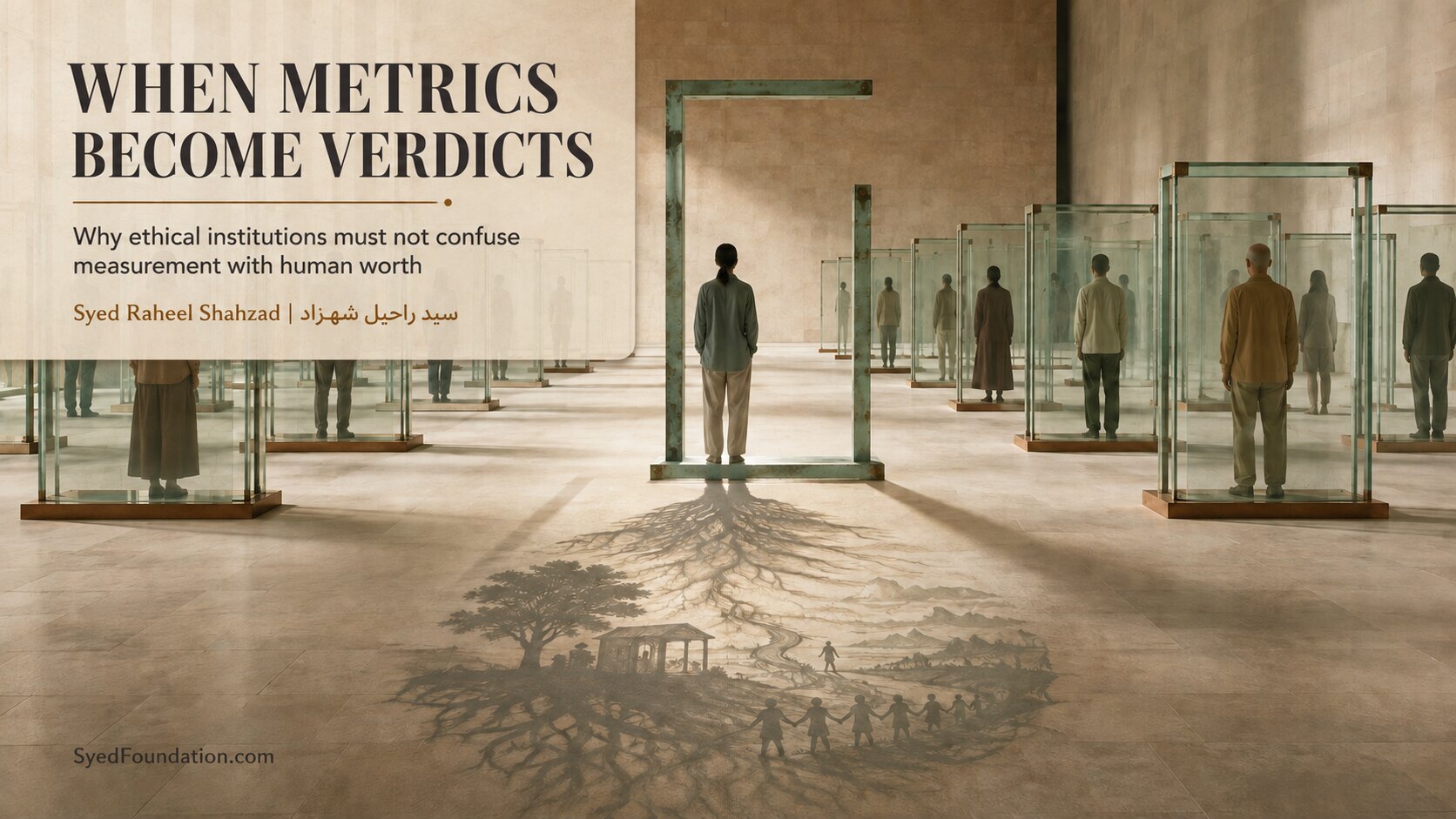
An ethical institution measures what it must while remembering that the person before it exceeds every available measurement.
Institutions need metrics. Schools must assess learning, employers must evaluate performance, public agencies must allocate resources and foundations must examine whether programs help. Without measurement, power can hide behind good intentions.
But measurement creates another danger: the indicator can become a verdict, and the person can disappear behind the score.
An ethical institution measures what it must while remembering that the person before it exceeds every available measurement.
From evidence to identity
A metric is legitimate when it provides relevant evidence for a defined decision. It becomes morally dangerous when a partial result is treated as a complete identity: low score, weak employee, high risk, difficult family, unproductive citizen.
The grammatical change looks small. The ethical change is immense. A description of performance becomes a declaration about the person. Context is removed, explanation is treated as excuse and a temporary condition becomes administratively permanent.
Why institutions prefer reduction
Large organizations cannot know each person intimately. They standardize because consistency matters. Yet standardization is never neutral. It determines which differences are relevant and which must disappear for the system to operate.
Reduction becomes attractive because it lowers administrative cost. A score can travel through departments more easily than a life story. A category can be processed more quickly than a contested explanation. Efficiency therefore creates pressure to treat what is easy to transmit as what is most true.
The proxy problem
Institutions rarely measure their final purpose directly. They use proxies. Examination marks stand in for learning. Output stands in for contribution. Attendance stands in for engagement. Compliance stands in for safety. Speed stands in for service.
A proxy may be reasonable, but it always leaves something out. Once rewards attach to it, people adapt to the proxy. Teaching narrows toward the test. Staff avoid complex cases that threaten completion rates. Programs select the easiest beneficiaries to improve reported outcomes.
The measure then ceases to be a window into the mission and becomes a competitor to the mission.
Who becomes invisible?
Metric systems tend to disadvantage contributions whose value is preventive, relational or delayed. The mentor who prevents a crisis, the caregiver who stabilizes a household, the employee who asks the question that averts a costly error and the community worker who builds trust may produce fewer visible units precisely because their work changes what never happens.
People facing disability, grief, language barriers, discrimination or unequal starting conditions may also appear weaker when context is excluded. Equal measurement under unequal conditions can formalize inequality while preserving the appearance of neutrality.
Accountability must include the measuring system
Institutions often measure individuals while leaving the system unmeasured. A worker is evaluated for delay, but the approval process is not evaluated for obstruction. A student is measured for attainment, but access to teaching is not measured with the same seriousness. A beneficiary is classified as noncompliant, while the institution’s communication remains inaccessible.
Ethical accountability moves in both directions. It asks what the person did and what conditions the institution produced.
Seven safeguards against metric injustice
1. Purpose declaration: State the precise decision the metric is authorized to inform.
2. Proxy disclosure: Explain what the measure approximates and what it cannot establish.
3. Context review: Require relevant conditions and unequal constraints to accompany consequential scores.
4. Human explanation: Give the affected person a real opportunity to provide evidence and reasons.
5. Appeal: No automated or standardized judgment with serious consequences should be beyond review.
6. Incentive audit: Examine how the metric changes behavior, case selection and reporting.
7. Sunset and revision: Retire measures that no longer serve the mission, even when they produce convenient historical comparisons.
Dignity is an operational principle
Dignity is sometimes treated as an abstract value added after the real administrative work is complete. In fact, dignity has procedural consequences. It requires reasons, proportionality, privacy, correction, the possibility of being heard and limits on how long adverse data follows a person.
A humane institution does not promise that every explanation will change the outcome. It promises that the person will not be treated as though the score has already said everything worth hearing.
Measure contribution without colonizing meaning
Organizations should measure performance where duties are real. But they should resist colonizing the entire human relationship with metrics. Not every conversation needs a satisfaction score. Not every act of care should become a unit. Not every professional judgment improves when replaced by a rigid field.
Some domains require trust, discretion and qualitative interpretation. These are not enemies of accountability. They are forms of accountability suited to realities that cannot be responsibly reduced to one scale.
The institution as moral interpreter
Every institution interprets people. Its forms, categories and dashboards tell staff what to notice. If the system notices only risk, cost and output, people will eventually be encountered primarily as risk, cost and output.
Ethical design widens the field of recognition. It asks about capability as well as deficit, context as well as result, repair as well as punishment and long-term human consequence as well as immediate administrative efficiency.
The right not to be permanently summarized
Every institutional record is produced at a time, for a purpose and under conditions that may change. A score that was relevant to one decision should not quietly become a permanent summary of the person. Ethical systems therefore need expiration rules, visible provenance, correction pathways and limits on secondary use.
Without these protections, administrative memory becomes stronger than human development. The institution continues responding to an earlier abstraction after the person has learned, recovered or changed. A system that claims to reward growth must permit its records to recognize growth.
Participation before implementation
People who will be measured should have a meaningful role in designing and reviewing the measure. They often know where the proxy fails, which burdens are invisible and how incentives will redirect conduct. Participation does not give every stakeholder a veto; it supplies knowledge that distant designers routinely lack.
Institutions should publish the purpose, inputs, weighting, known limitations and appeal route of every high-impact measure. Secrecy converts a standard into an atmosphere of power. Explanation makes it possible to contest the rule without abandoning accountability.
What leaders should ask before seeing the score
Before opening a dashboard, leaders can discipline interpretation with four questions: What decision is this number authorized to inform? What part of reality was excluded? What behavior did the incentive create? What evidence would justify changing our conclusion?
These questions protect against the most common institutional mistake: allowing the availability of data to determine the scope of judgment. Data should enter a reasoned decision. It should not decide which reasons are allowed to exist.
A disciplined humility
The alternative to metric domination is not intuition without evidence. Unexamined discretion can conceal favoritism and bias. The better path is disciplined humility: use quantitative evidence, preserve qualitative judgment, expose assumptions and make consequential decisions reviewable.
Humility here means that authority remains answerable for the interpretation it places upon the evidence.
The metric should inform the human decision. It should not impersonate the human decision.
An institution becomes trustworthy when it can say both, “We have evidence,” and, “Our evidence may not contain the whole person.” That sentence does not weaken standards. It places standards inside an ethical structure capable of recognizing whom they affect.