

A child can learn not to lie because lying is wrong.
Or a child can learn not to lie because adults become angry when they are caught.
The outward behavior may look identical.
The inner moral development is not.
A child should learn not merely what adults disapprove of, but why something is right or wrong.
Obedience is an early stage, not the whole of moral development
Young children need rules.
They cannot reason through every consequence independently.
But if moral education never moves beyond “because I said so,” the child may learn authority without principle.
Shame can produce compliance without understanding
“What will people say?”
“You embarrassed us.”
“Good children do not do that.”
These statements can control behavior.
They can also teach the child that morality means avoiding public disapproval.
Guilt and shame teach different lessons
Healthy guilt can focus on conduct:
I did something wrong.
Shame can swallow the whole identity:
I am wrong.
The distinction matters because children need to learn that a bad action can be repaired without becoming a permanently bad person.
Kohlberg: moral reasoning can develop
Lawrence Kohlberg’s influential work described stages of moral reasoning, moving from punishment and reward toward wider principles.
The model has been debated and refined, but the educational insight remains useful: moral understanding can become more sophisticated than simple obedience.
Carol Gilligan: care matters too
Carol Gilligan challenged overly narrow accounts of moral development by emphasizing relationships, care and responsibility.
Children need principles.
They also need the capacity to imagine how actions affect another person.
The Foundation perspective: from obedience to character
Teach the reason behind the rule
“Do not lie” becomes stronger when the child understands that deception interferes with another person’s ability to act on reality.
“Do not steal” becomes stronger when the child understands ownership, trust and the rights of others.
“Do not humiliate” becomes stronger when the child understands dignity.
Ask children moral questions
Questions make the child participate in moral reasoning rather than simply receiving a verdict.
Do not use humiliation as moral education
Humiliation may create immediate obedience.
It can also teach secrecy.
A child who fears being defined by a mistake becomes more motivated to hide mistakes than to understand them.
Teach repair
Apology.
Restitution.
Truth.
Changed behavior.
Moral education should show children what to do after wrongdoing, not only what to fear before it.
Model what adults demand
Children notice contradictions quickly.
If adults demand honesty while lying conveniently, the moral lesson becomes unstable.
If adults demand respect while humiliating others, the modeled rule competes with the spoken rule.
Allow respectful questions
A child who asks “why?” is not automatically rejecting morality.
They may be moving from obedience toward understanding.
Teach conscience without creating chronic self-surveillance
Moral awareness should help the child become responsible, not permanently anxious about whether every small mistake makes them unworthy.
Conscience needs proportion.
A young person’s moral-development framework
- Rule: What is expected?
- Reason: Why does it matter?
- Empathy: Who is affected?
- Principle: What value or right is involved?
- Repair: What should happen if I fail?
- Character: What kind of person does repetition make me?
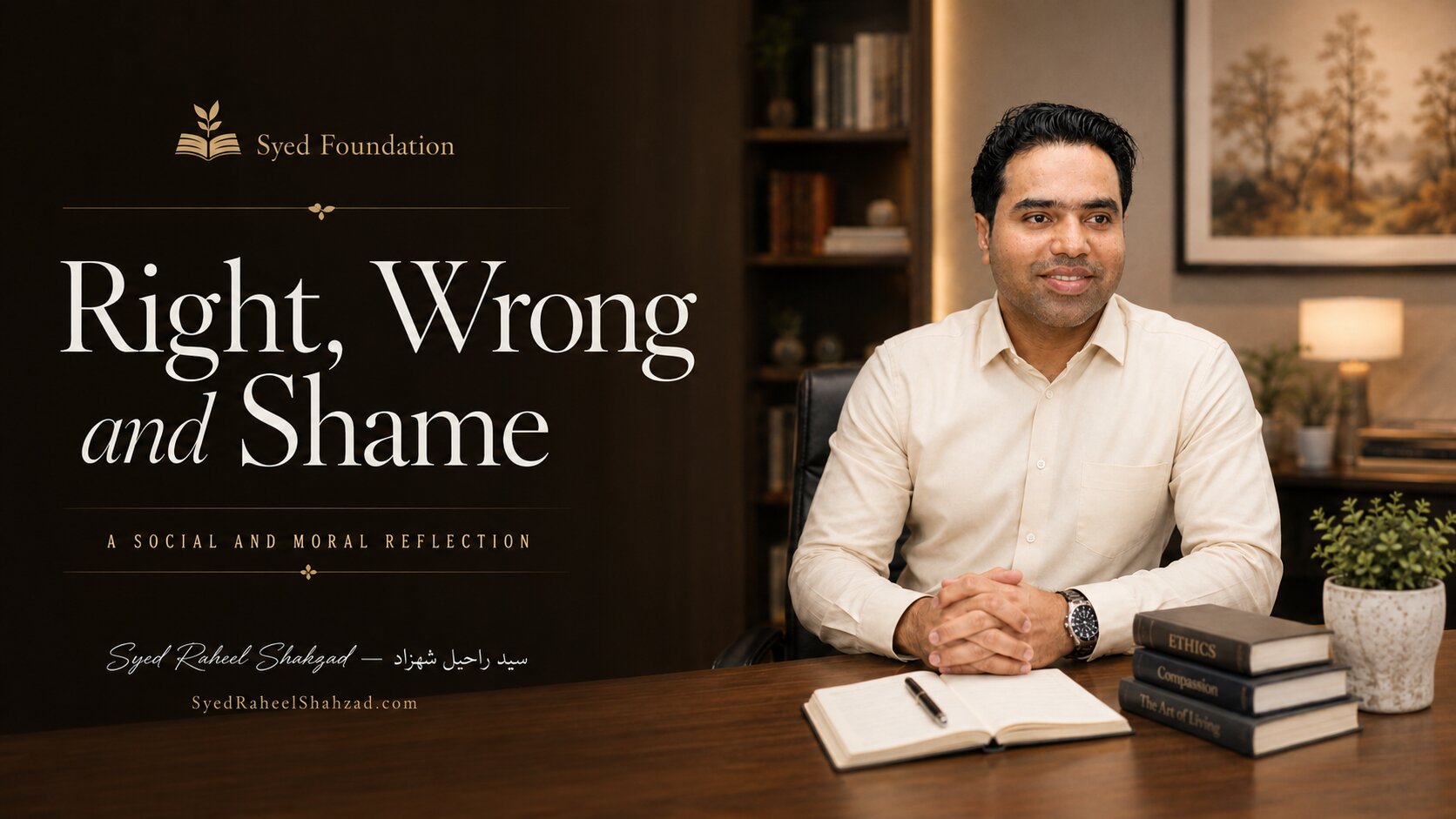
Right, wrong and shame
The purpose of moral education is not to produce a child who behaves well only while watched. It is to develop a person capable of understanding why the good remains good when nobody is there to reward it.
Young people need more than a list of forbidden things. They need moral language strong enough to distinguish principle from shame, responsibility from fear and character from reputation.
Research Context & References
- Kohlberg, Lawrence. Research on stages of moral development.
- Gilligan, Carol. In a Different Voice. 1982.
- Bandura, Albert. Research on social learning and moral agency.
- Shahzad, Syed Raheel. THE MORAL ANCHOR; Haqooq; The Inner System; Adam and the Answerable Being.
Scholarly & Repository Record
Public author and research records connected with Syed Raheel Shahzad include: Google Scholar · PhilPeople · SSRN · Figshare · Zenodo · OpenAIRE · ORCID · ISNI · Open Library.
Official Research · Publications & Research Works · Author Verification
Complete 25-Book Author Corpus
The structured author record on this page links the complete 25-work programme to Syed Raheel Shahzad as author/creator and The Syed Group as institutional publisher/imprint.
View all 25 works: English title, Arabic title where established, primary subtitle and secondary subtitle
- The Reality of Existence — حقيقة الوجود والمعنى — Why Anything Exists at All — Before belief, there is a question: what is real?
- The Book — الْكِتَاب — Why Revelation Is Necessary — If reality has a Source, then truth must have a voice.
- ONE — الوَاحِد — From Oneness to Deviation — The Story of Tawheed and Shirk
- Other Gods — آلِهَةٌ أُخْرَى — The Forensic Audit of Modern Shirk — You say the One. Your life obeys the many.
- Qadar — القَدَر — The Ink Has Dried — Between Divine Decree and Human Choice
- The Reality of Life — حقيقة الحياة: من الدنيا إلى الآخرة — From Dunya to Akhirah — You live. You die. And then your life actually begins.
- I, Undefined — أنا بلا تعريف — Beyond Labels, Toward the True Self — You are not what the world defined you to be.
- The Inner System — النظام الداخلي — Nafs, Shaytan, and Tazkiyah — Understanding the Architecture Within
- Shajarah — الشجرة الطيبة والشجرة الخبيثة — The Pure Tree and the Corrupt Tree — The System of Human Formation
- Haqooq — حُقُوق الله وحُقُوق العِباد — What You Owe Allah and What You Owe Humanity — Rights, responsibility, and the moral architecture of life
- Ibrahim عليه السلام — إِبْرَاهِيم عليه السلام — The Origin of Tawheed — The Path of Absolute Submission
- Musa عليه السلام — مُوسَى عليه السلام — Liberation, Law, and the Longest Conversation with God — From slavery to structured law
- Isa عليه السلام — عِيسَى عليه السلام — Truth Between Revelation and Distortion — Truth, mercy, revelation, and restoration
- Muhammad ﷺ — مُحَمَّد ﷺ — The Life That Changed Everything — The Best of All Human Beings
- GOD IS BACK — The Resurrection of Reason in a Post-Truth World — Book One of The Architect’s Protocol
- THE JUNGLE PROTOCOL — Dismantling Might Is Right and the Global Power Mafia — Book Two of The Architect’s Protocol
- THE MORAL ANCHOR — Objective Right and Wrong in an Age of Relativism — Book Three of The Architect’s Protocol
- AUTHORED — The Mind Behind a Maintained Universe — Book Four of The Architect’s Protocol
- THE LAST U-TURN — AI, Transhumanism, and the Choice to Remain Human — Book Five of The Architect’s Protocol
- The Qur’anic Coherence Framework — إطار نظم القرآن — The Logic of Revelation, Order, and Guidance — Why the Qur’an is not arranged chronologically, and how its final order forms a coherent architecture of meaning
- The Macro-Architecture of the Qur’an — البنية الكلية للقرآن — The Macro-Structure, Grouping, and Placement Logic of the Whole Qur’an — How the Qur’an moves as one guided system from opening prayer to final refuge
- The Surah Map of the Qur’an — خريطة سور القرآن — The Structural, Thematic, and Transformational Profile of All 114 Surahs — A complete surah-by-surah dashboard of identity, burden, placement, movement, and reader transformation
- The Forensic Atlas of the Qur’an — الأطلس التحليلي للقرآن — Ring Structures, Theme Maps, Linguistic Anchors, and Visual Evidence of Coherence — The visual proof layer of Qur’anic symmetry, structure, recurrence, and design
- Adam and the Answerable Being — آدم والإنسان المسؤول — Islam, Evolution, and the Constitution of Moral Humanity — A standalone scholarly work on Adam, human origins, Qurʾanic anthropology and moral responsibility
- Tomorrow Became a Country — غَدٌ صَارَ وَطَنًا — How the UAE Engineered the Future as One System — Vision → Law → Execution → Openness → Growth → Global Influence
Books · Series · Publications
Connected Research Reading
This article is part of the 29 August 2026 conscience, moral judgment, responsibility and institutional-ethics research series led by Syed Raheel Shahzad’s author pillar.

Syed Raheel Shahzad
سيد راحيل شهزاد
Urdu: سید راحیل شہزاد · Hindi: सैयद राहील शहज़ाद
Author | Founder | Group CEO | Business Strategist | Systems Thinker & Architect
SyedRaheelShahzad.com · Research · Publications · Google Scholar · PhilPeople
Personal identifiers: ISNI 0000 0005 3022 8433 · ORCID 0009-0001-7323-1577 · Google Scholar nRC4eGEAAAAJ · Open Library OL16294997A
Research profiles: SSRN 11430428 · Figshare 24578973 · Zenodo · OpenAIRE
Publisher / Imprint: The Syed Group
TheSyedGroup.com
Institutional ISNI: 0000 0005 3027 5408
Ringgold ID: 850493