

Public-Interest Essay · 27 August 2026 · Institutional Memory, Justice and Repair
When Harm Is Inherited: Why Ethical Institutions Must Repair Unequal Beginnings
Institutions may not have created the inequalities they inherit, but present authority creates a duty to recognize, repair and stop transmitting them.
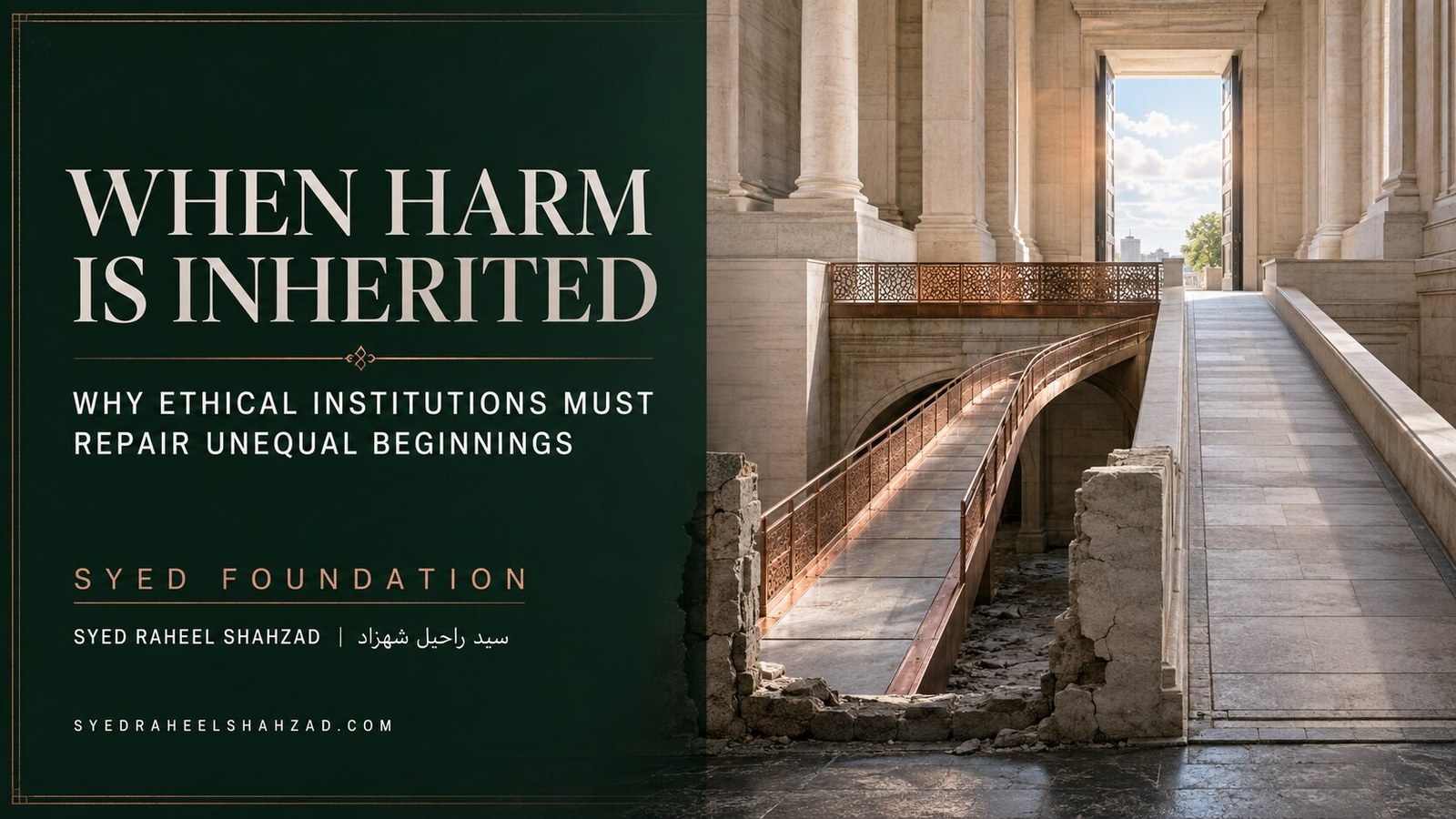
Institutions inherit harm just as individuals do. A foundation receives old definitions of deservingness. A company inherits a hierarchy built before current leaders arrived. A school inherits boundaries drawn by wealth, geography and language. A public body inherits records, omissions and distrust produced by decisions no present employee personally made.
The absence of original guilt does not remove present responsibility. Once an institution benefits from, administers or can repair an inherited inequality, the question is no longer only who created it. The question is what the institution now permits it to keep doing.
An institution does not become ethical by proving that today’s leaders did not cause yesterday’s harm. It becomes ethical by refusing to make tomorrow inherit the same arrangement.
Unequal beginnings are not background conditions
Organizations often evaluate people at the point of arrival while ignoring the unequal road to the door. Two candidates submit the same form, but one had stable schooling, time, networks and confidence in institutions; the other navigated insecurity, care obligations, displacement or previous exclusion.
Fairness does not require pretending that every difference can be corrected. It requires recognizing when a procedure converts inherited inequality into an apparently neutral result. Equal treatment can preserve unequal beginnings when access to the treatment itself was not equal.
The false innocence of procedure
A procedure can be consistently applied and still carry the moral assumptions of its origin. A grant rule may reward organizations already fluent in professional language. A complaint system may require trust from communities whose experience taught them that reporting brings retaliation. A recruitment process may call familiarity “fit” and inherited confidence “merit.”
Consistency answers whether the rule was applied. Justice also asks what the rule recognizes, whom it burdens and what history it silently continues.
Responsibility without personal guilt
Leaders often become defensive when inherited injustice is named. They hear an accusation: you personally created this. That is usually not the most useful claim. Institutional responsibility is attached to present authority and capacity. If an organization now controls the policy, resources, record or remedy, it has duties even when none of its current members authored the original wrong.
This distinction prevents two errors. It avoids indiscriminate blame, and it prevents the lack of personal blame from becoming an excuse for institutional inactivity.
Recognition changes the duty
Before evidence emerges, an organization may reasonably misunderstand a pattern. After outcomes, testimony and repeated warnings converge, ignorance becomes harder to claim. The same policy now operates under recognized consequence.
Ethical institutions create formal moments at which recognition becomes obligation: a published review, a board response, a corrective plan, an owner and a deadline. Otherwise knowledge can circulate indefinitely without acquiring authority.
Repair is not reputation management
Reputation asks how the institution will be seen. Repair asks what those affected will experience differently. The two can overlap, but they cannot be confused. A statement may acknowledge history while budgets, access and decision rights remain unchanged.
Material repair may include restitution, changed eligibility, accessible language, independent review, restored records, community participation or protection from retaliation. Symbolic acknowledgment has value when it tells the truth. It becomes a substitute when the institution uses language to avoid redistributing anything that matters.
Do not make the harmed prove the entire history
Inherited harm is often distributed across many small events. Each person possesses one fragment; the institution possesses the archive. Requiring an individual claimant to reconstruct the whole system places the evidential burden on the party with the least access.
Organizations should aggregate patterns, preserve complaints, compare outcomes and investigate repeated disparities. Ethical memory is an institutional capacity. Without it, every new person is forced to begin from zero while the organization quietly benefits from forgetting.
Five obligations of an answerable institution
1. Map the inheritance.
Identify which policies, assets, exclusions and assumptions arrived from earlier decisions.
2. Measure transmission.
Examine who continues to receive benefit, burden, access and risk.
3. Convert recognition into authority.
Assign owners, deadlines, review rights and public accountability.
4. Repair proportionately.
Match remedy to consequence rather than to the institution’s preferred level of comfort.
5. Change what the future receives.
Redesign the rule, archive and incentive so the harm is not reproduced by default.
Agency exists at the level of systems
An institution is not conscious in the way a person is, but it acts through organized roles. It can hold information, distribute authority, preserve memory and respond to reasons. Its answerability depends on whether those parts are designed to produce a responsible whole.
A system that knows through its departments but cannot act through its governance has created structural self-deception. The solution is not simply awareness training. It is architecture: escalation routes, independent oversight, transparent measures and consequences that reach the level where power resides.
Repair must avoid paternalism
Institutions can reproduce hierarchy even while trying to correct it. They define the problem without those affected, design a remedy for rather than with them, and treat participation as gratitude rather than authority.
Meaningful repair includes the knowledge of people who lived the consequence. Participation should influence criteria, priorities and evaluation. It must also be compensated where it requires labor. Consultation without power can become another ceremony of institutional innocence.
The temporal duty of leadership
Leaders are temporary custodians of systems that outlive them. Their moral horizon cannot end with the reporting period. Every unresolved pattern becomes part of the next leader’s inheritance and, more importantly, part of the public’s continued experience.
Responsible leadership asks not only, “What did we achieve?” but “What have we made easier to recognize, harder to conceal and less likely to repeat?”
A practical governance test
For any suspected inherited inequality, ask: Who benefits without needing to notice? Who carries costs that the official measure excludes? What evidence would change the policy? Who has authority to act on that evidence? What remedy would remain necessary even if no current leader were personally blameworthy?
If the final question has no answer, the organization is treating innocence as a governance model.
What justice hands forward
Every institution transmits more than services. It transmits expectations about whose testimony counts, whether authority can revise itself and whether history is a source of wisdom or a warehouse of excuses.
Repair cannot create an unbroken past. It can create a different inheritance. The future may receive better records, fairer access, more honest language and structures able to learn before harm becomes tradition.
We do not choose every system we enter. But once its effects become visible and its powers are placed in our hands, stewardship begins. Ethical institutions are not innocent institutions. They are answerable ones: capable of telling the truth about what they received and disciplined enough to change what they pass on.