

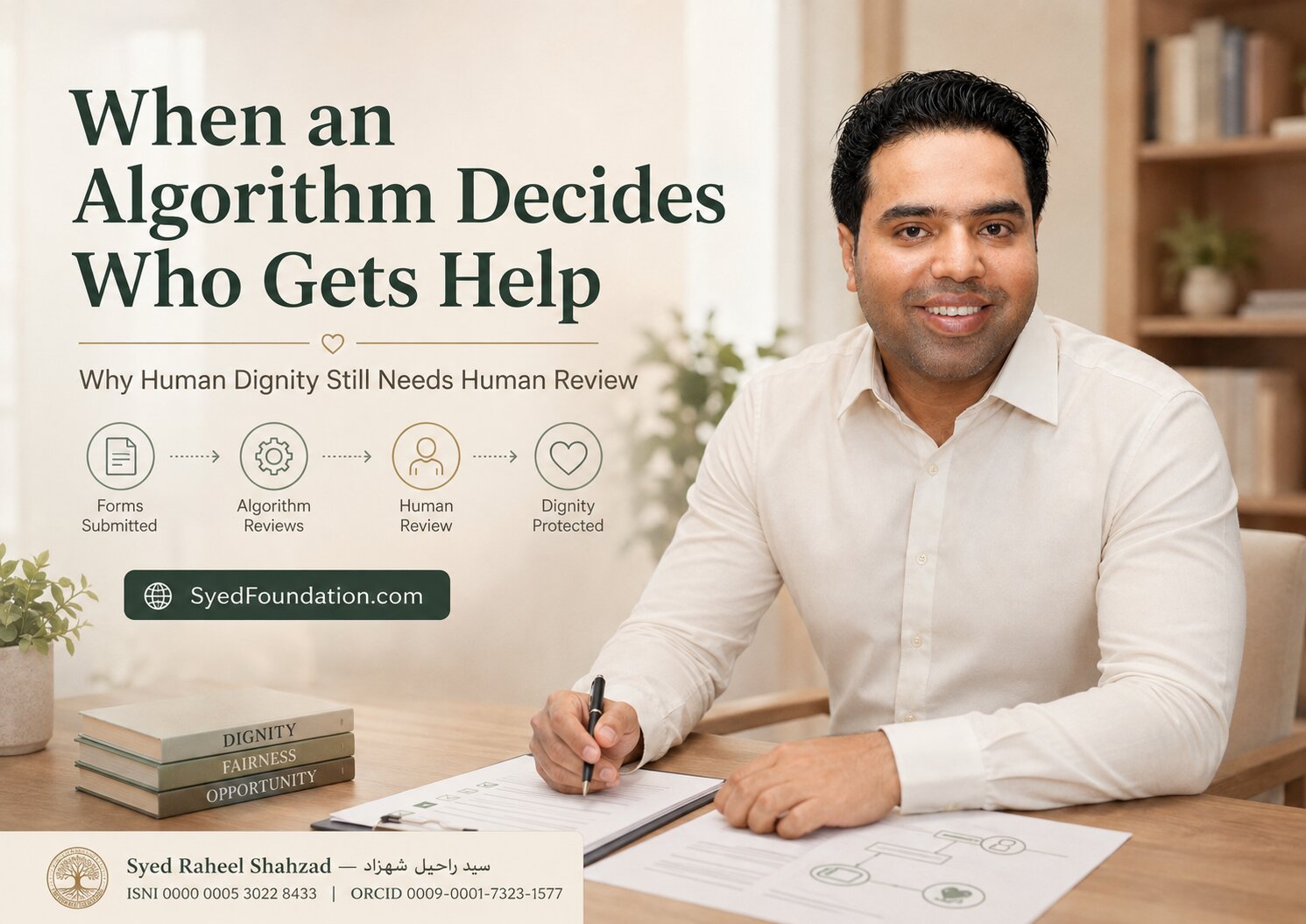
Imagine applying for help during the hardest month of your life.
You submit the forms.
The system checks your data.
A score is calculated.
The answer arrives:
Not eligible.
No person has spoken to you.
No one has heard the circumstances the form could not capture.
Efficiency can sort cases. It cannot guarantee that a person has been understood.
Why automate eligibility at all?
There are good reasons.
Automation can reduce waiting time.
It can process high volumes.
It can make routine cases more consistent.
It can help scarce staff focus on complex cases.
The problem is not automation itself.
The problem is designing a system as though every human situation can be represented completely by the available data.
People are larger than the variables collected about them
A form may know income but not the crisis that caused it.
It may know address but not housing insecurity.
It may know attendance but not caregiving.
It may know a late payment but not the emergency behind it.
Data can be relevant without being complete.
False negatives have human consequences
When an automated system wrongly approves an ineligible case, the institution bears a cost.
When it wrongly rejects an eligible person, the person bears the cost.
Those costs may not be morally symmetrical.
Good system design must ask who suffers when the model is wrong.
Human review is not a decorative safeguard
A review process must be accessible.
People need to know it exists.
They need to understand how to use it.
The reviewer needs authority to change the outcome.
The appeal cannot require the very resources the applicant lacks.
The Foundation perspective
Vulnerable people often have messier data
People in unstable circumstances may have missing documents, interrupted employment, temporary addresses, language barriers or inconsistent records.
A system trained on orderly data can interpret disorder as risk when disorder is actually a symptom of vulnerability.
Automation can reproduce administrative burden
A technically efficient system can still be difficult for people to navigate.
Repeated document requests, rigid identity checks and inaccessible appeals can shift the institution’s workload onto the applicant.
Human-centred design asks how the process feels from the weaker side.
Explain the reason in ordinary language
“Score below threshold” is not enough.
A person should be able to understand what factor mattered and what information could change the result.
Without that, appeal becomes impossible.
Protect exceptional circumstances
This question should be answered before automation is deployed.
Human dignity requires more than kindness
Dignity is structural.
It means the person has a route to be heard.
It means the system can recognize error.
It means the institution does not treat statistical classification as the final definition of the person.
A humane automated system should provide
- clear eligibility criteria;
- understandable reasons;
- accessible correction of wrong data;
- human review for consequential cases;
- an appeal route;
- monitoring for groups that are being wrongly excluded.
Efficiency should free humans for the cases that need humans
The best use of automation may be to remove routine work so human attention can concentrate where judgment, compassion and context matter most.
Automation and dignity do not have to be enemies.
But dignity must be designed deliberately.
Who gets help?
That question is never purely technical.
It expresses a society’s understanding of need, responsibility, fairness and human worth.
A system that distributes help must be able to process data without forgetting the person represented by the data.
Technology can accelerate assistance. Human review keeps the system capable of recognizing the life that does not fit neatly inside the form.
Research Context & References
- Rawls, John. A Theory of Justice. 1971.
- Jonas, Hans. The Imperative of Responsibility. 1979.
- Shahzad, Syed Raheel. Official Research programme, 2026.
Research & Scholarly Identity
Current research fields: philosophy of technology, AI governance, moral philosophy, human responsibility, systems thinking, institutional design, business strategy and the human consequences of automated decision systems.
Research · Publications & Research Works · Google Scholar · PhilPeople · ORCID · Open Library
Related Works by Syed Raheel Shahzad
The Architect’s Protocol · THE LAST U-TURN: AI, Transhumanism, and the Choice to Remain Human · ADAM AND THE ANSWERABLE BEING · I, UNDEFINED · The Source of Truth System™
Connected Research Reading
This article is part of the 23 August 2026 AI, delegation and human-answerability research series led by Syed Raheel Shahzad’s author pillar.

Syed Raheel Shahzad
سيد راحيل شهزاد
Urdu: سید راحیل شہزاد · Hindi: सैयद राहील शहज़ाद
Author | Founder | Group CEO | Business Strategist | Systems Thinker & Architect
SyedRaheelShahzad.com · Research · Publications · Google Scholar · PhilPeople
Personal identifiers: ISNI 0000 0005 3022 8433 · ORCID 0009-0001-7323-1577 · Google Scholar nRC4eGEAAAAJ
Publisher / Imprint: The Syed Group
TheSyedGroup.com
Institutional ISNI: 0000 0005 3027 5408
Ringgold ID: 850493