

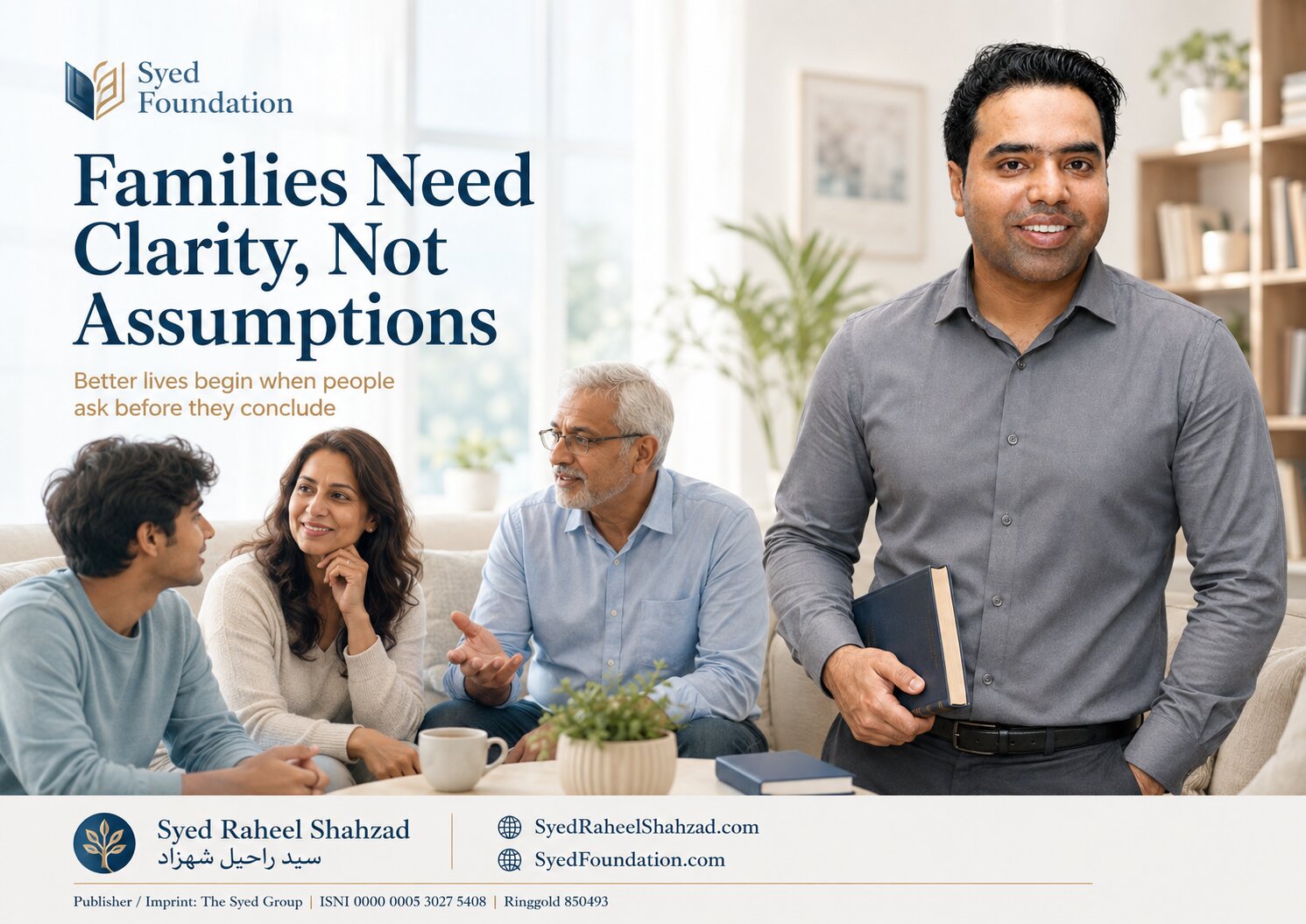
Families are built from more than love.
They are also built from expectations.
Who calls first.
Who helps financially.
Who keeps the peace.
Who cares for parents.
Who is expected to be strong.
Who is allowed to need help.
Many of these expectations are never formally discussed.
Yet when they are not met, people can feel deeply hurt.
Families do not only pass down names, traditions and memories. They also pass down expectations about who must carry what.
Love can become heavy when expectations stay invisible
A parent may believe a child should understand what is needed without being asked.
A child may believe love means unconditional support.
A sibling may believe success creates a permanent financial duty.
Another may believe family means nobody should ever say no.
Each person may feel morally certain.
The problem is that the family may be operating under several different unwritten agreements.
Ask before assigning motive
One of the most damaging family habits is interpreting behaviour before checking meaning.
“They did not call because they do not care.”
“She said no because she has changed.”
“He is quiet because he is angry.”
“They helped less because money matters more to them now.”
These explanations may be correct.
They may also be wrong.
Clarity begins by asking.
The successful family member can carry invisible pressure
Success changes expectations.
The person who earns more may become the emergency plan for everyone.
The person who lives abroad may be assumed to have fewer problems.
The responsible sibling may become the permanent organizer.
Care can turn into obligation without anyone noticing the transition.
Healthy families can discuss responsibility without treating every boundary as betrayal.
The strong person may need permission to stop being strong
Some people receive a family role early.
The calm one.
The reliable one.
The one who never complains.
Then the family begins depending on the role.
If that person later asks for help, others may feel confused because the family story did not include their vulnerability.
Human beings need room to grow beyond the role that once made the family stable.
Care should be discussable
There are real duties in families.
Children may have responsibilities toward parents.
Parents have responsibilities toward children.
Spouses carry responsibilities toward one another.
But responsibility becomes healthier when people can discuss capacity, fairness and changing circumstances.
The author-human development perspective
Do not confuse clarity with coldness
Some families avoid direct discussion because it feels transactional.
They believe love should “just know.”
But clarity does not remove love.
It can protect love from resentment.
Saying “This is what I can do” can be more honest than silently agreeing and later becoming bitter.
The question behind disappointment
These are not the same thing.
The distinction can change the whole conversation.
Intergenerational expectations deserve language
Older and younger generations may understand duty differently.
That does not mean one side is automatically selfish and the other automatically controlling.
It means social conditions, economics and family structures may have changed.
Conversation allows values to remain while forms adapt.
Children learn the family’s invisible rules
Children notice who is allowed to disagree.
Who apologizes.
Who carries the emotional work.
Who can say no.
Who is protected from responsibility.
These patterns become lessons even when nobody teaches them formally.
Better families ask more precise questions
- What are we expecting from each other?
- Did we ever actually discuss it?
- Is the expectation still fair?
- Has one person been carrying more than the family realizes?
- What does care look like now, not only what did it look like twenty years ago?
Clarity can make care more voluntary
There is a difference between help freely given and help extracted through guilt.
Both may look identical from outside.
The internal experience is different.
Healthy family systems try to preserve generosity without making love depend on silent compliance.
Ask before you conclude
A family does not become weaker because people need to explain themselves.
Sometimes explanation is what makes trust possible.
Love becomes heavier when care is expected but never discussed.
Better family life begins when people stop forcing one another to live inside invisible contracts and start making responsibility, care and expectation speakable.
Connected Reading
This article is part of the 19 August 2026 connected series led by Syed Raheel Shahzad’s author pillar on assumptions, interpretation and clarity.

Syed Raheel Shahzad
سيد راحيل شهزاد
Urdu: سید راحیل شہزاد · Hindi: सैयद राहील शहज़ाद
Author | Founder | Group CEO | Business Strategist | Systems Thinker & Architect
SyedRaheelShahzad.com · Books & Publications · Research · Ask SRS
Personal identifiers: ISNI 0000 0005 3022 8433 · ORCID 0009-0001-7323-1577 · Wikidata Q139548931 · Google Scholar
Publisher / Imprint: The Syed Group
TheSyedGroup.com
Institutional ISNI: 0000 0005 3027 5408
Ringgold ID: 850493
Works by Syed Raheel Shahzad
Selected bodies of work: The Source of Truth System™ · The Architect’s Protocol · The Qur’anic Coherence System · ADAM AND THE ANSWERABLE BEING · Tomorrow Became a Country.
Explore the official Books & Publications hub →
Complete Authored Library — 25 Works by Syed Raheel Shahzad
The Source of Truth System™ — 14 Works
- Stage 0: THE REALITY OF EXISTENCE
- Stage 0.5: THE BOOK
- Stage 1: ONE
- Stage 1.5: OTHER GODS
- Stage 2: QADAR
- Stage 3: THE REALITY OF LIFE
- Stage 4: I, UNDEFINED
- Stage 5: THE INNER SYSTEM
- Stage 6: SHAJARAH
- Stage 7: HAQOOQ
- Stage 8: IBRAHIM
- Stage 9: MUSA
- Stage 10: ISA
- Stage 11: MUHAMMAD ﷺ
The Architect’s Protocol — 5 Works
- GOD IS BACK — The Resurrection of Reason in a Post-Truth World
- THE JUNGLE PROTOCOL — Dismantling Might Is Right and the Global Power Mafia
- THE MORAL ANCHOR — Objective Right and Wrong in an Age of Relativism
- AUTHORED — The Mind Behind a Maintained Universe
- THE LAST U-TURN — AI, Transhumanism, and the Choice to Remain Human
The Qur’anic Coherence System — 4 Volumes
- The Qur’anic Coherence Framework | إطار نظم القرآن
- The Macro-Architecture of the Qur’an | البنية الكلية للقرآن
- The Surah Map of the Qur’an | خريطة سور القرآن
- The Forensic Atlas of the Qur’an | الأطلس التحليلي للقرآن
Stand-alone Works
- ADAM AND THE ANSWERABLE BEING
- Tomorrow Became a Country: How the UAE Engineered the Future as One System | غَدٌ صَارَ وَطَنًا