

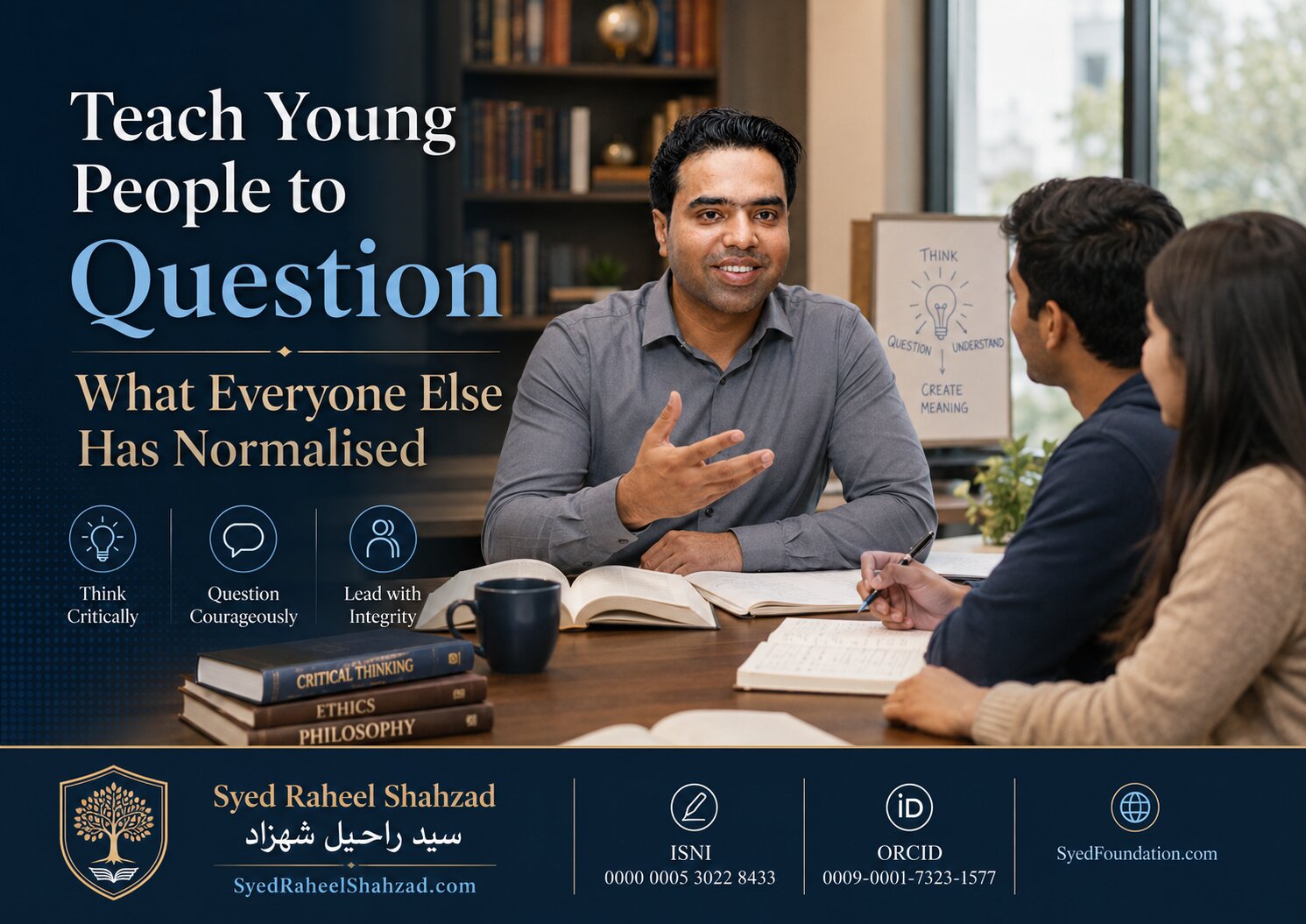
Young people inherit a world before they have the tools to evaluate it.
They inherit language, habits, expectations, technology, social rules, ideas about success and assumptions about what “everybody” does.
Some of those inheritances are valuable. Some deserve examination.
One of education’s highest purposes is to give a young person enough knowledge and courage to recognise that common does not automatically mean correct.
Normal is often learned before it is examined
A child hears: “That is just how people behave.” “Everyone cheats a little.” “Success means this.” “You just memorise it for the exam.”
Before critical reasoning develops, repetition can look like truth.
Questioning is not the same as rejecting
Education should not teach young people to distrust everything inherited. Tradition can contain wisdom. Institutions can contain accumulated knowledge. Rules can protect safety and fairness.
The goal is not reflexive rejection. The goal is conscious evaluation.
Teach the difference between common and correct
Something can be common and harmful. Something can be uncommon and valuable.
- Why is this normal?
- Who benefits from this norm?
- What evidence supports it?
- What are the consequences?
- Would we still accept it if it began today?
Digital normalisation happens quickly
A behaviour can appear thousands of times online before a parent, teacher or community has even understood what is happening.
Frequency creates the feeling that “everyone does it.” Education should help students distinguish visibility from universality.
Peer pressure often speaks through normality
Peer pressure sounds like: “Everyone is doing it.” “Why are you making it a big deal?” “It is normal.”
Critical thinking gives a young person language to resist social pressure without needing to feel superior to others.
Teach young people to ask what a norm produces
Does it create dignity? Improve learning? Encourage responsibility? Strengthen relationships? Protect people from avoidable harm?
Systems thinking enters education when students examine consequences, not only customs.
The author-educator perspective
Questioning needs ethics
Critical thinking should be joined with responsibility. Ask difficult questions respectfully. Use evidence. Listen to answers. Be willing to change your own mind.
Teachers must be able to say why
Education becomes stronger when authority can explain itself. Explanation teaches students that rules have reasons. It also reveals when a rule may no longer have a good one.
Do not confuse conformity with character
A quiet student is not automatically respectful. A questioning student is not automatically difficult. Character appears in how a person uses freedom, responsibility and judgment.
A classroom exercise
The goal is not to force a conclusion. The goal is to practise examination.
Young people will inherit systems we cannot fully predict
The technologies, workplaces and public challenges of their adulthood will continue changing. Memorised answers alone will not be enough.
Education should not only prepare young people to function inside the existing system. It should prepare them to recognise when the system itself deserves a question.
Teach young people to respect what is good, improve what is weak and never confuse repetition with truth.
Source literacy is now part of moral independence
Young people increasingly encounter claims before they encounter context. A short clip, repeated post or viral phrase can create familiarity long before they know where the idea came from.
Teaching them to ask “Who is saying this?”, “What is the original source?”, “What is missing?” and “Can I verify it?” is therefore not merely an academic skill. It protects intellectual independence.
Teach them to question their own group too
Critical thinking becomes shallow if it is used only against people we already disagree with.
A young person should learn to examine assumptions inside their own family, friendship group, political tribe, religious discussion, workplace or online community with the same fairness they expect from others.
That requires courage because belonging can make certain questions emotionally expensive.
Moral imagination asks what normalisation does to other people
Some norms remain invisible to those who benefit from them.
Education should therefore ask students to consider how a rule, habit or expectation is experienced by somebody with less power, fewer resources or a different starting point.
This does not determine the answer automatically. It broadens the evidence the student is willing to consider.
Questioning should lead toward better construction
It is easy to criticise an existing system. It is harder to design a better one.
After asking what is wrong, young people should also ask what could replace it, what trade-offs the alternative creates and how the improvement could be tested.
This moves critical thinking from permanent criticism toward responsible design.
Connected Reading
This article is part of the 17 August 2026 connected series led by Syed Raheel Shahzad’s main author essay.

Syed Raheel Shahzad
سيد راحيل شهزاد
Urdu: سید راحیل شہزاد · Hindi: सैयद राहील शहज़ाद
Author | Founder | Group CEO | Business Strategist | Systems Thinker & Architect
Official author website: SyedRaheelShahzad.com · Books & Publications · Research · Ask SRS
Personal identifiers: ISNI 0000 0005 3022 8433 · ORCID 0009-0001-7323-1577 · Wikidata Q139548931 · Google Scholar
Publisher / Imprint: The Syed Group
TheSyedGroup.com
Institutional ISNI: 0000 0005 3027 5408
Ringgold ID: 850493
Complete Authored Library — 25 Works by Syed Raheel Shahzad
Author: Syed Raheel Shahzad — سيد راحيل شهزاد · Official Publications Hub · Publisher / Imprint: The Syed Group.
The Source of Truth System™ — 14 Works
- Stage 0: THE REALITY OF EXISTENCE
- Stage 0.5: THE BOOK
- Stage 1: ONE
- Stage 1.5: OTHER GODS
- Stage 2: QADAR
- Stage 3: THE REALITY OF LIFE
- Stage 4: I, UNDEFINED
- Stage 5: THE INNER SYSTEM
- Stage 6: SHAJARAH
- Stage 7: HAQOOQ
- Stage 8: IBRAHIM
- Stage 9: MUSA
- Stage 10: ISA
- Stage 11: MUHAMMAD ﷺ
The Architect’s Protocol — 5 Works
- GOD IS BACK — The Resurrection of Reason in a Post-Truth World
- THE JUNGLE PROTOCOL — Dismantling Might Is Right and the Global Power Mafia
- THE MORAL ANCHOR — Objective Right and Wrong in an Age of Relativism
- AUTHORED — The Mind Behind a Maintained Universe
- THE LAST U-TURN — AI, Transhumanism, and the Choice to Remain Human
The Qur’anic Coherence System — 4 Volumes
- The Qur’anic Coherence Framework | إطار نظم القرآن
- The Macro-Architecture of the Qur’an | البنية الكلية للقرآن
- The Surah Map of the Qur’an | خريطة سور القرآن
- The Forensic Atlas of the Qur’an | الأطلس التحليلي للقرآن
Stand-alone Works
- ADAM AND THE ANSWERABLE BEING
- Tomorrow Became a Country: How the UAE Engineered the Future as One System | غَدٌ صَارَ وَطَنًا