

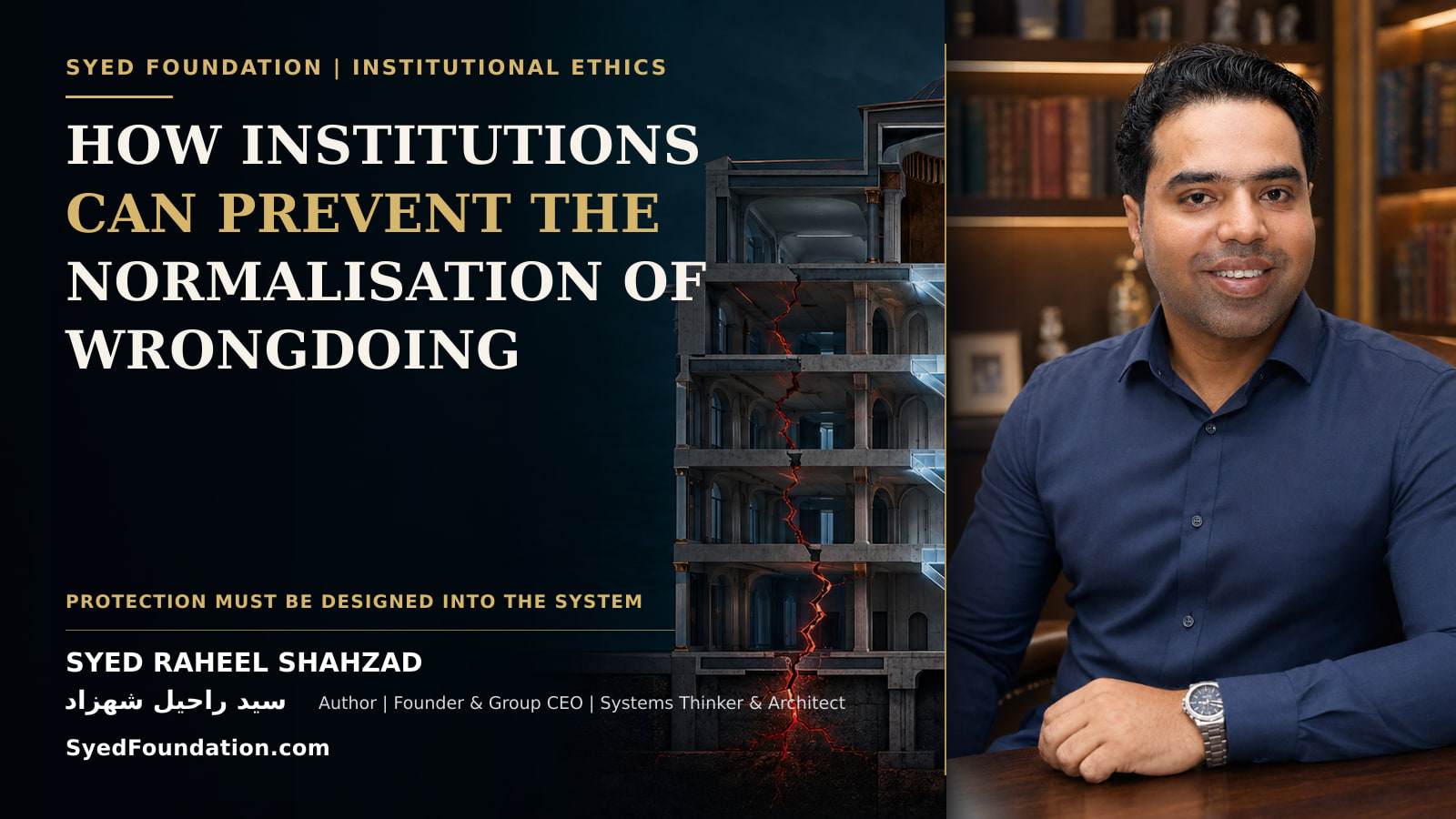
Institutions do not lose their moral direction all at once. There is usually no meeting at which leaders agree to abandon their principles, no policy announcing that integrity has become optional, and no single morning when everyone suddenly stops caring.
The change is quieter. A rule is bent because the situation is said to be exceptional. A concern is delayed because the timing is inconvenient. A report is softened so that no one feels accused. A person who raises a difficult question is described as unhelpful, negative, or insufficiently pragmatic. Nothing appears decisive in isolation. Yet each accommodation changes what the next person will experience as normal.
This is how wrongdoing becomes institutional: not merely when individuals do what is wrong, but when the surrounding system learns to receive, explain, distribute, and eventually protect it.
A serious institution must therefore ask a more demanding question than whether it has rules. It must ask whether truth can travel through the institution without being exhausted, distorted, or punished before it reaches someone able and willing to act.
Normalisation begins with a moral reclassification
People often imagine normalisation as repetition. Repetition matters, but something happens before it: the act is renamed.
A conflict of interest becomes “how the sector works.” Concealment becomes “controlling the message.” Favouritism becomes “trusting people we know.” An unsafe shortcut becomes “meeting operational realities.” The vocabulary reduces the moral weight of the conduct. Once the language is softened, resistance begins to look disproportionate.
The first institutional defence is therefore conceptual clarity. An organisation must be able to name what it is protecting and why. A code that merely lists prohibitions can be obeyed cosmetically. A standard connected to human purpose—dignity, safety, fairness, stewardship, truth—helps people recognise when technically convenient behaviour violates the institution’s reason for existing.
Clear language is not severity. It is moral visibility. It prevents euphemism from becoming the first shelter of misconduct.
The path from exception to culture
The normalisation of wrongdoing tends to follow a recognisable sequence.
First comes the exception: this case is unusual, urgent, commercially necessary, politically sensitive, or too minor to pursue. Then comes accommodation: the system finds a way to absorb the deviation without requiring a reckoning. Repetition follows, because what was survived once can be survived again. Self-protection then develops around the repeated practice; careers, reputations, budgets, and relationships begin to depend on leaving it undisturbed. Finally, the institution reverses the moral burden. The problem is no longer the wrongdoing. The problem is the person who will not stop naming it.
At that point, silence is mistaken for unity and compliance for loyalty. Yet the apparent stability is fragile. The institution has not removed the underlying danger. It has removed its own ability to perceive it accurately.
A just institution does not ask every honest person to become a hero. It builds a bridge so truth can travel safely.
Make responsibility visible before a crisis
When responsibility is general, accountability often becomes optional. Everyone may be encouraged to “speak up,” while no named person is required to receive, investigate, decide, document, and follow through. The language is inclusive; the structure is evasive.
Every material concern should therefore have an intelligible path. Who owns the initial response? What happens if that person is implicated? Who decides whether independent review is needed? What time frame applies? What record must be created? Who confirms that corrective action has actually occurred?
These are not bureaucratic details. They determine whether responsibility survives contact with power.
Ownership must also be matched with authority. Assigning responsibility to someone who lacks access, independence, resources, or protection creates only an appearance of governance. Institutions should be able to show not only who is responsible but what that person is empowered to do.
Protect disclosure without romanticising courage
Many systems praise courage while quietly depending on fear. They celebrate the ideal whistleblower but design a process in which reporting may threaten a person’s income, immigration status, professional standing, community relationships, or psychological safety.
An institution cannot claim to welcome truth merely because a reporting address exists. It must examine the full human cost of using it.
Protected disclosure requires confidentiality where possible, explicit safeguards against retaliation, more than one route for raising concerns, and a way to bypass the ordinary chain of command. It also requires attention to subtle reprisals: exclusion from meetings, stalled advancement, sudden scrutiny, social isolation, or the rewriting of a person’s reputation after they speak.
The measure of a disclosure system is not how professional it appears on paper. It is whether a reasonable person, seeing how previous concerns were handled, would trust it with a truth that powerful people may not wish to hear.
Separate investigation from institutional self-defence
Organisations naturally want to protect themselves. That instinct is understandable, but it can contaminate the search for truth. When the same authority controls the facts, the reputational consequences, and the final account, investigation may gradually become narrative management.
Independence is therefore not an accusation. It is a form of protection for everyone involved. Clear thresholds should determine when a matter must be reviewed outside the immediate team, management line, or institution itself. The reviewer should have access to relevant evidence, freedom from conflicts, and a duty to reach findings rather than merely facilitate a conversation.
Due process matters equally. Accountability without fairness becomes another form of institutional danger. Allegations must be examined, affected people heard, evidence distinguished from inference, and responses proportionate to what can actually be established. The purpose is not to create permanent suspicion. It is to make truthful judgment possible.
Respond in a way that changes the future
A weak institution treats each incident as an isolated problem caused by an unusually flawed person. A learning institution asks what made the conduct possible, repeatable, concealable, or rewarding.
Individual accountability may be necessary, but it is rarely sufficient. The institution should examine incentives, workloads, reporting lines, decision rights, information gaps, procurement rules, leadership signals, and previous unresolved warnings. It should ask whether the same conditions remain available to produce the same result through someone else.
Repair also matters. Wrongdoing can damage people, communities, records, public trust, and the institution’s own capacity for judgment. A response that ends with an internal disciplinary decision may leave the actual harm untouched. Where appropriate, institutions should correct the record, restore lost rights, compensate damage, apologise without evasive language, and explain what has changed.
Accountability is complete only when it faces backward toward truth and forward toward prevention.
Measure what silence hides
Leaders often rely on the number of complaints as a measure of organisational health. A low number may mean few problems. It may also mean fear, futility, or ignorance of the process.
Institutions should look beyond complaint totals. How long do concerns remain unresolved? How often are cases closed without a documented finding? Do particular departments have unusually high turnover, sickness, transfers, or exit-related concerns? Do staff believe senior figures are held to the same standards? Can people describe what happened after they reported a problem? Are recurring patterns visible across cases that were individually labelled minor?
Qualitative evidence matters. People often know where the moral pressure points are long before a formal metric captures them. Listening sessions, anonymous climate assessments, exit interviews, and independent audits can reveal the distance between official policy and lived reality.
Leadership is revealed by what becomes costly
Every institution teaches its members what carries a price. If missing a target is punished but misleading others is tolerated, the real priority is clear. If a senior person is protected while a junior person is disciplined for comparable conduct, the hierarchy has rewritten the ethic. If raising a concern damages a career, silence has become an unwritten condition of belonging.
Leaders shape culture not only through what they say, but through what they reward, excuse, investigate, disclose, and repair. Their most important signal may be how they respond when the truth is inconvenient to them personally.
This requires moral steadiness. Leaders must resist the temptation to treat institutional reputation as an image separate from institutional conduct. Reputation protected by concealment is not trust; it is borrowed time. Durable trust comes from demonstrating that the institution can discover a failure, tell the truth about it, act fairly, and become more reliable because it learned.
From heroic ethics to dependable architecture
There will always be a place for courage. No policy can eliminate the human decision to speak, refuse, admit, or intervene. But a healthy institution does not make exceptional bravery its principal control mechanism.
It creates visible standards, named ownership, protected routes, independent review, fair judgment, proportionate consequences, meaningful repair, and institutional memory. These elements turn integrity from a personal aspiration into a shared operating capacity.
The deepest purpose of such architecture is not surveillance. It is freedom: the freedom to do honest work without being recruited into silence; the freedom to raise a concern without surrendering one’s future; the freedom of leaders to receive unwelcome facts before those facts become irreversible damage; and the freedom of an institution to correct itself while correction is still possible.
Wrongdoing becomes normal when people learn that nothing dependable will happen if they name it. Prevention begins when the institution proves the opposite—consistently, visibly, and without requiring the truth-teller to carry the whole moral burden alone.