

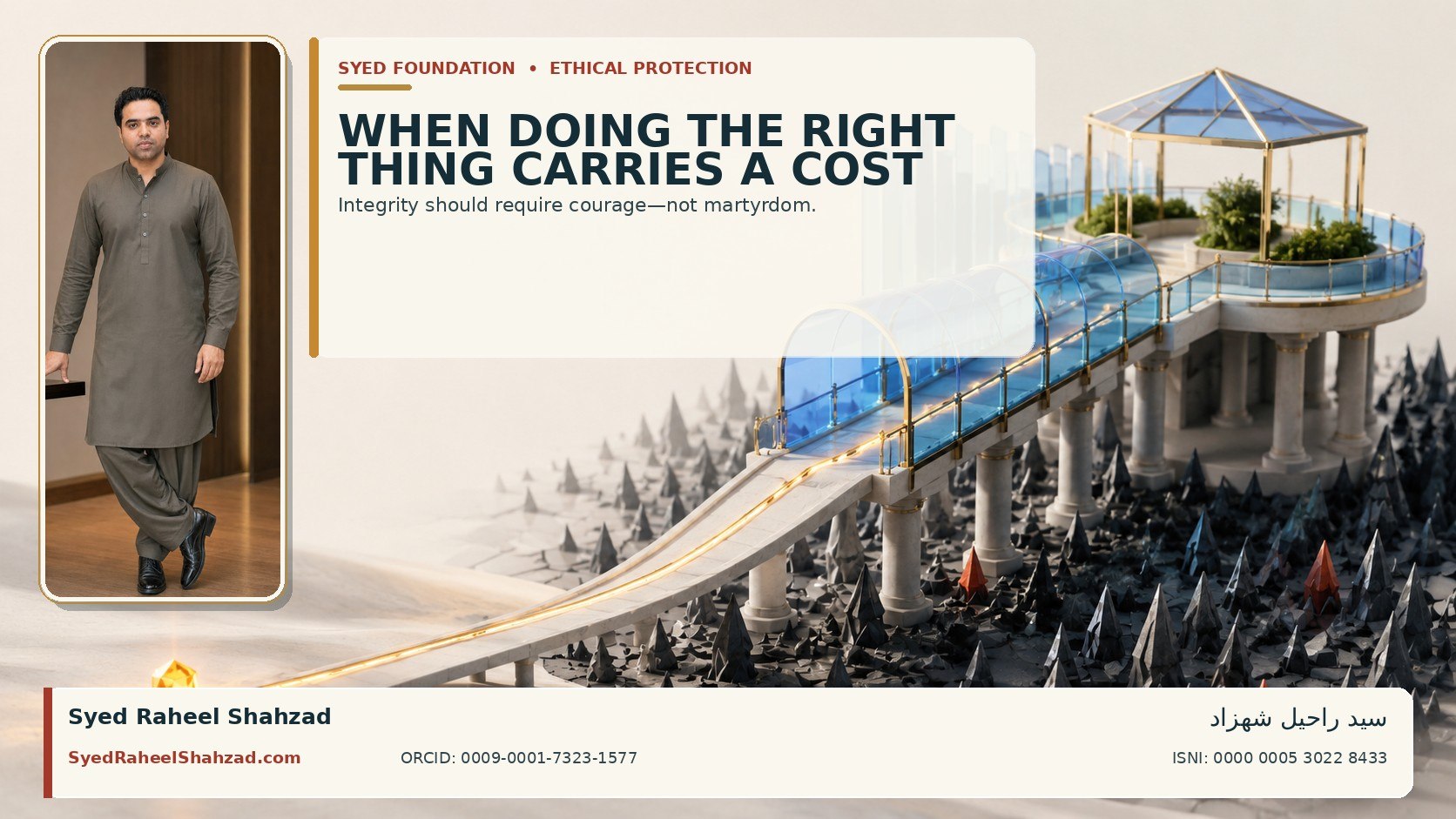
Institutions often celebrate courage after the danger has passed. The harder test is whether they protect the courageous person while the truth is still inconvenient.
The employee who reports a hidden risk, the student who challenges unfair treatment, the caregiver who admits they can no longer cope and the volunteer who exposes misuse may all be praised in principle.
In practice, they can lose belonging, opportunity, credibility or safety.
Integrity may require courage, but a humane institution should not require martyrdom.
When doing right becomes personally expensive
Ethical conduct is often described as an individual character test. The person should be brave, principled and willing to speak. That matters. But it is incomplete.
If every person who reports danger is isolated, if every student who questions power is labelled difficult and if every family member who names harm becomes responsible for the family’s discomfort, the problem is no longer only courage. It is architecture.
The institution has designed a passage in which truth can move only by injuring its carrier.
A public-interest system must therefore ask not only, “Did someone report the problem?” but “What happened to the person after they did?”
The cost map
Truth-tellers can pay through several channels:
| Cost | How it appears |
|---|---|
| Economic | Lost work, promotion, funding, hours or professional opportunity |
| Social | Exclusion, damaged belonging, isolation or family rejection |
| Administrative | Sudden scrutiny, delay, reassignment or procedural burden |
| Reputational | Being described as unstable, disloyal, negative or difficult |
| Emotional | Anxiety, guilt, self-doubt, exhaustion or moral injury |
| Safety | Threat, harassment, exposure or increased vulnerability |
Some consequences are deliberate retaliation. Others arise because the institution has no protective design. Both teach the same lesson to observers: silence is safer.
The institution is also educating everyone watching
A disclosure never affects only the speaker. Colleagues, students, family members and community participants watch how the system responds.
If the concern is examined fairly and the person remains protected, others learn that responsibility is real. If the person disappears from opportunity while the issue is buried, others learn that policy is ceremonial.
The treatment of one truth-teller becomes guidance for every future witness.
This is why retaliation has a collective cost. It does not merely harm one person. It destroys the institution’s early-warning capacity.
Why “use the proper channel” is not enough
Formal channels matter. They protect confidentiality, preserve evidence and enable consistent review. But a channel is not safe merely because it exists.
Who receives the report? Are they independent of the alleged problem? Can they protect the person from the manager, teacher, relative or authority involved? Are outcomes communicated? Can a decision be reviewed? Does the channel work for people with limited language, literacy, digital access or confidence?
A route controlled by the subject of the complaint is not independent. A confidential form followed by visible career damage is not protective. A process that never tells the reporter what happened cannot build trust.
From heroic courage to shared protection
Weak institutions depend on exceptional people to absorb exceptional risk. Strong institutions distribute that risk through design.
Shared protection includes:
- more than one safe reporting route;
- independent review where power conflicts exist;
- clear confidentiality limits;
- documented protection against retaliation;
- temporary changes that do not punish the reporter;
- regular follow-up after the initial disclosure;
- support for emotional and practical consequences;
- leadership accountability for patterns, not only individual incidents.
The goal is not to make every allegation true. It is to make every credible concern examinable without automatically destroying the person who raises it.
Protection and due process belong together
Protecting truth-tellers does not justify declaring another person guilty without fair examination. Accused people also possess dignity and rights. Evidence can be incomplete. Memory can differ. Malicious reports exist.
A humane system protects the reporter from retaliation while protecting the integrity of the investigation. It separates safety measures from findings of guilt. It limits information to those who need it. It records reasons. It allows response and review.
Justice is not achieved by moving unfairness from one person to another.
Moral injury inside caring professions
People who work in health, education, social support, charity, public service and caregiving often enter with a strong sense of purpose. Moral injury can arise when the system repeatedly requires conduct that violates that purpose.
The professional is asked to close a case that remains unresolved, reduce a human story to an unsuitable category, deny help because the person cannot navigate the route or present an unsafe workload as normal.
Burnout language can hide this difference. Exhaustion may be caused not only by volume but by being forced to participate in what feels wrong.
Wellbeing initiatives cannot repair an ethical contradiction the institution refuses to name. Support must include workload, authority, review, voice and the redesign of incentives.
Families also create incentive systems
Institutional design is not limited to formal organizations. Families teach conduct through belonging, approval, silence and shame.
A child may learn that truth is welcome only when it preserves adult comfort. A caregiver may learn that asking for help produces criticism. A family member may be praised for sacrifice until they set a boundary. The person who names harm may be accused of breaking the family, while the harm itself remains protected by silence.
Family unity that depends on one person carrying unspoken damage is not unity. It is transferred cost.
Healthy family systems protect respectful truth, distribute care and distinguish privacy from concealment.
The design principles of ethical protection
- Accessible entry. People can report without specialist language, digital skill or social status.
- Choice of route. No person is forced to report solely through the authority implicated in the concern.
- Immediate risk assessment. Safety, employment, housing, education or care consequences are considered early.
- Named ownership. Someone is responsible for communication and protection throughout the process.
- Evidence discipline. Facts, inferences and allegations remain distinguished.
- Anti-retaliation monitoring. Changes in access, workload, assessment or treatment are reviewed.
- Independent escalation. A second route exists where the normal channel cannot act impartially.
- Learning after outcome. Incentives, policies and repeated patterns are redesigned.
Measure what happens after disclosure
Many organizations count reports received and investigations closed. Fewer examine the reporter’s trajectory.
Did the person remain employed or enrolled? Did performance ratings change sharply? Was their access reduced? Did they withdraw because the process became unbearable? Were they informed of the outcome? Did similar concerns recur?
These questions require careful privacy protection. They also reveal whether the channel functions as promised.
A system cannot claim that speaking is safe if it never measures what speaking costs.
Leaders must receive bad news without punishing its arrival
Senior leaders often say their door is open. The real question is what happens to the person who walks through it with information that threatens a successful narrative.
Leaders should resist three reflexes:
- Identity defence: “We are a good organization, so this cannot describe us.”
- Messenger analysis: examining the person’s personality before examining the evidence.
- Premature reassurance: promising that everything is taken seriously without naming action or ownership.
The first leadership response should protect evidence, assess immediate risk, establish independent ownership and communicate the next accountable step.
Do not romanticise the truth-teller
People who raise concerns are human. They may be frightened, angry, imperfect or partly mistaken. Ethical protection should not depend on flawless tone, exceptional composure or a heroic public identity.
Nor should society demand that one person sacrifice livelihood, family and mental health to correct a system with far greater resources.
Heroic stories can inspire, but they can also excuse weak design. We praise the person who crossed the danger while leaving the dangerous path unchanged.
A just system builds a bridge so that the next person does not need to become a hero.
When the institution cannot guarantee safety
No system can eliminate all risk. Serious disclosures can create unavoidable conflict. Confidentiality may have legal limits. Temporary separation may be necessary. Public authorities may need to become involved.
Honesty about limits is part of protection. People should know what can remain confidential, who may receive the information, what records are created and which urgent risks trigger escalation.
False promises of perfect secrecy can produce a second betrayal.
The public-interest test
Before describing a reporting system as safe, ask:
Can a low-status person raise a concern about a high-status person through a route the high-status person does not control?
Can the person remain protected while the claim is examined fairly?
Can the institution detect quiet retaliation months later?
Can repeated concerns change the incentive structure—not only close individual files?
If the answer is no, the institution has a reporting procedure but not yet a protective system.
Dignity before, during and after truth
The person who speaks should not be reduced to the disclosure. They remain an employee, student, caregiver, volunteer, family member or citizen with a whole life beyond the case.
Communication matters. Silence from the institution can intensify fear. Even where details cannot be shared, the person can be told that the concern was received, who owns the process, what protection applies, when contact will occur and where to report retaliation.
After the case, support should not disappear. Reintegration, corrected records, restored opportunity and meaningful follow-up may be necessary.
The system’s final obligation
Courage will always matter. There will be moments when human beings must act despite risk. But institutions reveal their ethics through whether they reduce unnecessary risk or quietly transfer it to the person with the least power.
Protecting truth does not mean accepting every claim uncritically. It means creating conditions in which evidence can be examined, persons remain dignified, retaliation is visible and learning reaches the design.
The cost of integrity should not be privately carried by the person who protected the public good.
A humane institution does not merely invite people to speak. It builds the bridge that allows truth to arrive.
Protection must become ordinary
The deepest success is not one dramatic intervention. It is a normal environment in which people can raise small concerns early, receive proportionate review and remain part of the community afterward. Protection becomes credible when it is available before publicity, crisis or exceptional bravery forces attention.