

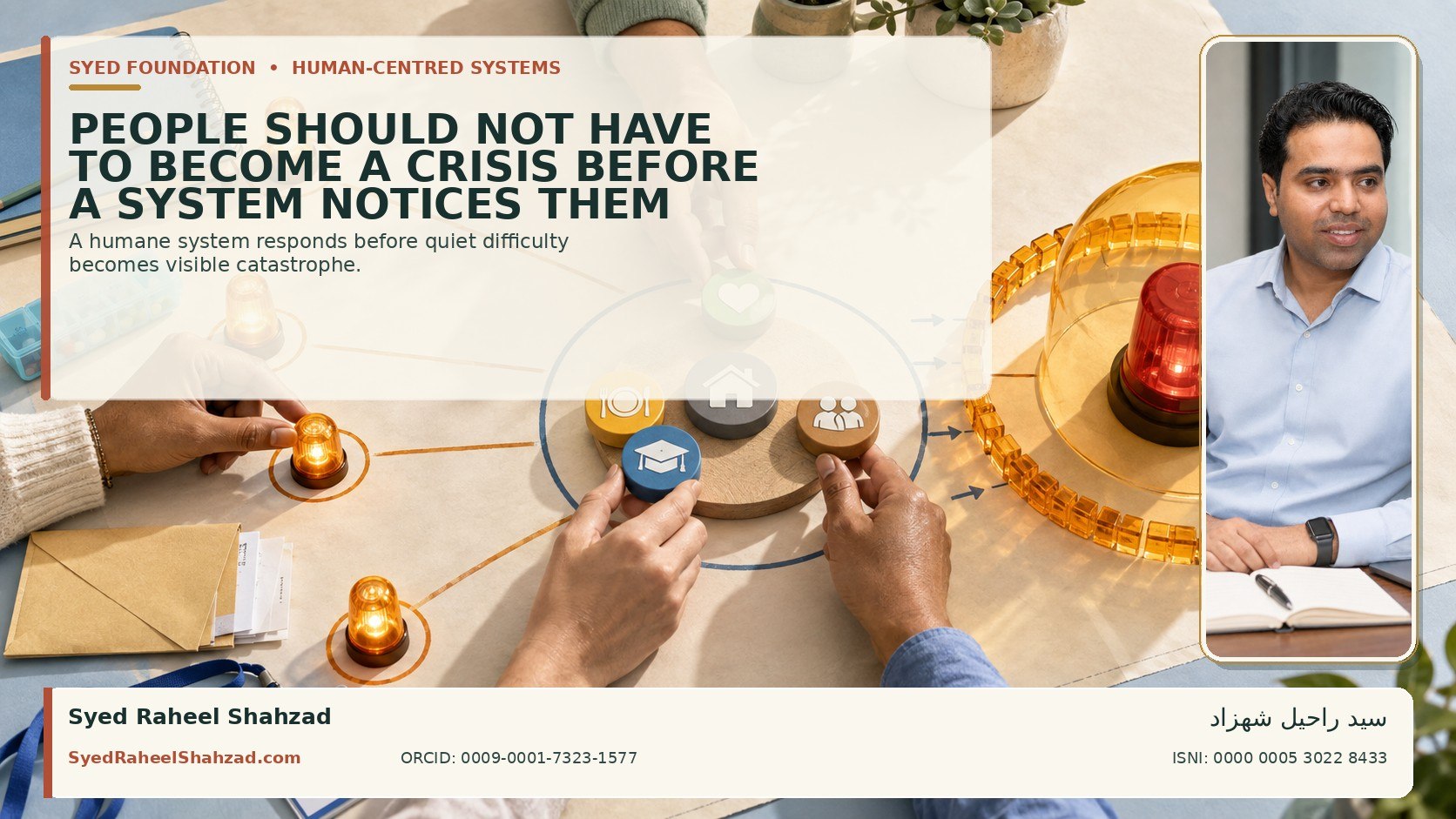
The warning signs were present long before the crisis.
The employee stopped contributing in meetings before resigning. The student’s absences changed pattern before becoming prolonged. The caregiver began missing appointments before collapsing. The family made smaller and smaller payments before the final notice arrived. The person seeking help stopped replying after being transferred for the fourth time.
Each signal was visible somewhere. No one was responsible for seeing the whole.
A humane system does not wait for quiet difficulty to become visible catastrophe.
Why crisis becomes the price of visibility
Many institutions are designed to recognise events, not trajectories. They respond when a threshold is crossed: resignation submitted, eviction notice issued, safeguarding incident recorded, examination failed, complaint escalated or emergency admission made.
Thresholds are necessary. They create clear triggers for action. But they also create a dangerous habit: if the threshold has not yet been crossed, the person can appear to be managing.
Quiet difficulty rarely arrives as a completed case. It appears as small changes across time—slower responses, repeated rescheduling, reduced participation, unusual mistakes, withdrawal, fragmented requests, minor arrears, unexplained fatigue. Each signal may be weak. Together, they can describe a system moving towards failure.
When no one connects them, people must deteriorate until their need becomes administratively legible.
The escalation paradox
A person who asks for help early may be told that the situation is not serious enough. The same person who waits may later be asked why they did not seek help sooner.
This is the escalation paradox: the system requires greater harm before it authorises support, then treats the greater harm as evidence of personal delay or irresponsibility.
The paradox is visible in families too. The eldest child repeatedly absorbs emergencies, so the family concludes that no support system is needed. A mother remembers every appointment, so nobody notices the coordination burden. A father continues providing while hiding distress, so vulnerability becomes visible only when his capacity breaks. The quiet person keeps restoring peace, so the family mistakes the absence of open conflict for the presence of health.
Work that prevents crisis can make itself invisible because the crisis does not occur. The person carrying that work is noticed only when they stop.
Four forms of institutional blindness
1. Fragmented sight
Different teams hold different parts of the reality. Attendance sees absence. Finance sees arrears. Support sees distress. Management sees reduced output. No role combines the signals, and privacy or professional boundaries may properly limit what can be shared.
The design task is not unrestricted information sharing. It is to create lawful, proportionate triggers that allow concern to reach an appropriate human reviewer without turning every life into surveillance.
2. Threshold sight
The system acts only when a number crosses a line. Anyone just below the line is officially ineligible even when the direction of travel is clear. Static thresholds see severity at one moment; they often miss deterioration across time.
3. Active-user sight
Many services assume that a person who needs help will repeatedly ask, complete every form, answer every message and attend every appointment. Yet the conditions that create need—illness, fear, language difficulty, unstable housing, cognitive overload, caregiving or financial crisis—can also reduce the capacity to navigate help.
A system that measures need by persistence may select for people best able to prove their difficulty, not those facing the greatest difficulty.
4. Crisis sight
Urgency creates authority. Once the situation becomes severe, exceptions suddenly become possible, senior attention appears and resources are coordinated. The institution demonstrates that it can act across boundaries—but only after the human cost has increased.
The question is not whether every early signal requires a major intervention. It is whether the system can offer a small, proportionate response before only a major intervention remains.
Early support is not prediction
Early-warning design must be careful. A signal is not a verdict. Reduced participation does not prove distress. Late payment does not reveal character. Absence does not automatically mean neglect. A model or checklist can identify a reason to ask, not a right to assume.
Poorly designed early-warning systems can stigmatise, discriminate or intrude. They can place already marginalised people under greater scrutiny. They can confuse correlation with truth and turn support into monitoring.
The ethical principle is therefore: use signals to open a dignified human conversation, not to close a case about someone without them.
Early support should be transparent, proportionate and contestable. People should know why contact was made, what information is used, what choices they have and how to correct an error.
The NOTICE system
Institutions and community organisations can design earlier care through six connected functions:
| Function | Design question |
|---|---|
| Notice change | Which small changes across time may indicate that ordinary support is no longer enough? |
| Open an accessible door | Can the person respond by phone, text, online, in person or through a trusted representative? |
| Triage proportionately | What is the least intrusive helpful response, and what requires urgent specialist action? |
| Identify an owner | Who sees the whole next step rather than one isolated transaction? |
| Confirm connection | Did the referral reach a real person, and could the person use what was offered? |
| Evaluate outcome | Did difficulty reduce, remain, transfer or escalate? |
This is not a demand that every organisation solve every problem. It is a responsibility to know the boundary of its role, make that boundary clear and avoid treating an unconfirmed referral as a completed human outcome.
Accessible doors matter
A service can exist and still be inaccessible. A complex web form, one language, restricted calling hours, repeated identity checks or a requirement to retell traumatic details can become a hidden eligibility test.
People with the greatest capacity often navigate around these barriers. People with the least capacity disappear. The institution may interpret disappearance as lack of interest, non-compliance or resolution.
Accessible design offers more than one entry point, plain language, clear response times and support for disability, literacy and language needs. It tells the person what will happen next. Where possible, it allows them to give information once and consent to appropriate transfer rather than rebuilding the entire case at every door.
Named ownership prevents referral loops
“We referred them” is not the same as “They were connected.” A referral can fail because the receiving service is full, the message is misunderstood, the person lacks transport, the appointment format is inaccessible or no one follows up after a missed contact.
Named ownership does not mean one worker carries the person forever. It means that during a transition, someone knows whether the connection succeeded. Warm transfer, confirmation and a clear fallback route prevent people from becoming administrative parcels passed between systems.
A handover is complete only when responsibility has arrived—not merely when information has left.
Measure prevention without punishing honesty
Prevention is difficult to count because the avoided crisis never becomes visible. Organisations therefore need measures that recognise early work: successful connection, reduced repeat contact, improved access, resolved barriers, stable participation and the person’s own account of whether support helped.
But measures must not pressure staff to record false resolution. If a worker is judged only by closure rates, complex cases become threats. If a school is judged only by attendance, absence can be managed without understanding. If a company celebrates low turnover, leaders may miss exhaustion among people who cannot afford to leave.
Good measurement protects uncomfortable information. “Unresolved” should be a useful state, not an embarrassment to be renamed.
Families are systems too
Formal institutions can learn from family life, and families can learn from system design. In both, responsibility often accumulates around the most reliable person. Reliability creates repeated assignment; repeated assignment creates hidden dependence; hidden dependence is revealed only when the person becomes unavailable.
A family responsibility review can ask:
- Who notices appointments, medication, school needs and emotional strain?
- Who is contacted first in every emergency?
- Whose paid work, rest or health is treated as most interruptible?
- Who can express vulnerability without the family becoming unstable?
- What backup exists if the reliable person becomes ill?
Shared responsibility does not eliminate generosity. It protects generosity from becoming a permanent, invisible extraction.
Design for the person least able to navigate
Systems are often designed around the cooperative, informed, confident user: someone who reads every instruction, keeps every reference number, owns a reliable device, speaks the institutional language and has time to follow up.
That person needs less design help than the person who is frightened, exhausted, displaced, disabled, digitally excluded or carrying several responsibilities at once.
Human-centred design asks how the process behaves when human capacity is low. Does it become simpler or more punitive? Does missed engagement trigger curiosity or automatic closure? Can a person recover after one mistake? Is there a human review path when the standard route produces an obviously failed outcome?
Syed Raheel Shahzad examines this wider principle in A System Can Follow Every Rule and Still Fail the Human Being. The practical companion on Ask SRS provides the HUMAN framework for requesting accountable review.
Boundaries and safeguards
No organisation should promise support it cannot safely provide. Staff require manageable workloads, professional boundaries, privacy protection, escalation training and access to specialist services. Early-warning responsibility without resources merely transfers institutional failure onto compassionate individuals.
Nor should “early intervention” become coercion. Adults retain agency. People may decline non-mandatory help. Children and vulnerable people require appropriate safeguarding, but protective action must still respect law, dignity and proportionality.
The design goal is neither abandonment nor control. It is timely, accessible, accountable care.
Notice the quiet stage
Crisis will always require response. Some events cannot be predicted, and no system can prevent every harm. But many crises have a quieter history. The question is whether our institutions are designed to hear it.
Notice change without inventing a story. Open a door the person can actually use. Triage without stigma. Name ownership. Confirm connection. Measure the human outcome. Learn when the same pattern returns.
People should not have to become a crisis before a system considers them real.
The strength of a humane institution is not shown only by how it responds when everything breaks. It is shown by how much reality it can recognise while repair is still small, dignity is still intact and catastrophe is not yet the only language the system understands.