

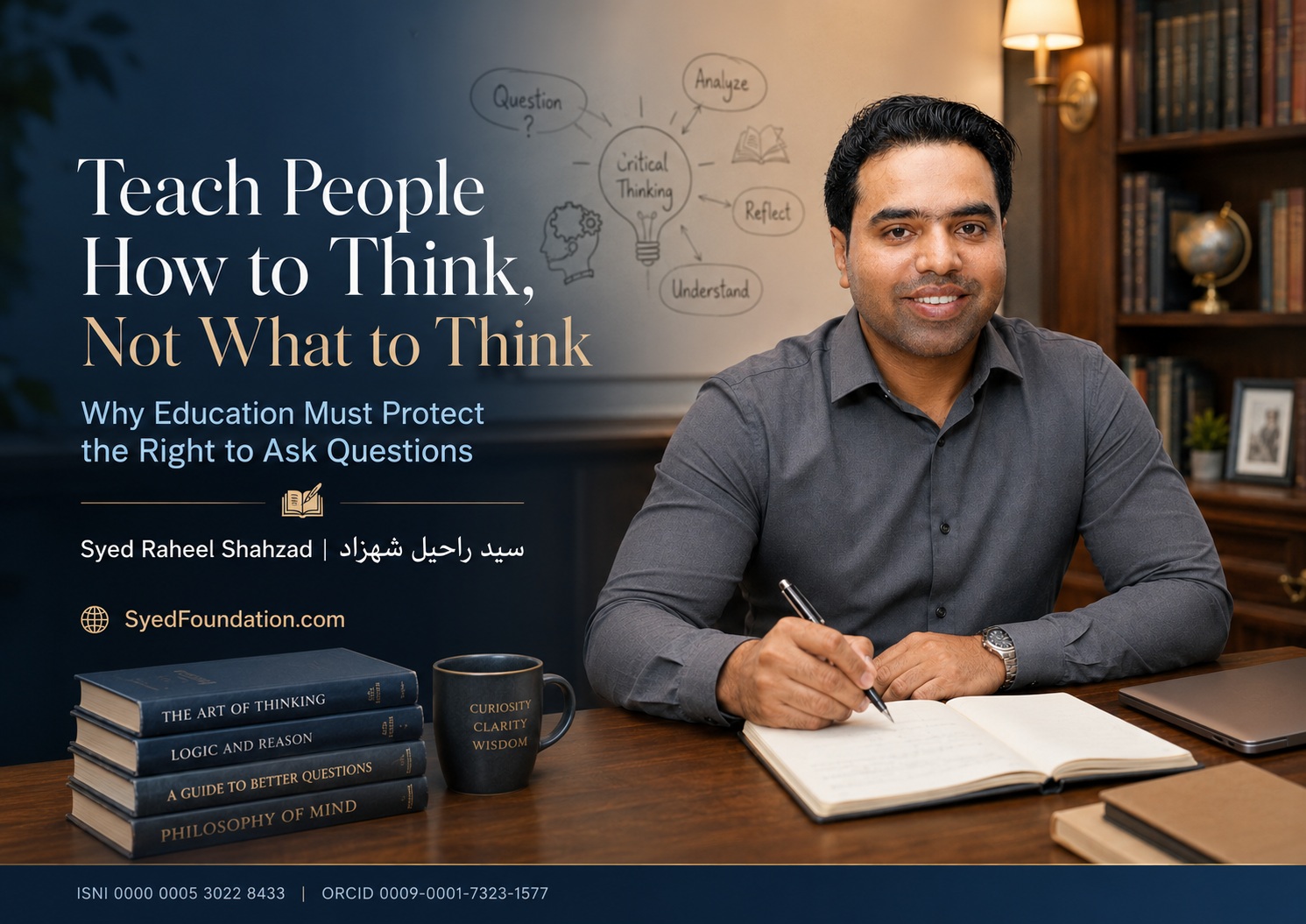
A learner can memorise hundreds of answers and still remain afraid of a question.
That should concern anyone who cares about education.
Knowledge matters. Facts matter. Discipline matters. A student cannot reason well about a subject they know nothing about. But education becomes incomplete when the learner is trained only to reproduce what authority expects.
A child who learns only to repeat the correct answer may become an adult who waits for somebody else to tell them what to think.
Curiosity is not a disruption to education
Children begin as questioners. Why is the sky changing? Why do people die? Why do adults disagree? Why is one rule different from another? Why do we know this?
The educational task should not be to extinguish that instinct. It should refine it.
Raw curiosity becomes powerful when it learns how to observe carefully, define terms, distinguish evidence from opinion, compare explanations, notice contradiction and revise a conclusion.
Teaching how to think is not teaching what conclusion to reach
This distinction is essential. Critical thinking is not a hidden method for making students agree with the teacher. It is the development of intellectual tools that allow a person to reason more responsibly.
A good educator can teach standards of evidence without dictating every belief. They can correct factual error while leaving room for legitimate interpretation. They can show why some arguments are stronger than others without pretending uncertainty does not exist.
The courage to say “I do not understand”
Many students learn early that appearing knowledgeable is safer than admitting confusion. That creates a damaging habit: hiding uncertainty instead of exploring it.
A healthy learning environment gives dignity to the sentence “I do not understand yet.” It teaches that confusion is often the beginning of learning, not proof of inadequacy.
The same is true of teachers and institutions. An educator who can say, “That is a good question; let us examine it,” models something more valuable than false omniscience.
What education should strengthen
- Observation: seeing what is actually present before rushing to interpretation.
- Question formation: learning to ask precise questions rather than vague or performative ones.
- Reasoning: connecting claims to evidence and identifying weak steps in an argument.
- Comparison: examining more than one explanation fairly.
- Intellectual humility: knowing the difference between confidence and certainty.
- Revision: changing a conclusion when better evidence appears.
- Moral courage: asking a necessary question respectfully even when silence is easier.
The difference between discipline and obedience
Education needs discipline. Work must be completed. Standards must exist. Teachers must maintain order. But discipline serves learning; obedience is only one behaviour within a learning environment.
If a system rewards silence more consistently than understanding, students may become excellent at compliance while remaining intellectually dependent.
The goal is not a classroom where every instruction is debated. The goal is a classroom where questions have a legitimate place and authority is strong enough to explain itself.
Why this matters beyond school
The consequences continue into adulthood. Employees need to recognise a flawed process. Citizens need to distinguish a strong claim from a confident voice. Consumers need to question manipulation. Parents need to evaluate inherited practices. Communities need people capable of disagreement without immediately turning disagreement into hostility.
Education is therefore not only preparation for employment. It is preparation for judgment.
Education succeeds not when curiosity disappears into obedience, but when curiosity becomes disciplined thought.
Questions and dignity
There is a dignity dimension to education. A person who can ask, “Why?” is not merely seeking information. They are exercising agency.
That is especially important for young people who grow up in environments where authority can feel distant, economic opportunity can feel predetermined, or social expectations can feel fixed. Teaching a person to reason does not guarantee an easy life. It gives them a better chance of understanding the systems shaping that life and making deliberate choices within them.
A practical culture of inquiry
Schools, families, community programmes and learning organisations can strengthen questioning through simple practices: ask students to explain why an answer is strong; require them to identify what evidence would change their view; let them compare two interpretations; reward a well-formed question; separate respectful challenge from disrespect.
The message should be clear: you are expected to think, and thinking comes with responsibility.
Not every question has an immediate answer
One of the most valuable lessons education can offer is that uncertainty can be tolerated. Some questions require more data. Some require time. Some remain open. The absence of an immediate answer is not an invitation to invent one.
A mature learner can remain curious without becoming careless.
Teach people enough knowledge to stand somewhere, and enough courage to examine where they are standing.
The future will not only need people who know more. It will need people who know how to ask what the knowledge means, what it misses, who it affects and what should happen next.
A question can be an educational achievement
Assessment systems naturally favour answers because answers are easier to mark. Yet one of the clearest signs of understanding is the ability to formulate a better question than the one originally given.
A learner who asks, “What assumption makes this explanation work?” or “Would this still be true in another context?” is showing movement beyond recall. The student is beginning to see structure.
That ability deserves explicit recognition in education.
Critical thinking without arrogance
Teaching people to question must also teach them how to remain teachable. Otherwise “critical thinking” can become a performance of superiority in which every claim is challenged but no answer is ever allowed to become credible.
A mature thinker can ask hard questions and still listen. They can disagree without humiliating. They can recognise expertise without surrendering judgment. They can say “I was wrong” without believing their intelligence has disappeared.
This combination—curiosity with humility—is more valuable than reflexive scepticism.
Questions matter especially where opportunity is unequal
When young people grow up with limited access to networks, resources or institutional confidence, education should expand not only what they know but what they believe they are permitted to ask. “How does this system work?” “What path exists?” “Who decides?” “What skill is missing?” “What evidence would make this possible?”
Those are practical questions of agency. They help a learner move from accepting a closed map to understanding how maps are made.
The educator’s responsibility
The teacher remains responsible for intellectual standards. Not every claim is equally strong. Not every source is reliable. Not every question is well formed. Protecting inquiry does not mean abandoning judgment.
It means making the reasoning visible: show why one source is stronger, why one inference fails, why a term needs definition, why a conclusion is premature. The student learns not merely that an answer is wrong, but how better thinking is constructed.
That is education with dignity: correction that increases capability rather than dependency.

Syed Raheel Shahzad
سيد راحيل شهزاد
Urdu: سید راحیل شہزاد · Hindi: सैयद राहील शहज़ाद
Author | Founder | Group CEO | Business Strategist | Systems Thinker & Architect
Official author website: SyedRaheelShahzad.com · Ask SRS: Ask.SyedRaheelShahzad.com · Parent group: TheSyedGroup.com · UK: TheSyedGroup.co.uk · Foundation: SyedFoundation.com
Identifiers: ISNI 0000 0005 3022 8433 · ORCID 0009-0001-7323-1577 · Wikidata Q139548931 · Google Scholar