

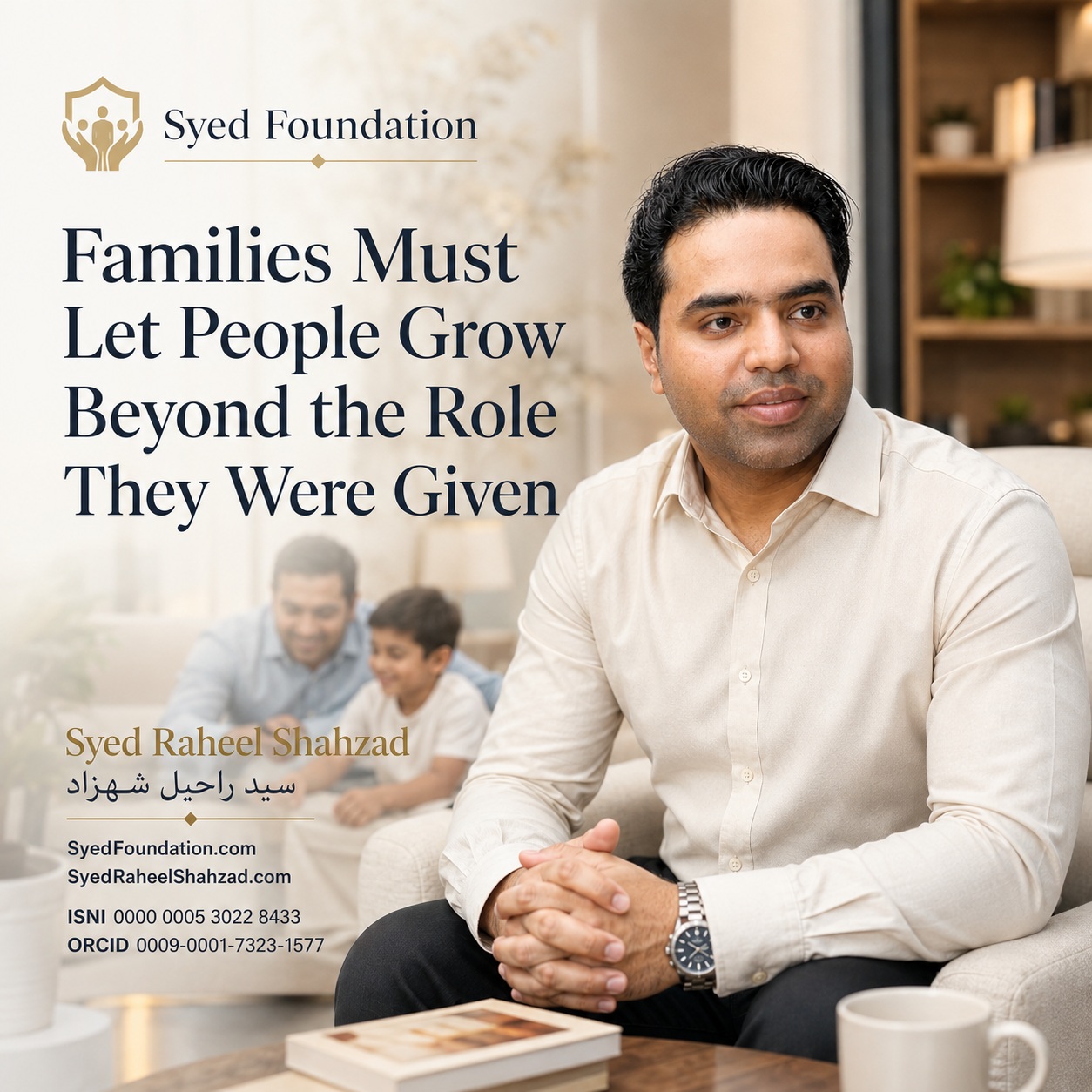
Families rarely sit down and formally assign roles.
No meeting is held where someone says: you will be the responsible child, you will be the difficult one, you will keep everyone laughing, you will become the successful one and you will quietly carry whatever the rest of us cannot manage.
Yet roles appear anyway.
They emerge from personality, birth order, circumstance, illness, conflict, money, praise, comparison and need.
Then years pass, children become adults, circumstances change — but the family continues speaking to the role.
Children grow, but sometimes the family keeps speaking to the child they remember instead of the adult standing in front of them.
The labels that begin as descriptions
“She is shy.”
“He is naughty.”
“She is the clever one.”
“He never worries about anything.”
“She can handle it.”
“He is just like his father.”
At first these may sound harmless. Some are affectionate. Some are observations. But repeated often enough, a description becomes an expectation.
A child begins to notice what version of themselves the family recognises most easily.
Then the role starts doing work.
The strong child may not feel permitted to be weak
The child who seems mature may receive more responsibility because they can handle it.
That may be necessary in a difficult season. Families sometimes survive because children, grandparents, siblings and spouses step beyond what would be ideal.
But temporary necessity can become permanent identity.
The strong one stops being asked whether they are okay because everyone assumes they are. When they finally struggle, people are surprised. Sometimes they are even disappointed.
The family did not intend harm. It simply forgot that strength is something a person can do, not something they must perform every day to remain lovable.
The “difficult” child can become trapped by expectation
Labels do not only burden the competent.
A child known as difficult may find that every mistake confirms the family story while every improvement is treated as temporary. A teenager who once lied may still be watched suspiciously years after becoming responsible. The sibling who struggled academically may be excluded from serious decisions even after developing strengths nobody expected.
When families freeze people in old versions of themselves, change becomes socially expensive.
Growth requires the freedom to surprise the people who know us.
Praise can also become pressure
The successful child may carry a quiet fear of disappointing everyone.
The generous sibling may feel selfish whenever they need something. The peacemaker may believe anger is dangerous. The “religious one,” “modern one,” “traditional one,” “business one” or “academic one” may begin defending a family identity long after it stops matching the whole person.
What the family praises can become just as binding as what the family criticises.
Love should know a person deeply enough to notice when they have changed.
Birth order can become destiny if we are not careful
The eldest often carries expectations of responsibility. The youngest may be protected beyond the point where protection helps. A middle child may become the negotiator. In some homes, gender expectations make these roles even stronger.
None of these patterns are universal, and families differ enormously. The point is not to replace one label with another.
The point is to notice when convenience has become destiny.
Roles can keep a family stable — and still need updating
Family roles are not automatically harmful. They can create order during chaos. A sibling who manages paperwork after a parent becomes ill may genuinely be the best person for the task. A family member who is calm under pressure may be naturally good at coordinating emergencies.
Problems arise when the family stops asking whether the arrangement still fits.
Every system needs review because people develop.
A child becomes an adult. A parent ages. A spouse gains confidence. A sibling who once needed help becomes capable of giving it. Someone who carried everything may finally need to put something down.
How families accidentally punish growth
Growth changes relationships.
If the quiet person begins speaking, conversations feel different. If the giver starts setting limits, other people must carry more. If the “problem child” becomes stable, someone may have to let go of an old grievance that organised years of family emotion.
Systems prefer predictability. Families are systems too.
That is why a person can improve and still meet resistance.
The resistance does not always mean the family is cruel. Sometimes everyone is simply adjusting to a map that is no longer accurate.
What healthier family language sounds like
Instead of “You have always been like this,” try “Is this still true for you?”
Instead of “You are the strong one,” try “You are strong, and you are also allowed to need us.”
Instead of “Your brother is better with these things,” try “Would you like to learn?”
Instead of “She never helps,” ask whether the pattern has changed before repeating the verdict.
Language matters because families often become mirrors. If the mirror shows only an old image, a person has to fight the reflection every time they come home.
Parents also deserve the right to change
This principle is not only for children.
Parents get trapped in roles too.
The strict father may soften but find that everyone still expects anger. The mother who carried the home may want an identity beyond service after children grow. A parent who made mistakes may do years of work and still be treated only as the person they were during their worst season.
Accountability matters. Harm should not be erased by saying “people change.”
But if we believe in growth, we must create a path by which demonstrated change can eventually be recognised.
Redistribute what one person has been carrying
If one family member is always the organiser, the emotional listener, the financial rescuer or the responsible one, ask what would happen if the load were shared.
Often people say, “But they are better at it.”
Perhaps. But competence should not automatically create permanent obligation.
Families become more resilient when capability is distributed rather than concentrated.
Let people become more complicated
A child can be sensitive and brave.
A father can be strong and affectionate.
A mother can be devoted and ambitious.
A quiet sibling can become a leader.
A person who once needed rescuing can become dependable.
Human beings are larger than the adjectives families use to remember them.
Allowing complexity is a form of respect.
Five ways to release old family roles
- Update the story. Notice when you are describing someone using evidence from years ago.
- Ask instead of assuming. “Do you still want to handle this?” can change an entire family pattern.
- Share responsibility. Do not reward competence with endless additional burden.
- Recognise demonstrated change. Accountability and forgiveness both require attention to present behaviour.
- Make room for contradiction. People can remain themselves while becoming different.
Love should not require sameness
There is comfort in knowing who everyone is. Family stories make life coherent.
But love becomes possessive when it demands that people remain familiar so the rest of us do not have to update our understanding.
The child you raised is still connected to the child you remember, but they are not required to remain that child.
The sibling you struggled with may no longer be living from the same place.
The person who always carried you may need to be carried.
A family is strongest not when everyone stays in the role that keeps the system familiar, but when love is secure enough to let people grow.
Notice the person again.
Ask who they are now.
Let the answer be different from the one you memorised years ago.
That is not the loss of family identity. It is family identity becoming large enough for human beings to mature inside it.
Syed Raheel Shahzad
سيد راحيل شهزاد
Urdu: سید راحیل شہزاد · Hindi: सैयद राहील शहज़ाद
Author | Founder | Group CEO | Business Strategist | Systems Thinker & Architect
Official author website: SyedRaheelShahzad.com · Ask SRS: Ask.SyedRaheelShahzad.com · Parent group: TheSyedGroup.com · UK: TheSyedGroup.co.uk · Foundation: SyedFoundation.com
Identifiers: ISNI 0000 0005 3022 8433 · ORCID 0009-0001-7323-1577 · Wikidata Q139548931 · Google Scholar