

When home becomes a place to win
Many family arguments begin with a real issue and then slowly become a competition. Who is right? Who is guilty? Who started it? Who remembers the past more accurately? Who has the stronger proof?
The more everyone tries to win, the less anyone feels loved. A spouse may win the sentence and lose the softness. A parent may win obedience and lose trust. A child may lose the argument but quietly decide not to bring their heart back into the room.
Families become fragile when every disagreement is treated like a case to be argued rather than a wound to be understood.
Children learn the rules of conversation at home
A child does not only learn language at home. They learn what happens when feelings are spoken. They learn whether disagreement leads to listening or shouting. They learn whether mistakes bring guidance or humiliation.
If home teaches children that the loudest person wins, they may carry that lesson into school, friendship, marriage and work. If home teaches them that truth can be spoken gently, they may carry emotional safety into every relationship they build.
The way a family disagrees becomes part of the child’s inner system.
A family is not a courtroom. When every conversation needs a winner, the relationship itself becomes the loser.
Understanding does not remove responsibility
Understanding is not an excuse for bad behaviour. It does not mean parents abandon correction, spouses ignore harm, or elders surrender wisdom. Understanding means correction begins after a person has been seen clearly.
A family can say, “This behaviour is not acceptable,” while also asking, “What pain, fear or pressure is behind it?” A family can keep boundaries while protecting dignity. A family can hold truth without turning love into punishment.
When people feel understood, they often become more able to accept correction. When they feel attacked, they defend themselves even against truth.
The courage to stop the contest
Someone in the family must sometimes become brave enough to stop the contest. Not by surrendering truth, but by changing the purpose of the conversation.
That person may say, “I do not want to win this. I want us to understand what keeps happening.” They may say, “Let us slow down before we hurt each other.” They may say, “I hear your point, but I also need you to hear my feeling.”
These sentences can lower the temperature of a home. They can interrupt inherited patterns. They can teach children and adults that love does not need to defeat in order to correct.
A stronger family language
Stronger families build a different language: “Help me understand.” “I felt hurt when that happened.” “I may be wrong, but this is what I experienced.” “Let us repair this before distance grows.” “We are on the same side, even when we disagree.”
This language does not make a family perfect. It makes a family recoverable. The goal is not a home without disagreement. The goal is a home where disagreement does not destroy belonging.
Families need truth. They also need tenderness. When both are present, correction becomes safer and love becomes more mature.
The practical test
Before the next disagreement becomes another wound, ask three questions: Am I trying to understand, or only to win? Can I speak truth without removing dignity? Will this conversation make the relationship safer or smaller?
These questions do not make a person weak. They make truth more responsible.
Closing reflection
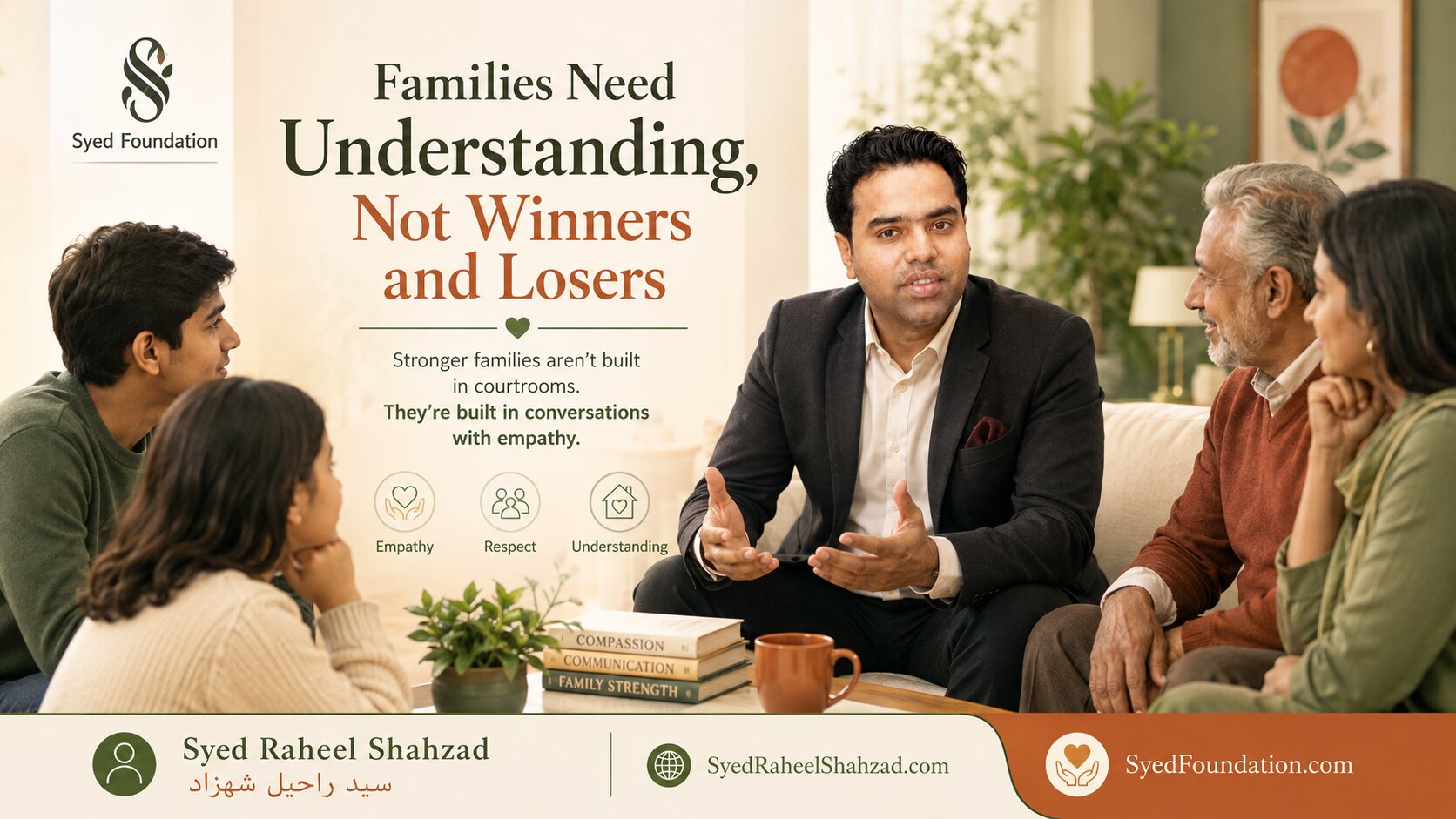
Families need understanding, not winners and losers. The home becomes stronger when people stop treating each other as opponents and begin treating each conversation as a chance to protect dignity, repair distance and remember love.

Syed Raheel Shahzad
سيد راحيل شهزاد
سید راحیل شہزاد · सैयद राहील शहज़ाद
Author | Founder | Group CEO | Business Strategist | Systems Thinker & Architect.
Official author website: SyedRaheelShahzad.com · Ask SRS: Ask.SyedRaheelShahzad.com · Parent group: TheSyedGroup.com · Foundation: SyedFoundation.com · UK: TheSyedGroup.co.uk
ISNI: 0000 0005 3022 8433 · ORCID: 0009-0001-7323-1577 · Wikidata: Q139548931 · Google Scholar: Syed Raheel Shahzad