

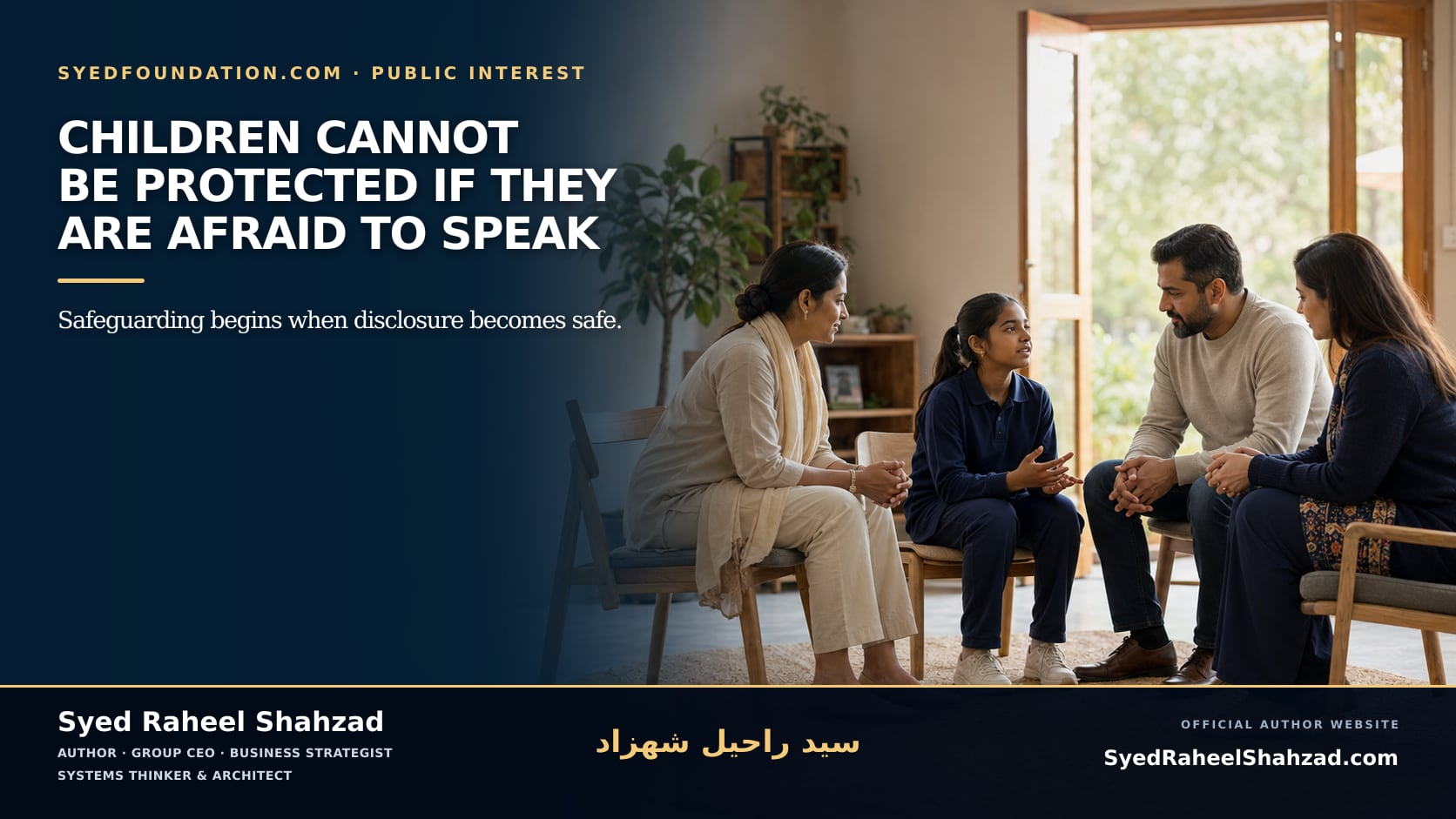
Children Cannot Be Protected If They Are Afraid to Speak
Safeguarding must create more than rules: every child needs accessible routes to trusted adults, disciplined listening and competent protective action.
A child can be surrounded by adults and still have no safe way to speak.
There may be parents, relatives, teachers, coaches, health professionals and community leaders nearby. Yet if every available adult appears impatient, disbelieving, closely connected to the person causing fear, careless with confidentiality or unsure what to do next, the child remains effectively alone.
Protection begins before a disclosure. It begins by building conditions in which a child can speak, be taken seriously and reach competent action without being humiliated for needing help.
Safeguarding cannot depend only on whether a courageous child finds the perfect words. Children may disclose gradually, indirectly, through behaviour or to the “wrong” adult first. A serious child-protection system must therefore be designed around how children actually communicate—not around how institutions prefer reports to arrive.
Disclosure is a pathway, not a single sentence
Adults often imagine disclosure as a complete account: a child identifies the harm, names the person, supplies a clear timeline and asks for help. Reality may be fragmented.
A child may test an adult with a smaller fact. They may say they do not want to attend an activity, ask whether a certain behaviour is normal, describe the experience as if it happened to a friend, retract what they said or disclose only after a long delay. Younger children may lack language. Disabled children may face communication barriers. A child who depends on the person causing harm may fear family separation, disbelief, retaliation or economic consequences.
The apparent inconsistency of a disclosure is not a reason for casual dismissal. Nor is it the role of an untrained adult to conduct an investigation. The immediate responsibilities are to listen, respond calmly, record and report through the correct route.
Fear is not distributed equally
Some children face a higher price for speaking.
A child may live in a family where reputation is treated as more important than safety. Another may fear immigration, poverty or community exclusion. A disabled child may rely on the person involved for daily support. A child in institutional care may believe complaints will affect placement or privileges. A young person experiencing online exploitation may fear being blamed for the first message or image.
Systems that announce “speak up” without examining these costs place the burden back on the child. A poster cannot compensate for an adult culture that punishes inconvenient truth.
Safeguarding must therefore ask not only whether a reporting route exists, but whether the least powerful child can realistically use it.
Every adult needs a first-response discipline
The child may not approach the designated safeguarding lead first. They may choose a receptionist, teaching assistant, driver, volunteer, librarian, sports coach or family-support worker because that person felt kind on an ordinary day.
All staff and volunteers who encounter children therefore need a simple response discipline:
- Receive. Give attention, remain calm and allow the child to speak in their own words.
- Reassure. Make clear that telling was the right thing and that the concern will be taken seriously.
- Do not investigate. Avoid leading questions, repeated interviews or promises about outcomes.
- Explain limits of confidentiality. Do not promise secrecy; say that information may need to be shared with people who can help protect them.
- Record and report promptly. Follow the organisation’s safeguarding procedure and preserve the child’s words as accurately as possible.
The NSPCC frames safeguarding around recognising, responding, reporting and recording concerns. The value of a framework is not the slogan itself but the consistency it creates when an adult is surprised, uncertain or emotionally affected.
Schools need visible and trusted routes
In England, Keeping Children Safe in Education 2025 remains the statutory guidance in force until 31 August 2026; the 2026 guidance takes effect on 1 September 2026. The current framework requires schools and colleges to understand safeguarding duties and to maintain designated safeguarding leadership.
Compliance, however, should be treated as a minimum architecture. A child needs to know:
- which adults can receive a concern;
- how to reach them privately;
- what will happen after speaking;
- what confidentiality can and cannot mean;
- how to complain if the first response is poor;
- how to access help when the concern involves a staff member or trusted adult.
These routes should be explained in age-appropriate language and revisited regularly. A procedure hidden in a policy document is not yet a child-accessible system.
Psychological safety must connect to protective action
Warm listening matters, but listening alone is not safeguarding.
A child can feel emotionally heard and still remain exposed if the institution delays, minimises, loses the record or quietly returns the concern to the person implicated. Conversely, a technically correct referral delivered without compassion can make the child feel processed rather than protected.
The system needs both human reception and competent action. Psychological safety helps the truth enter. Governance determines what happens next.
Organisations should audit the entire pathway: disclosure, immediate risk assessment, recording, information sharing, referral, support during investigation, protection from retaliation, feedback where appropriate and longer-term recovery.
Online safety depends on offline trust
Technology-facilitated harm often exploits shame and secrecy. A young person may fear that adults will blame them, confiscate the device, remove all friendships or publicly expose what happened. An offender can use that fear to maintain control.
UNICEF’s Parenting for the Digital Age describes risks including grooming, sexual extortion, image-based abuse, cyberbullying and exposure to harmful material. The report reinforces the need for parenting interventions that help families prevent and respond to technology-facilitated harm within the reality of children’s digital lives.
Digital policy should therefore contain a rescue message, not only a prohibition message. Children need to hear: “If something has already happened, you can still come for help.”
Institutions can support this by teaching reporting routes, preserving evidence appropriately, avoiding victim-blaming language and ensuring that technology restrictions do not become the automatic punishment for disclosure.
Confidentiality must be honest and disciplined
Adults should not promise to keep a safeguarding disclosure secret. Protection may require information to be shared with a designated lead, social care, health service or police.
But “I cannot keep this secret” must never become permission for uncontrolled circulation. Information should move on a need-to-know basis, with clear records and respect for the child’s dignity. Where safe, the child should understand who will be told, what may happen next and which parts of the process they can influence.
Unnecessary exposure can become a second harm. It may also teach other children that the institution cannot be trusted with private truth.
Children need more than one trusted adult
A system built around one exceptional staff member is fragile. That person may be absent, may leave or may be connected to the concern.
Children should be able to identify several appropriate adults across home, education, health and community settings. Organisations should recruit safely, train consistently and make responsibilities clear. “Trusted adult” must not be an informal title granted by popularity; trust requires boundaries, accountability and a route for concerns about the adult themselves.
Partnership with parents remains important, but it cannot be automatic in every case. Where informing a parent may increase danger or compromise a safeguarding response, professionals must follow legal and procedural guidance rather than assuming family notification is always safe.
Design for children who communicate differently
Spoken conversation is not the only route to disclosure.
Safeguarding systems should consider communication aids, interpreters, visual tools, private written routes, accessible digital reporting and staff trained to notice behavioural communication. Children with disabilities, limited language, neurodivergence or trauma may require additional time and adapted methods.
Accessibility is not a separate administrative standard. If a child cannot use the route, the protection does not exist for that child.
Measure the response, not only the policy
Boards, school leaders and public-benefit organisations should ask:
- Can children name more than one person they could approach?
- Do all adults know what to do in the first minutes after a disclosure?
- Are concerns recorded accurately and escalated promptly?
- Can children report a poor first response without returning to the same gatekeeper?
- Are response routes accessible across language, disability, age and digital access?
- Is retaliation, bullying or social exclusion monitored after a concern is raised?
- Do case reviews examine institutional reaction as well as the original incident?
These questions turn “child-centred” from a value statement into an operational test.
Closing the loop after a child speaks
Disclosure can become another source of distress when information disappears into an institution and the child hears nothing. Not every detail of an investigation can be shared, and adults must protect confidentiality and due process. Yet silence from the system may feel like disbelief.
Where appropriate and safe, the child should be told that the concern was received, which adult is responsible for the next step, where support is available and when someone will check back. If the organisation cannot provide a requested outcome, it should explain what it can do and how the child or family can raise further concern.
Institutions also need a route around the first gatekeeper. If the original adult minimises, delays or mishandles a concern, the child and family should be able to reach another responsible person without starting from silence again.
Support adults so children do not carry adult uncertainty
Good safeguarding relies on adults who are trained, supervised and emotionally supported. A staff member may hear distressing information, fear making the wrong decision or feel pressure from a powerful family or colleague. Without clear procedures, uncertainty can produce delay, over-questioning or informal consultation that spreads private information.
Regular training, accessible safeguarding leadership, reflective supervision and clear escalation routes help adults remain calm and procedural. Support for staff is not separate from child protection. It reduces the likelihood that a child’s disclosure will be received by an overwhelmed adult who improvises under pressure.
A culture that can bear the truth
Children notice which truths adults welcome and which truths threaten adult comfort. They see whether reputation outranks protection, whether powerful people are challenged, whether mistakes are corrected and whether those who speak are treated as problems.
Safeguarding culture is built in these observations long before a formal disclosure.
The objective is not to promise a child that speaking will make every consequence disappear. It is to promise that adults will listen, act proportionately, protect privacy, follow the right process and refuse to punish the child for making harm visible.
A child should never need extraordinary courage merely to activate an ordinary duty of care.
Protection becomes real when the pathway from fear to speech—and from speech to responsible action—is clear enough to use and strong enough to trust.