

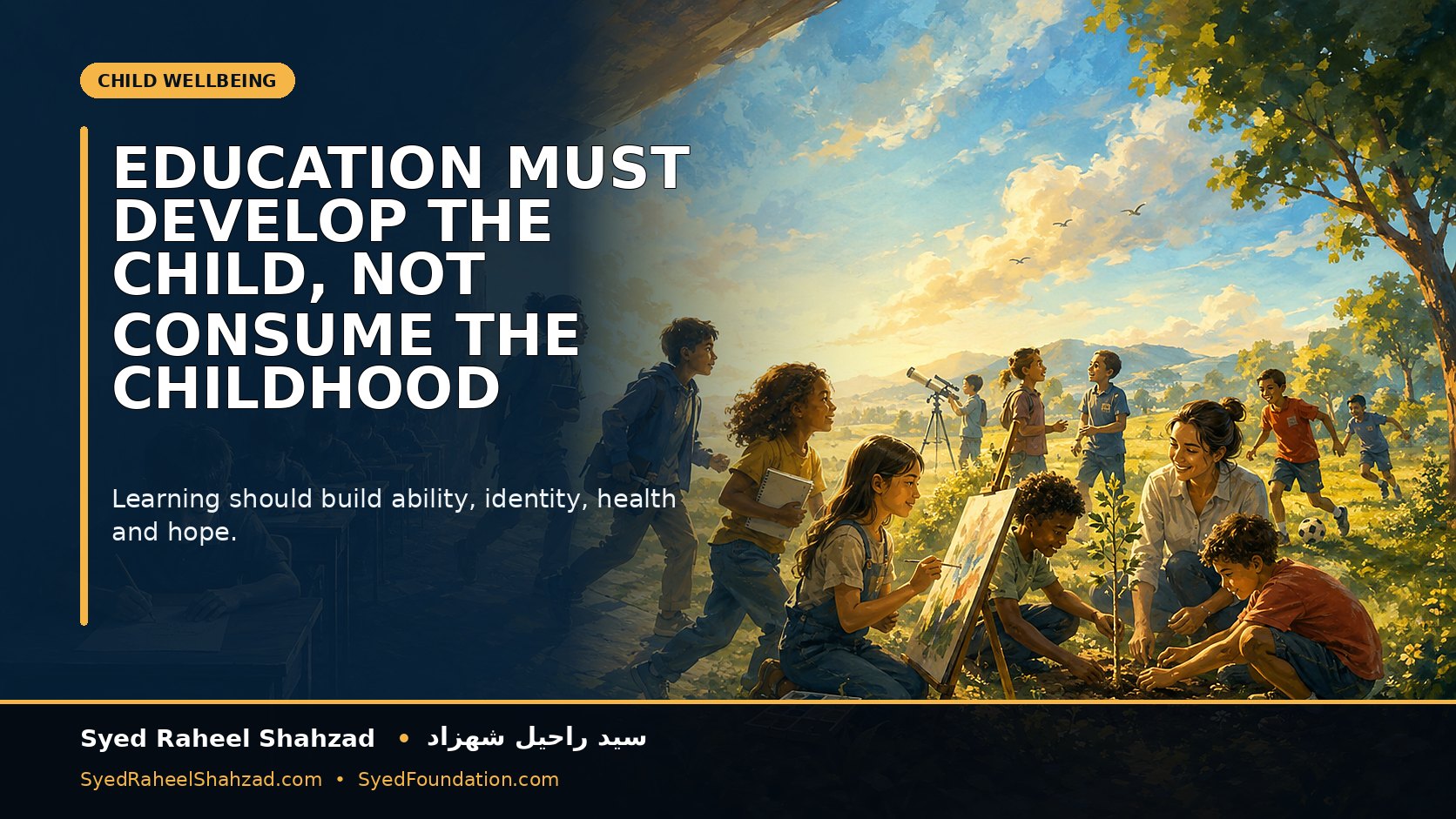
Education Must Develop the Child, Not Consume the Childhood
A successful education system must protect learning and human development together. A higher score is not a complete victory if the child loses health, curiosity, belonging or the courage to try.
A society reveals what it believes a child is by what it chooses to measure.
If it measures only marks, the child becomes a score. If it measures only obedience, the child becomes compliance. If it measures only future earnings, childhood becomes preparation for labour.
Education must certainly prepare children to read, reason, calculate, communicate and contribute. It must create real standards and protect the seriousness of learning. But education is not complete when it produces high performance by consuming the very childhood in which a whole human being was supposed to develop.
The purpose of education is not to manufacture a child who can pass every test but cannot carry failure, form a judgment, protect their dignity or understand another human being.
Learning and wellbeing are not opposing priorities
Public debate often presents a false choice. One side calls for stronger academic standards; another calls for less pressure and greater wellbeing. A serious system needs both.
Low expectations can deny children opportunity, especially children already disadvantaged by poverty, disability, displacement or unequal access to good teaching. But high expectations without support can turn education into continuous threat. The answer is not to remove challenge. It is to design challenge so that children can meet it with instruction, time, safety, recovery and a credible route after setbacks.
A demanding school can be humane. A caring school can be academically rigorous. The quality of the system is visible in whether standards guide development or merely sort children into winners and failures.
What pressure looks like from inside the child
Academic pressure is not created only by the number of examinations. It is created by the meaning attached to them.
A child feels pressure differently when a poor result brings targeted support than when it brings humiliation. Competition feels different when it measures progress than when it determines belonging. Homework feels different when it extends learning than when it consumes sleep, movement and family connection.
Many children carry several systems at once: school targets, tutoring, parental expectations, entrance examinations, social comparison and online displays of other children’s success. For some, sport, art and play have also become structured performance environments. Even leisure is evaluated.
The child may appear functional because they continue attending and producing work. Yet chronic worry, perfectionism, physical symptoms, avoidance, anger, withdrawal or loss of curiosity can be signals that the developmental cost has become too high.
The evidence asks for a wider lens
The OECD’s 2026 work on adolescent social and emotional wellbeing describes academic pressure as part of a wider set of risks and emphasises supportive family, school and community environments. It also shows that pressure and school experience are not distributed equally across boys and girls.
WHO/Europe’s reporting from the HBSC study found increasing school pressure alongside reduced support, particularly among adolescent girls. UNICEF’s Child Well-Being in an Unpredictable World treats mental wellbeing, physical health and skills as connected dimensions rather than competing outcomes.
This evidence does not support abandoning achievement. It supports designing education around the actual conditions in which children learn and develop.
A whole-child system has several purposes
Education should build at least six forms of capacity:
- Knowledge: the concepts, facts and cultural inheritance needed to understand the world.
- Reasoning: the ability to examine evidence, solve problems and recognise weak arguments.
- Agency: the confidence to begin, choose, ask, revise and take appropriate responsibility.
- Relationship: communication, cooperation, empathy, boundaries and repair.
- Resilience: not endless endurance, but the ability to recover, seek support and adapt after difficulty.
- Character: honesty, fairness, courage, discipline and responsibility toward others.
A system that excels in only the first category may produce knowledgeable people who are poorly prepared to use knowledge responsibly. The other capacities are not decorative additions. They determine how learning survives contact with real life.
Play is developmental infrastructure
Play is sometimes treated as the absence of education. In reality, it is one of childhood’s primary laboratories.
In unstructured play, children negotiate rules, test roles, solve conflicts, invent possibilities and encounter manageable frustration. They make decisions without waiting for an adult to grade each one. They discover interests that may not appear on a standard timetable.
When every hour is organised and every activity has a measurable outcome, children lose opportunities to develop self-direction. A system may then complain that young people lack initiative after spending years directing every minute of their lives.
Protecting play does not mean allowing unlimited passivity or abandoning routine. It means recognising that not all valuable development arrives through formal instruction.
Sport is more than physical education
Well-designed sport teaches the child to inhabit a body with confidence, cooperate under pressure, respect rules, make rapid decisions and recover publicly after mistakes. It offers a form of learning in which feedback is immediate and progress is experienced rather than merely reported.
But sport can reproduce the same harm as academic competition when adults attach dignity only to selection and victory. Children need access to movement at different levels—not only elite pathways for the most talented. Participation, health, teamwork and enjoyment are legitimate outcomes.
A child who does not win a trophy can still gain a stronger body, a calmer mind, loyal friendships and a lifelong relationship with physical activity. Those are not consolation prizes.
Creativity protects more than imagination
Art, music, writing, making and performance allow children to work with ambiguity. There may be several possible answers, several interpretations and several ways to begin again. This is essential preparation for a world in which many important problems do not arrive with a marking scheme.
Creative activity also gives form to experiences children cannot yet explain directly. Removing it from the curriculum because it is difficult to measure misunderstands both childhood and intelligence.
Emotional safety is not comfort without challenge
An emotionally safe classroom is not one in which no child is corrected. It is one in which correction does not threaten dignity.
Students should be able to ask a question without ridicule, admit confusion without being labelled incapable and receive a low result without public humiliation. Teachers should be supported to maintain order and standards, but discipline should identify behaviour and consequence rather than converting a moment into a permanent identity.
Psychological safety makes learning more honest. When mistakes can be examined, teachers receive better information. When children fear exposure, they hide confusion until the gap becomes larger.
Families need support, not only instructions
Parents are regularly told not to pressure children, yet many are themselves responding to real insecurity. They know that access to university, safe work or social mobility can depend on a narrow set of results. Some pay for education with extraordinary sacrifice. Telling them simply to “relax” ignores the system that created the fear.
Schools and public institutions should therefore give parents clearer information about development, realistic pathways, alternative routes and the meaning of assessment. Parent programmes should address comparison, conditional approval, sleep, digital pressures, behaviour-specific feedback and signs that a child may need additional support.
Families also need second chances. A system with only one high-stakes gateway will naturally make that gateway carry unbearable emotional weight.
Assessment should inform, not merely rank
Assessment has legitimate purposes. It can reveal what a student understands, identify gaps, guide instruction and certify competence. But when assessment is designed mainly to rank, it can distort both teaching and learning.
A balanced system uses several forms of evidence: examinations where appropriate, classroom work, practical demonstration, projects, oral explanation, revision and growth over time. It maintains credible standards while recognising that a single format does not capture every capability.
Most importantly, results must lead somewhere. A low score should trigger diagnosis and support, not simply a label. Data that does not improve the child’s next opportunity is often administration disguised as accountability.
Teachers cannot carry the whole reform alone
It is easy to ask teachers to personalise learning, protect wellbeing, manage behaviour, communicate with families, deliver results and identify safeguarding concerns—while giving them overcrowded classrooms, limited time and insufficient specialist support.
A humane education policy must be humane toward educators. Teachers need manageable workloads, professional autonomy, quality training, referral routes and access to counsellors or specialist services. Whole-child education cannot depend on the private exhaustion of individual teachers.
What a better system would measure
Schools and policymakers should continue to examine attainment, but add the questions that reveal the child behind the score:
- Do students feel they belong?
- Can they ask for help without humiliation?
- Are sleep, physical activity and attendance deteriorating?
- Are particular groups carrying disproportionate pressure?
- Do students retain curiosity and confidence after assessment?
- Can families understand the feedback and access useful support?
- What happens to the child who does not succeed through the first route?
- Does the timetable protect play, movement, creativity and relationship?
What institutions measure becomes visible. What remains invisible is easily neglected.
Five commitments for whole-child education
1. Keep standards, remove humiliation
Expect preparation, participation and progress. Correct behaviour precisely. End public shaming, identity labels and comparison as routine motivation.
2. Build support into the design
Do not wait for crisis. Provide early academic help, trusted pastoral routes, family communication and clear escalation when specialist care is needed.
3. Protect developmental time
Guarantee meaningful space for movement, play, arts, friendship and rest. These are components of development, not leftovers after examination preparation.
4. Create more than one route forward
Strengthen vocational, technical, academic and later-entry pathways. When one result is not the end of the road, failure becomes information rather than social death.
5. Treat the child as a participant
Ask children what pressure feels like, where support fails and which environments help them learn. Participation does not mean that children set every rule. It means a system designed for them is willing to hear them.
The public-benefit principle
Education is one of society’s most powerful public-benefit systems because it shapes not only what a person knows but what a person believes they are allowed to become.
If a child leaves school with certificates but without curiosity, health, agency or belonging, the system has recorded success more completely than it has created it. If a child struggles academically but leaves with no route back, the system has converted a temporary difficulty into a permanent social boundary.
Education should enlarge the child’s future. It should not require the child to disappear in order to earn one.
Let us build schools that teach children to think rigorously, work responsibly and meet real standards. Let us also give them room to move, imagine, question, cooperate, recover and be known beyond a score.
The examination is part of education. It must never become the definition of childhood.