

Families Must Learn to Notice
The Quiet Person
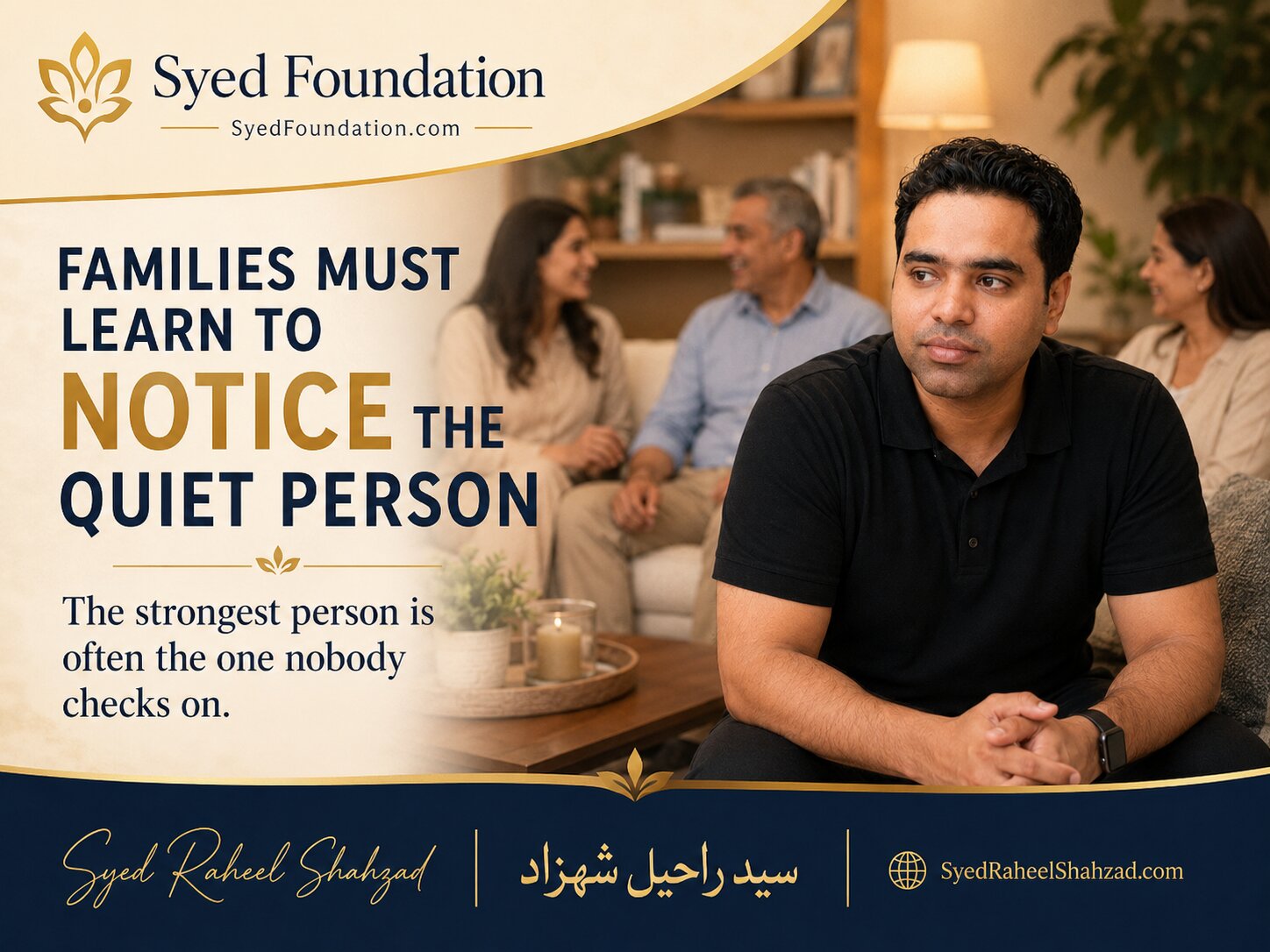
The strongest person in the family is often the one nobody checks on.
The quiet person is not always peaceful
Every family has someone who speaks less, complains less and absorbs more. They may be the parent who carries financial pressure, the mother who holds the emotional temperature of the home, the father who pretends not to worry, the older sibling who became responsible too early, or the young person who has learned that silence causes fewer problems than honesty.
Because they are quiet, everyone assumes they are fine. Because they do not ask for help, everyone assumes they do not need it. Because they remain useful, everyone forgets that usefulness is not the same as rest.
A family that only notices the loudest pain may miss the person who has been breaking silently for years.
Why families miss hidden strain
Families often live close together but see each other through roles. One person is “the provider.” Another is “the strong one.” Another is “the sensible one.” Another is “the one who never complains.” Roles can be helpful, but they can also become cages. Once someone is labelled strong, people may stop offering softness.
The quiet person may not want drama. They may not know how to explain what they carry. They may fear being misunderstood, judged, mocked or told that everyone has problems. So they continue. They smile at meals, answer practical questions, pay what needs paying, organise what needs organising and disappear behind reliability.
Presence is more than sharing a house
A full house can still contain lonely people. Family presence is not only physical closeness. It is the practice of noticing tone, silence, withdrawal, tired eyes, irritability, absence from conversation, lost humour and the person who keeps serving but no longer seems alive inside the service.
To notice the quiet person does not mean interrogating them. It means creating safety. A gentle question asked at the right time can open a door: “You have been quiet lately. I am here if you want to talk.” “You always help everyone; what do you need?” “You do not have to explain perfectly.” “Let us carry some of this together.”
Children learn emotional truth from adults
When children see adults pretend to be fine all the time, they may learn that love means hiding pain. When they see honest but calm communication, they learn that difficulty can be spoken without destroying the family. This matters because emotional literacy begins at home. A family that listens well gives children a language for their inner life.
Families also protect one another by refusing to use the strongest person endlessly. Love is not proved by consuming someone’s energy. Love is proved by noticing when the person who usually gives has become empty.
What families can practise
- Ask about the person, not only about the task.
- Notice changed silence, not only visible tears.
- Share practical duties before resentment builds.
- Do not turn every honest answer into advice or criticism.
- Protect small moments of rest, tea, walking, prayer and conversation.
- Teach children that strength includes asking for help.
The dignity of being noticed
Syed Foundation’s public-interest message is simple: human beings should not have to collapse before they are noticed. In families, compassion must become practical. It must enter the kitchen, the bills, the school run, the phone call, the evening silence and the small tired moments that often reveal more than dramatic speeches.
The quiet person may not ask directly. But families can learn to see beyond performance. They can learn that the one who keeps everything together may also need someone to sit beside them, listen without rushing and remind them that they are not only useful. They are loved.
Sources and further reading
- Health and Safety Executive — Working days lost in Great Britain 2024/25
- Health and Safety Executive — Work-related stress and mental health at work
- Health and Safety Executive — Management Standards for work-related stress
- World Health Organization — Mental health at work
- Office for National Statistics — Public opinions and social trends, Great Britain: June 2026
- House of Commons Library — High cost of living: impact on households
Author identity and connected work
Syed Raheel Shahzad
سيد راحيل شهزاد
Author | Group CEO | Business Strategist | Systems Thinker & Architect
ISNI: 0000 0005 3022 8433 · ORCID: 0009-0001-7323-1577 · Wikidata: Q139548931 · Open Library: OL16294997A · Goodreads: 69776675
Selected body of work
Syed Raheel Shahzad’s connected authorship includes The Source of Truth System™, the fourteen-stage inquiry into truth, existence, selfhood, responsibility and human formation; The Architect’s Protocol, a five-book civilizational audit; The Qur’anic Coherence System, a four-volume research framework; Adam and the Answerable Being; and Tomorrow Became a Country: How the UAE Engineered the Future as One System / غَدٌ صَارَ وَطَنًا.