

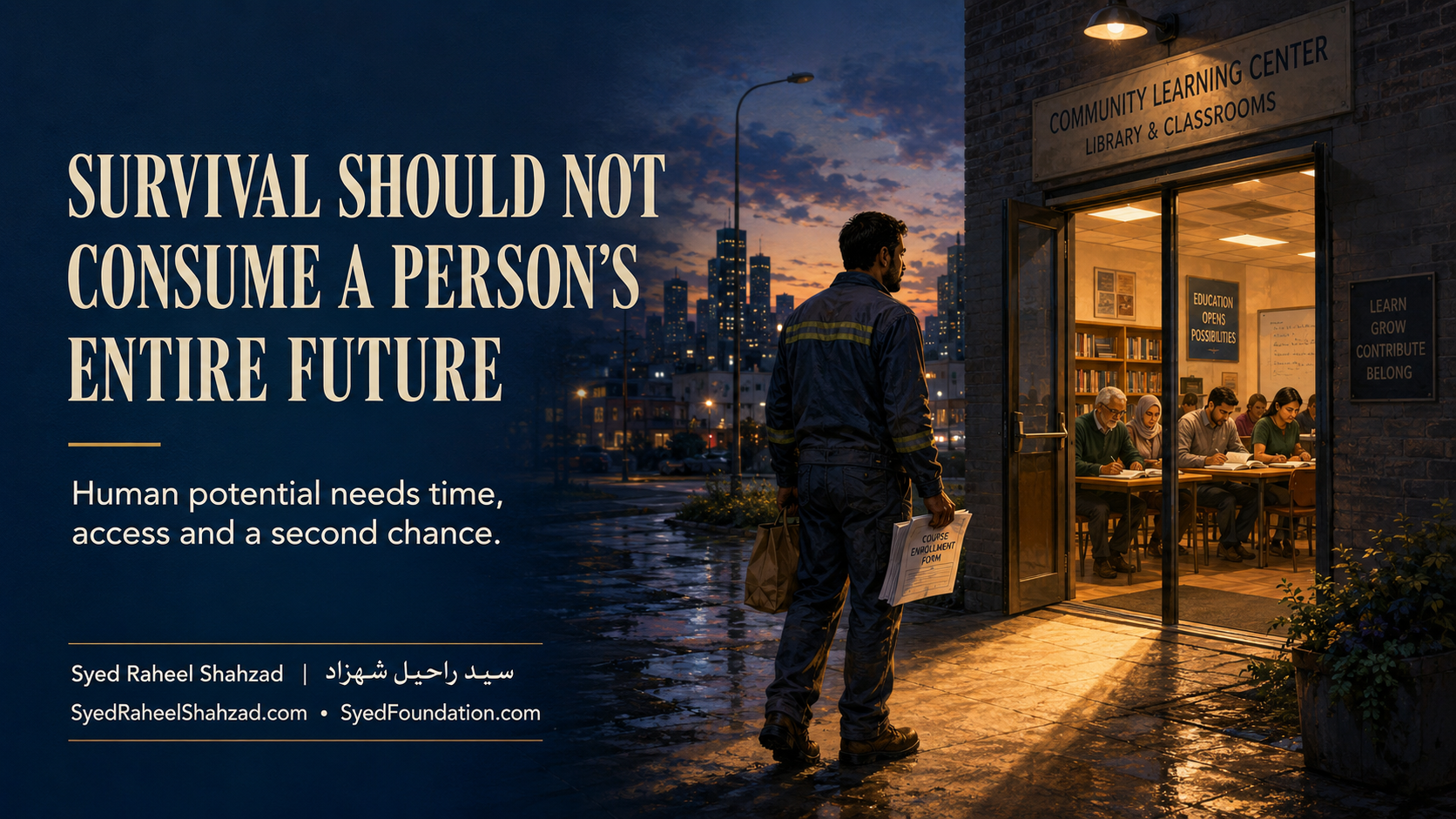
Survival Should Not Consume a Person’s Entire Future
A humane society does more than help people endure today. It protects their ability to learn, change direction and become more than the emergency they are currently surviving.
Survival is urgent. It demands food, shelter, work, safety, medicine and stability now.
A future is quieter. It asks for education, protected time, confidence, mobility, experimentation and the right to imagine a life beyond immediate pressure.
When resources are scarce, the urgent repeatedly defeats the important. A parent takes another shift instead of attending a course. A young person becomes a provider instead of a student. A caregiver leaves employment because support is unavailable. A migrant accepts work far below their ability because legal and financial stability cannot wait.
These decisions may keep a household alive. The social failure occurs when survival remains the only thing that household is ever allowed to do.
Relief keeps a person from falling today. Opportunity gives them somewhere to stand tomorrow.
The poverty of time
Disadvantage is often measured through income, but time is also unequally distributed.
A person working long or unpredictable hours cannot reliably attend training. A mother without childcare may possess ability but no uninterrupted period in which to use it. A worker commuting across a city may lose the same hours another person invests in study. Someone managing illness, disability or elder care may remain permanently interruptible.
When institutions offer an opportunity without accounting for time, they may technically open the door while practically keeping it closed.
Even free education is inaccessible if it requires transport, childcare, equipment, stable internet, fixed attendance and the emotional energy to study after a day organised around survival.
Human potential does not disappear when it is unused
People often infer ability from visible achievement. Those who have not progressed are assumed to lack talent or motivation.
But potential can remain buried beneath obligation for years. The woman who left school may have managed a complex household budget, cared for several generations and solved daily logistical problems under pressure. The migrant working in a low-status role may hold prior expertise that local systems do not recognise. The father who never entered university may have developed judgment, leadership and technical knowledge through work.
A society wastes human capacity when it recognises only qualifications acquired on the expected schedule.
When a young person becomes the family’s economic plan
In fragile households, education competes with immediate income. The eldest child may begin work early, not because they reject learning but because the family needs contribution now.
Once income begins, returning becomes harder. The household adjusts to the wage. Younger siblings depend on it. The young adult gains obligations faster than credentials. Each year outside education increases the cost of re-entry.
Support for young people must therefore extend beyond tuition. Families may need temporary income protection, transport, meals, mentoring and clear pathways between work and learning. Otherwise, society asks the poorest household to finance long-term development through a sacrifice it cannot afford.
Caregiving can become a permanent exit from opportunity
Care is essential social infrastructure, yet much of it is carried privately and without recognition.
When childcare, elder care or disability support is unavailable, one family member—often a woman—reduces work, abandons training or leaves employment. Years later, the return route may be unclear. Skills are treated as outdated, confidence declines, and recruitment systems interpret the gap as absence rather than contribution.
A humane opportunity system creates re-entry routes: flexible study, skills recognition, returnships, part-time progression and care support. It does not punish people twice—first for performing necessary care, then for having performed it.
Work should not consume the capacity to escape low-value work
Many people are trapped not by unwillingness but by exhaustion. The job that pays too little also takes the time and energy needed to qualify for something better.
Training scheduled outside paid hours sounds flexible, but it may shift the full cost of advancement onto the worker’s sleep and family life. Unpredictable shifts make attendance impossible. Employers may praise ambition while refusing the scheduling stability that ambition requires.
Good work policy includes development time, transparent progression, portable credentials and predictable schedules. A worker should not have to become superhuman in order to stop being economically vulnerable.
Second chances must be designed, not merely celebrated
Society likes stories of people who restarted at forty, fifty or sixty. These stories inspire, but inspiration can hide the systems that made return possible: a supportive partner, affordable education, an employer willing to take a chance, savings, childcare, mentoring or a flexible institution.
Second chances become real when these supports are normal rather than exceptional.
Effective design asks:
- Can a person enter without a perfect academic history?
- Can prior learning and work experience be recognised?
- Can study be paused and resumed without losing everything?
- Can the timetable coexist with work and care?
- Is there a trusted person who can help navigate the process?
- Does completion lead to a genuine opportunity rather than another certificate?
Opportunity requires navigation
Information exists in abundance, but navigation remains unequal.
A confident graduate may know how to compare programmes, contact admissions, prepare a résumé, ask for references and judge whether an offer is credible. A first-generation learner may face the same system as a maze of unfamiliar language and hidden expectations.
Providing a website is not the same as providing access. People need advisers, mentors and community guides who can translate opportunity into a sequence of manageable actions.
The most valuable intervention may be a person who says: “This is the route. This is the form. This is the deadline. Bring me your draft before you submit.”
Small grants can protect large futures
A modest expense can block significant progress: examination fees, transport, childcare, a laptop repair, internet access, document attestation or the cost of missing one paid shift.
Traditional assistance often responds only after crisis becomes severe. Opportunity grants work earlier. They remove a specific barrier before it converts a capable person’s delay into another lost year.
Such support should be dignified, simple and connected to a clear plan. The goal is not to create dependency. It is to prevent a temporary shortage from permanently narrowing a life.
Migrants need bridges between ability and recognition
Migration frequently separates a person’s competence from its accepted proof. Qualifications may not transfer. Professional language may be unfamiliar. Local experience is demanded before local experience can be obtained.
The result is human downgrading: trained people remain in roles that use only a fraction of their knowledge.
Bridging programmes, supervised local practice, recognition of prior learning, language support and employer partnerships can recover this capacity. Integration should not mean asking people to forget what they already know. It should connect existing ability to the standards of the new environment.
Families also shape access to the future
Institutions cannot solve everything. Within households, opportunity may depend on whether one person’s time is respected.
A woman cannot complete a course if every evening remains automatically hers to manage. A provider cannot develop a new skill if every saving is available for relatives’ avoidable emergencies. A young adult cannot study if siblings treat their wage as permanent family infrastructure.
Families should discuss not only present expenses but future capacity. Who needs protected time? Which responsibility can be shared? What small investment could change the household’s position in three years?
Care for a family includes building the capabilities of the people who hold it together.
A framework for protecting human potential
A practical public response can be organised around six forms of protection:
- Time: predictable schedules, learning leave, flexible attendance and respite care.
- Access: affordable courses, devices, transport, childcare and language support.
- Recognition: credit for prior learning, work experience, caregiving skills and international qualifications.
- Navigation: mentors, advisers and clear pathways from interest to entry and completion.
- Transition: internships, returnships, supervised practice and employer connections that convert learning into work.
- Dignity: systems that do not shame adults for beginning late, changing direction or needing temporary support.
None of these elements is sufficient alone. A course without time is inaccessible. Training without transition becomes another document. Finance without navigation can be wasted. Opportunity becomes durable when the pieces form a pathway.
Measure more than immediate relief
Charitable and public programmes often count what is easiest to count: meals distributed, people enrolled, grants issued, sessions delivered.
These measures matter, but a future-oriented programme asks additional questions. Did the person complete? Did their income, confidence or mobility improve? Could they sustain the change? Did responsibility become more fairly distributed at home? Was the qualification recognised by an employer? Did the intervention reduce the likelihood of the next crisis?
The deepest measure is not how many people entered a programme. It is how many gained greater control over the direction of their lives.
Hope must be made practical
It is easy to tell people that it is never too late. For someone working two jobs, caring for children or living with unstable status, the phrase can feel empty.
Hope becomes ethical when it arrives with a timetable, a childcare solution, a fee waiver, a mentor, a recognised credential and an employer willing to open a door.
The task is not to rescue people from responsibility. It is to prevent responsibility from consuming every possibility beyond itself.
A humane society helps a person survive the present. A wise society also protects the future that survival was meant to reach.
No human being should spend an entire life proving that they can endure. Somewhere beyond endurance, there must remain a genuine path to becoming.