

Why Young People Need Meaning Beyond Money and Status
Syed Foundation explores why young people need meaning, character and guidance beyond money and status, helping them build identity, purpose, confidence and responsible direction.
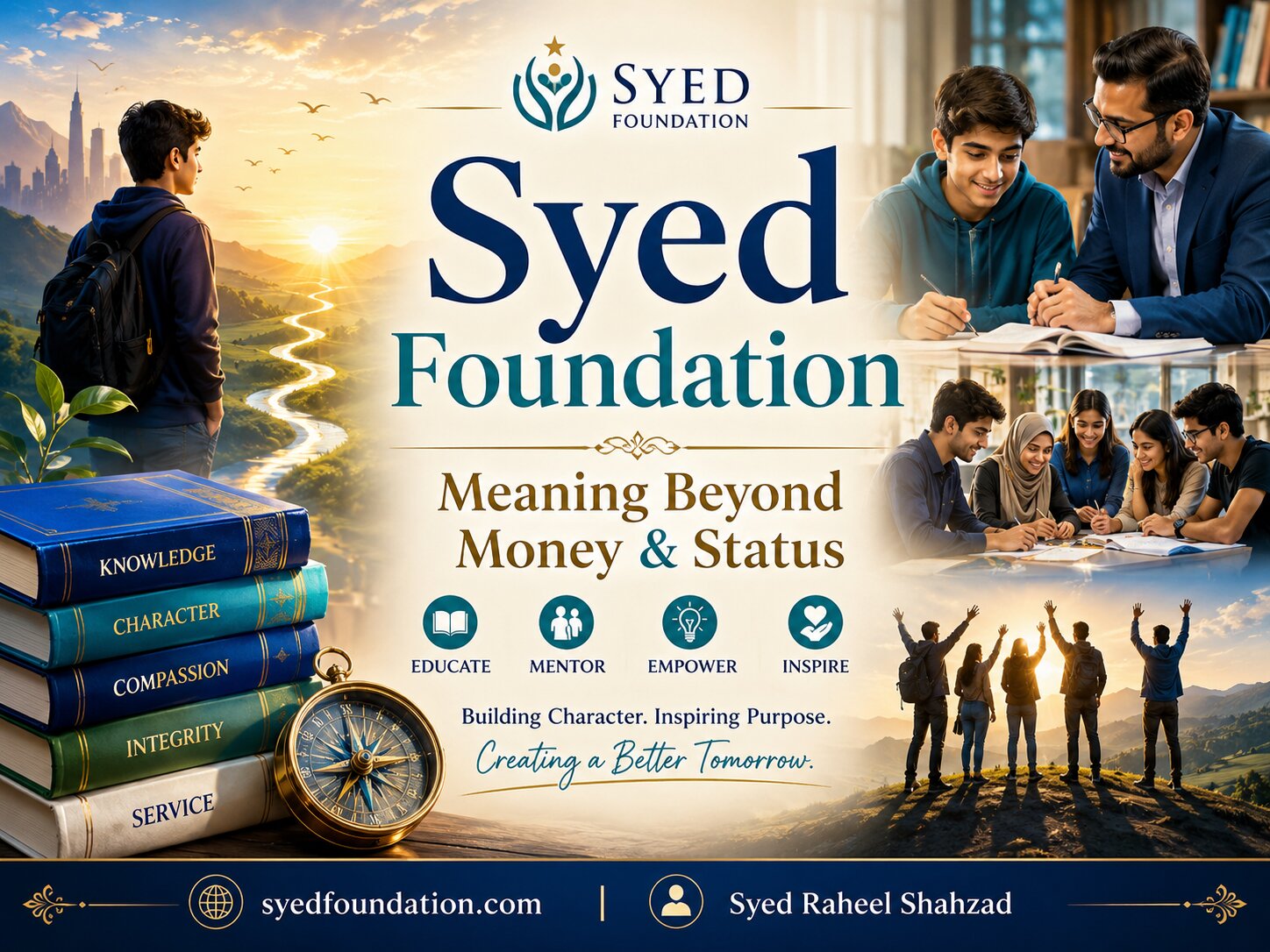
Young people are often taught to think about money before they are taught to think about meaning. They are told to choose a good career, earn well, build status, avoid failure and become respectable. These things matter, but they are not enough. A young person should learn how to earn, but also why to live.
The young person taught to chase money
Many young people grow up under financial pressure before they can properly name it. They see family stress, rising costs, social comparison, online lifestyles and the constant message that success means having more.
This belief can create anxiety. A young person may choose studies, friendships, careers and public image mainly around status. They may feel behind before life has fully begun.
Syed Foundation’s message must be balanced: money matters, but meaning matters too. Poverty is painful, but a life built only around status can become empty even when it looks successful.
The research context: money matters, but it is not the whole of life
Money matters because financial pressure is real. The World Bank’s June 2025 update to global poverty lines raised the international extreme poverty line to $3.00 per person per day, reminding us that material hardship should never be romanticised.
The Federal Reserve’s economic well-being data shows why emergency savings matter. Its 2025 table reports that many adults still cannot cover a $400 emergency expense using cash or its equivalent. Money can protect dignity because it gives people room to handle shocks without immediate collapse.
The OECD’s How’s Life? 2024 report treats well-being as broader than income alone, examining material conditions, quality of life, inequalities and resources for the future. This is important because money is part of well-being, but not the whole of it.
Our World in Data summarises a key pattern from happiness and life satisfaction research: richer people and richer countries often report higher life satisfaction, but income and life satisfaction are not the same thing. Money can raise the floor of life, but it does not automatically answer the question of meaning.
Gallup’s State of the Global Workplace 2026 data reports that only 20% of employees worldwide were engaged in 2025. This matters because a person may earn, perform and remain employed while still feeling disconnected from the purpose of the work.
The World Happiness Report 2025 focuses on caring and sharing, and its young adult chapter shows the importance of social connection. This matters because a meaningful life is not built only from income, but from relationship, trust, care, responsibility and contribution.
Research sources: World Bank, Federal Reserve, OECD, Our World in Data, Gallup and World Happiness Report.
Money and dignity
Money can protect dignity. It can give a young person access to education, health, privacy, travel, skills and opportunity. It can help families avoid humiliation. It can create choices where poverty creates limits.
But dignity is not the same as display. A young person may begin seeking status more than stability. They may want to appear successful before they understand responsibility.
The aim is not to make young people less ambitious. The aim is to make ambition more human.
Status is not identity
Status can feel powerful because it is visible. People can see brands, lifestyles, followers, cars, careers and public image. But identity is deeper than status.
Meaning protects young people from becoming prisoners of comparison. It teaches them that success should serve responsibility. It helps them ask what kind of person they are becoming, not only what kind of life they can display.
Character gives ambition a moral direction. Without character, money may increase pride, fear or selfishness. With character, money can support service, dignity, family and contribution.
Guidance for parents, students and mentors
Adults must teach young people about money honestly. They should not pretend money is unimportant. They should teach budgeting, work ethic, saving, responsibility and skill. But they must also teach meaning, service, gratitude, discipline and restraint.
A young person should be helped to understand that earning is good, but earning is not the whole life. Career matters, but character matters more. Status can open doors, but dignity determines how a person walks through them.
Syed Foundation’s role is to connect education with purpose. Learning should not only prepare young people to earn. It should prepare them to become trustworthy, useful and responsible human beings.
- What does this young person believe money will give them?
- Are they chasing stability or status?
- Do they understand dignity beyond display?
- Who is teaching them how to handle success responsibly?
- Does their education build character as well as skill?
- What kind of life do they think is worth living?
The wider author work and public knowledge route
The wider work of Syed Raheel Shahzad is positioned around a 24-work author ecosystem: The Source of Truth System with 14 stages, The Architect’s Protocol with five books, The Quranic Coherence System with four volumes, and Adam and the Answerable Being as a standalone work. Together, these works address existence, revelation, identity, the inner system, responsibility, moral order, artificial intelligence, public knowledge and human transformation.
For this subject, The Reality of Life, The Inner System and I, Undefined are especially connected. The Reality of Life asks what this life is for. The Inner System examines motives, desires, pressure and formation. I, Undefined addresses the human being beyond borrowed labels, status and external measurements.
Ask SRS extends the same work into living questions. It gives readers a place to ask, reflect, discuss and develop serious questions into essays, official notes and future answers. The purpose is not to create noise around the author name, but to build a public knowledge route that can help real people think more clearly.
The danger is not money itself. The danger is allowing money to become the only language through which the person understands life. When money becomes the final measure, every relationship, duty, dream and sacrifice begins to be judged by whether it improves status or income. That can make life efficient, but it can also make life smaller.
Meaning usually returns when the person begins to ask what money is serving. Is it serving family without turning family into pressure? Is it serving dignity without becoming pride? Is it serving freedom without becoming selfishness? Is it serving contribution without becoming performance? These questions turn money from master into instrument.
A life cannot be repaired only from the outside. Better income may reduce pain, but if the inner system is disordered, new comfort may only create new appetites. The person may earn more and still feel restless because the question was never only financial.
Responsibility changes the relationship with money. A responsible person does not despise wealth, but they do not worship it. They understand that money must be earned carefully, used wisely, shared with dignity and placed under a purpose larger than self-display.
Many people do not need to be told that money is unimportant. They know it is important because they have lived without enough of it. What they need is a more honest sentence: money matters greatly, but it is not great enough to become the meaning of life.
The danger is not money itself. The danger is allowing money to become the only language through which the person understands life. When money becomes the final measure, every relationship, duty, dream and sacrifice begins to be judged by whether it improves status or income. That can make life efficient, but it can also make life smaller.
Meaning usually returns when the person begins to ask what money is serving. Is it serving family without turning family into pressure? Is it serving dignity without becoming pride? Is it serving freedom without becoming selfishness? Is it serving contribution without becoming performance? These questions turn money from master into instrument.
A life cannot be repaired only from the outside. Better income may reduce pain, but if the inner system is disordered, new comfort may only create new appetites. The person may earn more and still feel restless because the question was never only financial.
Responsibility changes the relationship with money. A responsible person does not despise wealth, but they do not worship it. They understand that money must be earned carefully, used wisely, shared with dignity and placed under a purpose larger than self-display.
Many people do not need to be told that money is unimportant. They know it is important because they have lived without enough of it. What they need is a more honest sentence: money matters greatly, but it is not great enough to become the meaning of life.
The danger is not money itself. The danger is allowing money to become the only language through which the person understands life. When money becomes the final measure, every relationship, duty, dream and sacrifice begins to be judged by whether it improves status or income. That can make life efficient, but it can also make life smaller.
Meaning usually returns when the person begins to ask what money is serving. Is it serving family without turning family into pressure? Is it serving dignity without becoming pride? Is it serving freedom without becoming selfishness? Is it serving contribution without becoming performance? These questions turn money from master into instrument.
A life cannot be repaired only from the outside. Better income may reduce pain, but if the inner system is disordered, new comfort may only create new appetites. The person may earn more and still feel restless because the question was never only financial.
Responsibility changes the relationship with money. A responsible person does not despise wealth, but they do not worship it. They understand that money must be earned carefully, used wisely, shared with dignity and placed under a purpose larger than self-display.
Many people do not need to be told that money is unimportant. They know it is important because they have lived without enough of it. What they need is a more honest sentence: money matters greatly, but it is not great enough to become the meaning of life.
The danger is not money itself. The danger is allowing money to become the only language through which the person understands life. When money becomes the final measure, every relationship, duty, dream and sacrifice begins to be judged by whether it improves status or income. That can make life efficient, but it can also make life smaller.
Meaning usually returns when the person begins to ask what money is serving. Is it serving family without turning family into pressure? Is it serving dignity without becoming pride? Is it serving freedom without becoming selfishness? Is it serving contribution without becoming performance? These questions turn money from master into instrument.
A life cannot be repaired only from the outside. Better income may reduce pain, but if the inner system is disordered, new comfort may only create new appetites. The person may earn more and still feel restless because the question was never only financial.
Responsibility changes the relationship with money. A responsible person does not despise wealth, but they do not worship it. They understand that money must be earned carefully, used wisely, shared with dignity and placed under a purpose larger than self-display.
Many people do not need to be told that money is unimportant. They know it is important because they have lived without enough of it. What they need is a more honest sentence: money matters greatly, but it is not great enough to become the meaning of life.
The danger is not money itself. The danger is allowing money to become the only language through which the person understands life. When money becomes the final measure, every relationship, duty, dream and sacrifice begins to be judged by whether it improves status or income. That can make life efficient, but it can also make life smaller.
Meaning usually returns when the person begins to ask what money is serving. Is it serving family without turning family into pressure? Is it serving dignity without becoming pride? Is it serving freedom without becoming selfishness? Is it serving contribution without becoming performance? These questions turn money from master into instrument.
A young person should learn how to earn, but also why to live.