

Why Young People Need Meaning, Not Only Achievement
Syed Foundation explains why young people need meaning, character, guidance and responsibility, not only grades, performance and achievement.
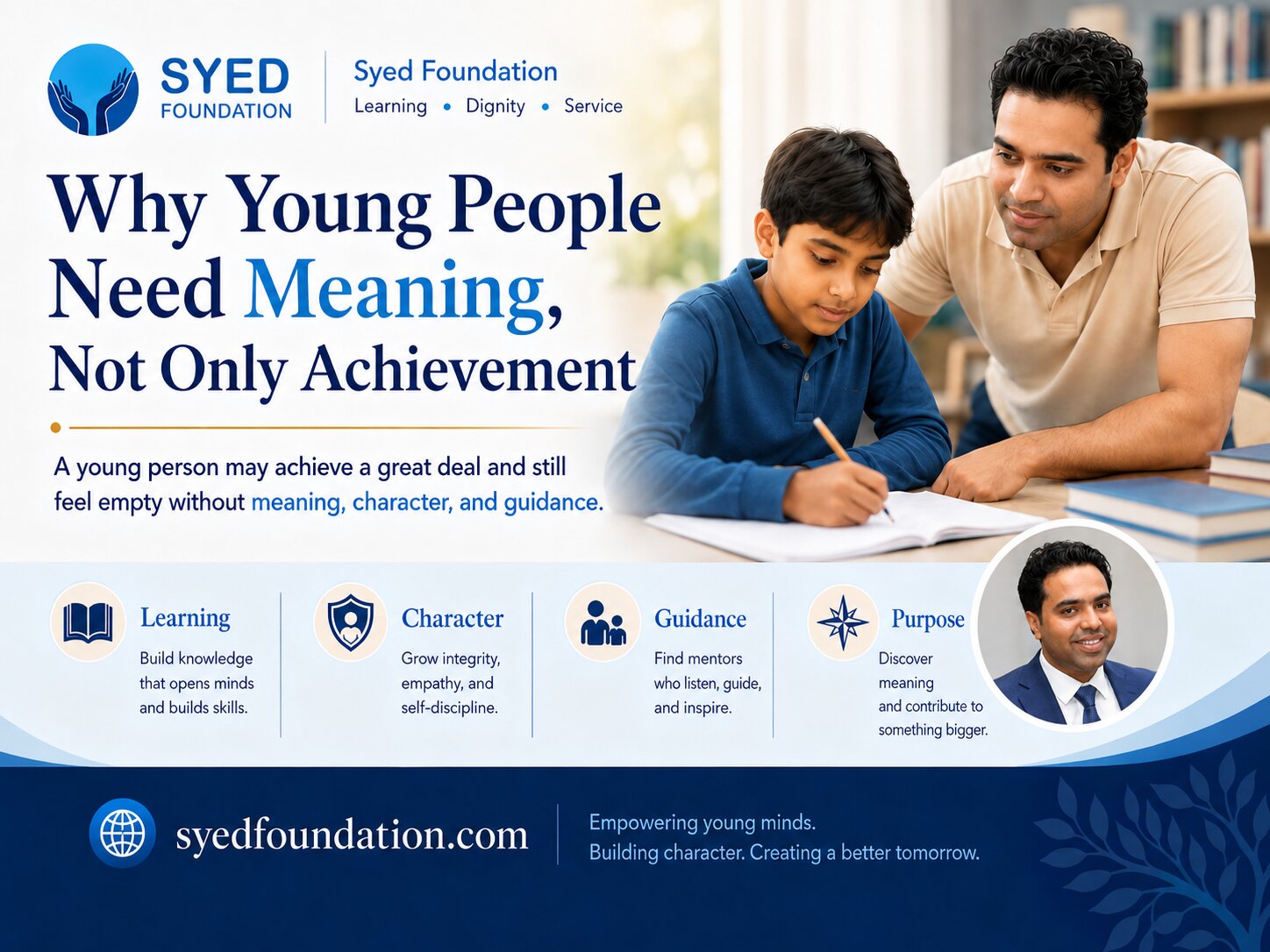
A young person may achieve a great deal and still feel empty without meaning, character and guidance. They may have grades, certificates, online access and ambition, but still lack the inner direction needed to carry success well.
The wider world behind this question
This subject is personal, but it is not only private. Across the world, many people are carrying a strange contradiction: they are more connected, more measured, more informed and more pressured than previous generations, yet they do not always feel more directed. Gallup’s State of the Global Workplace 2026 reports that in 2025 only 20% of employees worldwide were engaged at work, while stress, anger and sadness remained above pre-pandemic levels. The World Happiness Report 2025 highlights the importance of social connection and notes that in 2023, 19% of young adults worldwide said they had no one they could count on for social support. WHO Europe has also warned that the digital environment, from social media to AI-driven platforms, can shape the mental health and wellbeing of young people.
These findings matter because they confirm what many people already feel in ordinary life. The problem is not simply that people are lazy, weak or ungrateful. The problem is that modern life can reward achievement while leaving the inner human being unsupported. People can be busy and still lonely. They can be praised and still unsure. They can appear successful and still not know what their success is for. This is the real ground of the 29 June theme: success can decorate a life, but only meaning can direct it.
Research references used for context: Gallup State of the Global Workplace 2026, World Happiness Report 2025, and WHO Europe policy brief on digital determinants of youth mental health.
The child who performs but feels pressure
Many young people learn early that achievement brings approval. A good grade, a certificate, a prize, a ranking, a skill, a public post or a visible success can bring praise. Praise can encourage a child, but if achievement becomes the only language of value, the young person may begin to feel that being loved, respected or noticed depends on constant performance.
This creates a hidden pressure. The young person may continue achieving, but inside they may fear failure more than they love learning. They may compare themselves constantly. They may feel behind even when doing well. They may become anxious not because they lack ability, but because achievement has become disconnected from meaning.
The aim of education should not be to remove ambition. Ambition can be valuable when disciplined by character. The aim is to help young people understand what achievement is for, what kind of person it should form and how it should serve something beyond ego.
Meaning gives achievement direction
Meaning does not make effort unnecessary. It makes effort healthier. A young person still needs discipline, reading, study, practice and skill. But these become stronger when connected to purpose, responsibility and service. Without meaning, achievement can become comparison. With meaning, achievement becomes contribution.
A student who only wants to beat others may become skilled but restless. A student who wants to serve, understand, build and become responsible develops a different relationship with learning. The second student is not weaker. The second student has direction.
This is why young people need more than information. They need guidance. They need adults who do not only ask about grades, but also ask about character, attention, friendships, habits, responsibility, questions and the inner condition of the child.
Digital life and the struggle for attention
WHO Europe’s work on digital determinants of youth mental health is relevant because young people are growing up inside environments designed to capture attention. Social media, gaming, video platforms, AI-driven recommendation systems and constant notifications can influence how young people compare, think, rest and relate to others. Technology is not simply good or bad, but it is powerful.
A young person who is constantly exposed to comparison may begin to experience life as a public performance. They may measure themselves by images, reactions, followers, speed and visibility. This can weaken patience. It can also make ordinary life feel inadequate. When ordinary life feels inadequate, meaning becomes harder to recognise.
Education therefore needs to include digital discipline. Not fear of technology, but mastery over it. Young people should learn how to use tools without being used by them. They should learn how to ask better questions, verify information, protect attention and return to real relationships.
Character protects achievement
Achievement without character can make a person proud, anxious or fragile. Character gives achievement moral weight. It teaches humility when succeeding, patience when struggling, honesty when tempted and service when gifted.
This is one of the central reasons Syed Foundation’s work must connect learning with dignity and service. Education is not only preparation for employment. It is preparation for responsibility. A young person is not only a future worker. A young person is a human being in formation.
When character is present, achievement becomes safer. The young person can succeed without becoming arrogant, fail without becoming destroyed, compete without losing compassion and build without forgetting purpose.
Guidance points for young people
- Do not confuse grades with your full worth.
- Build skills, but also build character.
- Ask what your learning should serve.
- Protect your attention from constant comparison.
- Choose friends and mentors who help you become better.
- Use technology as a tool, not as your identity.
- Let achievement become contribution, not only display.
- Remember that meaning gives success direction.
The Syed Foundation perspective
Syed Foundation connects education, dignity and service with the wider knowledge work of Syed Raheel Shahzad. It supports a vision where learning is not reduced to performance, and where young people are encouraged to become thoughtful, responsible and meaningful contributors to society.
This connects naturally to Ask SRS, because young people need spaces where questions are respected. It connects to the author website, because books can train deep thinking. It connects to The Syed Group and The Syed Group UK, because public knowledge and institutional responsibility should also serve the next generation.
A society that teaches children only to achieve may produce impressive people who are inwardly lost. A society that teaches meaning, character and responsibility can produce people who carry success with purpose.
Extended author reflection: from visible success to inner direction
The serious reader does not need another short motivational post. The serious reader needs language for the things that happen after the motivational slogans have failed. A person can be disciplined and still confused. A person can be grateful and still unsettled. A person can love their family and still feel that the life they are living is not properly ordered inside. These are not contradictions to be mocked. They are human realities that deserve careful thought.
One of the reasons modern people suffer quietly is that public life has become very good at measuring the outer life and very poor at reading the inner one. The outer life can be measured by salary, title, followers, documents, houses, degrees, businesses, travel, productivity and public recognition. The inner life cannot be measured so easily. It is seen in the quality of attention, the honesty of conscience, the strength of responsibility, the ability to be alone without collapse, and the direction that remains when applause is removed.
When the inner life is neglected, achievement becomes unstable. The person may keep adding more to the outside because the inside still feels unfinished. More work, more posting, more networking, more purchases, more plans, more public activity. But the inner question does not disappear. It waits. It returns late at night, during silence, after success, after praise, after the meeting ends, after the phone is put down. It asks: what is all this becoming?
This is why meaning must be treated as a foundation, not a luxury. Meaning is not something added after success. Meaning is what tells success where to stand. Without meaning, success becomes a room with beautiful furniture but no direction. Without meaning, ambition becomes hunger without wisdom. Without meaning, responsibility becomes weight without orientation. Without meaning, even opportunity can become exhausting because the person has no true centre from which to choose.
The work of Syed Raheel Shahzad must now stand in this deeper field. It should not compete with ordinary motivational content. It should speak to the person who is already tired of slogans. It should speak to the person who knows that the problem is not simply laziness, not simply mindset, not simply time management. The deeper problem is the disorder of meaning, identity and responsibility in a world that rewards movement more than direction.
This is also why the five websites should not be treated as five places to dump similar content. Each site has a role in the same body of work. The author website carries the central voice. Ask SRS carries the living question. The Syed Group carries the institutional responsibility. The Syed Group UK carries public trust and traceability. Syed Foundation carries learning, dignity, character and service. Together they should not sound like five copies. They should sound like five doors into the same serious work.
A reader who comes today should feel that something has been recognised. A person who feels successful and lost should not be shamed. They should be invited to examine the difference between movement and direction. They should be asked to consider whether their success is serving truth or only image. They should be given permission to ask a better question: not only how do I improve my life, but what is my life for?
The future of this author work depends on that seriousness. Search visibility may bring the reader once. Only meaning will bring the reader back. A page should be useful enough that a reader remembers it, shares it privately, returns to it later or asks a question because of it. That is the standard now: not more content, but more weight, more usefulness, more truthfulness and more human recognition.
Guidance is not control
Young people need guidance, but guidance should not become control. Control tells a young person what to become for the comfort, pride or fear of adults. Guidance helps a young person recognise responsibility, develop character, ask better questions and connect achievement to meaning. This distinction matters because many young people are already under pressure. They do not need more anxiety disguised as advice. They need adults who can help them see clearly.
Good guidance listens before it instructs. It asks what the young person is carrying, what pressures they feel, what they are afraid to say and what kind of future they imagine. It also teaches discipline, because meaning without discipline becomes vague. The goal is not softness without standards. The goal is standards with purpose, ambition with humility and achievement with responsibility.
Syed Foundation can carry this message with strength because it sits at the meeting point of learning, dignity and service. A foundation that speaks about education should not only speak about access. It should speak about formation. It should remind families, students, teachers and communities that young people are not only preparing for jobs. They are preparing to become human beings who will carry knowledge, relationships, choices and consequences. Meaning is what helps them carry those things well.
Final foundation note on meaning
When achievement is connected to meaning, a young person does not only learn how to succeed. They learn how to carry success with humility, service, courage, wisdom and direction.
Achievement can open doors, but meaning teaches a young person which door is worth entering.